


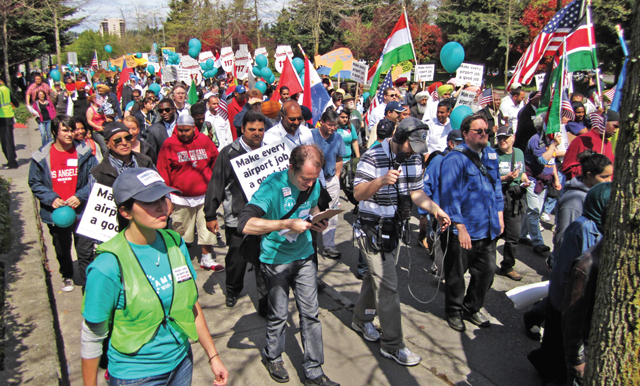
 The SEIU, one of the nation's most activist unions, has launched an innovation incubator. (Photo courtesy of Working Washington)
Could digital gaming be used to retrain fast-food workers for better-paying waiter jobs in fancy restaurants? Could an Uber-like “sharing economy” app help freelance workers boost their income?
Today’s napkin sketches might well become tomorrow’s solutions to the challenges faced by the American working class. That’s the hope behind the Workers Lab, a first-of-its-kind incubator launched this past October with $1 million in start-up funding from the Service Employees International Union (SEIU). “We’re looking for audacious ideas about how to rebuild the middle class,” says Carmen Rojas, CEO of the Workers Lab.
Winning applicants will receive $150,000 over a nine-month period to develop and pilot their ideas. They’ll also get access to mentors and introductions to investors who might provide next-round financing. The first cohort of winners—to be announced early this year—will include up to five projects.
Despite its links to organized labor, the Workers Lab, based in Oakland, Calif., aims to be “platform agnostic,” Rojas says. It will entertain ideas from all sectors, and winning ideas won’t necessarily be those that bolster union rolls. Incubator-worthy efforts might range from new enterprises to projects that focus on advocacy or policy work.
Protecting union membership “would have been a concern in 1950 or 1960,” says David Rolf, chairman of the Workers Lab. (He’s also president of SEIU 775, a local union that represents long-term-care workers in Washington State and Montana, and international vice president of SEIU.) “The fact is, the labor movement has already eroded: Eleven percent of American workers are now in unions. In the private sector, it’s 6.7 percent. What we desperately need is to find something to replace those [lost union] jobs.”
The Workers Lab, Rolf explains, aims to cultivate ideas that have three characteristics: “the power to change workers’ lives for the better; the ability to scale up, geographically or across an industry; and a sustainable revenue model that will enable [a venture] to survive even in a bad economy.” Beyond those essentials, the field is wide open: “What are the experiments and models that can do what the labor movement used to do—help all boats rise together?” Rolf says. The best idea, he adds, “might come from a social entrepreneur, a PhD, or a former SEIU janitor with a cool idea for other janitors. We want to plant a lot of seeds and see what roots.”
Project teams selected for the incubator will meet as a cohort four times during their nine-month funding period. They will need to meet certain milestones along the way, but otherwise they will be on their own. “We want to invest in great leaders and then give them time to noodle around. They can fall back on our resources and mentors if they need them,” Rojas says.
Rolf expects funding to expand beyond SEIU. “We’re hearing excitement about this idea from philanthropy, high-net-worth individuals, venture capital, and banking,” he says. The Workers Lab is also convening discussions about the initiative with a variety of partners, including the Ford and Rockefeller foundations, and Democracy Alliance.
Amalgamated Bank, owned by the SEIU affiliate Workers United, is one early backer. Keith Mestrich, president and CEO of Amalgamated, says the Workers Lab “gives people with good ideas a runway, without them needing to raise money all the time.”
As projects exit the incubator, the bank may offer financing to help them grow. “We’re open to being creative. Just imagine if the labor movement had invented Uber,” says Mestrich, referring to the ride-share company that competes with taxis. “We’d have an electronic hiring mall. Maybe someone is looking at other industries that have variable employment needs and is thinking about Uber-like technologies that could match workers with employers on a regular basis.”
Joseph McCartin, professor of history and director of the Kalmanovitz Initiative for Labor and the Working Poor at Georgetown University, sees the Workers Lab as a sign that the labor movement is ready for innovation. “The union movement is more open to reinvention now than it has been at any time since the mid-1930s. The present crisis is triggering a period of healthy experimentation and openness to new ideas,” he says. “When the labor movement was at its strongest, its influence spread far beyond its ranks. We need to think that way again.”
Read more stories by Suzie Boss.