


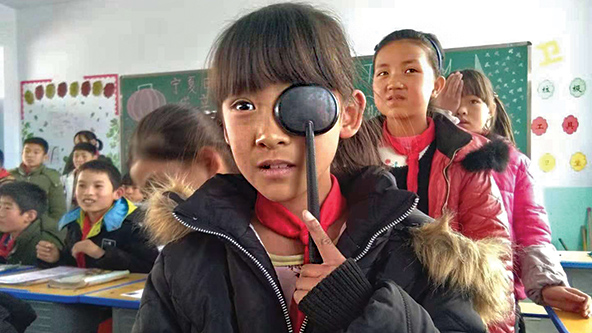
 A student participates in a Smart Focus eye exam survey to determine the extent of uncorrected vision in rural China. (Photo courtesy of Smart Focus)
A young boy named Sun Ming woke up one day to find that the world around him had gotten blurrier. While at school in his village in rural China, he discovered that he could not easily make out the words on the blackboard. Sun Ming informed his grandparents, who had been his caregivers since his parents moved away for work. But they told him not to worry; “eye exercises”—a traditional eye massage technique—would remedy the problem. However, Sun Ming’s vision continued to worsen, and eventually even his teacher became a blurry, undefined shape. He could no longer play with his classmates. His grades started to fall, and Sun Ming began to despair and isolate himself from others.
Sun Ming’s story is not unique. Of all children with uncorrected vision in the world, it is estimated that approximately half of them live in China. “I’ve been to hundreds of villages over the years to collect data and screen children,” says Hongyu Guan, a researcher at a local university in Xian, China. “With every visit we find at least one child who cannot even see the biggest ‘E’ on a visual screening chart, and as many as half of the kids can’t see 20/20. [But] almost none wear glasses.”
Until recently, very little government data or published research existed on vision care in rural China. Yet researchers at the Rural Education Action Program (REAP), a research collaboration between Stanford University and multiple partner universities in China, have uncovered tens of millions of Chinese children with uncorrected myopia. About two-thirds of China’s population—approximately 800 million people—lives in rural areas where quality of life lags far behind that of urbanites on China’s coast.
In 2017, REAP launched Smart Focus, an innovative social enterprise that has pioneered a sustainable vision-care model for rural China and helped hundreds of thousands of children along the way.
Solutions Through Research
In 2013, REAP partnered with OneSight, an international vision-care charity, and researchers at the Zhongshan Ophthalmic Center in Guangzhou, one of the premier eye hospitals in China, to launch Smart Focus. Led by researchers in the United States and China, Smart Focus first sought to determine the prevalence of uncorrected vision in rural China and measure the effects of vision correction on children’s academic test scores.
For their method, the Smart Focus team first gave an eye exam and a standardized test to a random sample of 20,000 primary school students from 250 schools in rural northwest China. The survey revealed that about a quarter of the students had vision problems—almost double the rate among US children. Unfortunately, only one in six children with myopia in the sample had eyeglasses. The researchers then gave half of the nearsighted children free prescription glasses. The other half, those without glasses who served as a control group, were told they needed glasses and were simply given a prescription.
Giving prescriptions to the control group would allow researchers to determine how many children would seek care simply with the knowledge that their vision could improve with glasses. Nine months later, the researchers returned to the same schools to give all of the students a second standardized test and to give glasses to the children in the control group. Only about one in six children in the control group had gotten glasses on their own during the intervening nine months. The children who received glasses at the beginning of the study performed twice as well as their peers who did not receive glasses until the end of the study. The evidence was clear: Vision correction boosted learning.
Smart Focus research also revealed that there were both supply- and demand-side barriers to children having glasses. On the supply side, the two main obstacles were the quality and quantity of rural optometrists and the absence of screening in schools. A Smart Focus survey of 145 rural clinics and 50 township hospitals across five provinces found that nearly all township clinics and county hospitals, which make up the backbone of the public health-care system in rural China, lacked the ability to provide vision-care services. While private optical shops operate in rural county seats, they often offer low-quality refractions and never screen patients in outlying areas due to the high costs. On the demand side, the lack of awareness of myopia and common misconceptions about vision correction have kept many from seeking care.
The Smart Focus team’s research yielded a number of insights into how a scalable vision-care model might work to overcome these obstacles. The researchers knew that information alone was not enough to motivate children to get glasses. When given a prescription and a note to parents, only about 1 in 10 nearsighted children without glasses would seek care. But if care was subsidized through the offer of free or low-cost glasses, uptake of services rose to about 75 percent.
To address the lack of clinicians and the high cost of conducting vision screenings, Smart Focus identified a specialized training regimen hosted by partners in China’s best eye hospitals that could prepare a rural clinician to make simple, accurate prescriptions in just two to three months. Clinicians could also train teachers in schools to conduct simple screenings with an “E” chart and refer children for a full exam if needed.
With these insights, Smart Focus built pilot vision centers in two rural counties in 2015. It signed an agreement with the county hospitals to build and staff the vision centers with trained refractionists, and then it entered into agreements with local school districts to allow teachers to screen children for vision problems. Children who failed the screening would be encouraged to go to the new vision center at the county hospital and receive a free eye exam. If the test determined that the student needed glasses, they were provided for free. The initial results were promising: The clinicians passed their training with flying colors, teachers screened accurately, and children came in to get their exam and free glasses.
A Sustainable Model
With the components of the vision centers working, the question remained of how to pay for the costs of launching and operating a center: purchasing equipment and inventory, renovating a space, training clinicians, and covering payroll and occupancy fees. Somehow, the vision centers needed to raise revenue. But it was clear from research that without the glasses being heavily subsidized, children would not receive care.
To address the problem, Smart Focus worked with OneSight to develop a social enterprise business plan whereby children from rural areas received care and glasses, if needed, for free, but children who lived in more affluent urban areas would pay at-market or slightly below-market cost. Equipped with this cross-subsidization business model, Smart Focus could assist rural patients while also financially sustaining itself.
“The key to the model is really the cross-subsidization,” says Smart Focus cofounder Matthew Boswell. “Free care for rural children ensures that a large portion of nearsighted children will come in and get glasses that they otherwise would never get. At the same time, margins for eyeglasses sold to urban kids are high enough that you can give away half your inventory for free and still cover the costs of running a vision center.”
On the basis of this model, and with launch funding from OneSight, Smart Focus has built 28 vision centers in 28 counties across three rural provinces in China in just three years. Smart Focus has also provided vision screening services for close to a million children, and has prescribed, manufactured, and delivered roughly 200,000 glasses.
There have been bumps in the road. “Most of us are not really businesspeople,” admits Smart Focus General Manager Wenting Liu, “so we have had to learn a lot very quickly, and there have been mistakes.” Smart Focus has encountered a number of challenges. Sometimes hospitals renege on agreements, for instance. The rules about whether glasses can be sold in hospitals also are varied and not very clear, making some hospitals in otherwise promising counties hesitant to collaborate. Both of these problems mean that Smart Focus managers have to spend extra time seeking out new partners for expansion, which is time-consuming. Traffic in the vision centers comes in peaks and troughs, which is problematic for cash flow and also slows growth.
Despite these challenges, the rollout of vision centers has been reasonably smooth, built on years of experience dispensing glasses during the earlier research work and long-standing ties to local officials. “Many of our staff came from the original Smart Focus research projects, so at least we’re familiar with many of the day-to-day issues,” Liu says. “And some people from county governments know us from the research days, so they know we’re not trying to profiteer off rural people.”
Smart Focus has not abandoned its roots in research. In addition to a service provision, the vision-center network serves as a platform for ongoing study. Smart Focus clinicians and managers are running a randomized trial now with a local university to identify the role of vision correction in educational progress: If a child receives needed glasses, will they perform well enough to stay in school longer? Or even go to a better school? This question follows an ongoing research agenda: quantifying vision care’s impact as an educational input.
An important reason that Smart Focus continues to do research is to provide evidence that can incentivize China’s government. Smart Focus operates in about 2 percent of China’s nearly 1,500 rural counties. Only a player as big as the central government can perform the heavy lift of reaching all these children. Using its research and experience, Smart Focus regularly lobbies China’s parliament and its ministries of health and education. This lobbying takes the form of policy briefs that it develops and transmits to China’s government by way of university partners. Smart Focus hopes that in years to come, China’s rural county hospitals will copy its model with funding from the government in order to realize a nationwide rollout of accessible, affordable, and sustainable vision-care services for rural populations.
Read more stories by Tianli Feng & Jia Li.