


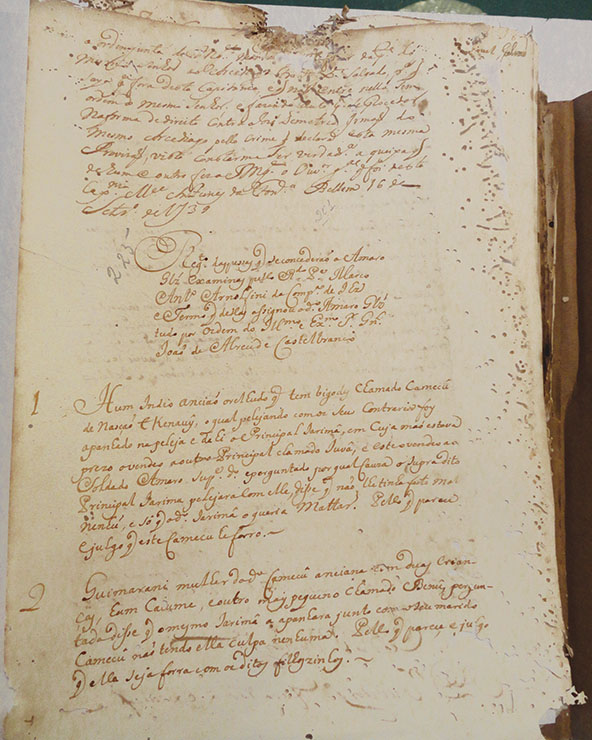
 A document from 1739 details a slave raid in Amazonia. (Photo courtesy of Native Bound Unbound)
For historian Estevan Rael-Gálvez, history is not simply a record of the past. It teaches us and allows us to learn not just from the triumphs but also from the inhumane atrocities.
History’s significance inspired Rael-Gálvez’s creation of Native Bound Unbound, a digital archival project dedicated to documenting the lives of enslaved Indigenous people throughout the Americas between the 15th and 19th centuries.
The transatlantic slave trade began in 1495 when Spanish colonizers captured 1,600 Indigenous people in the Caribbean. These natives, including children, were either shipped to Spain for sale or “distributed” among Spaniards who occupied the islands.
The origins of Native Bound Unbound lay in Rael-Gálvez’s decades of historical research focused on Mexico, northern New Mexico, and southern Colorado. But the project itself wasn’t established until January 2022, after his idea for it landed a $1.5 million grant from the Andrew W. Mellon Foundation in December 2021. It is housed at the School for Advanced Research, in Santa Fe, New Mexico, for which Rael-Gálvez serves on the board. The project is in its early phase of construction, with Rael-Gálvez and a team of approximately 50 volunteers building its centralized repository of digital records about the lives of enslaved people, based on materials gathered from libraries, museums, and personal collections around the world.
“Collectively, all these archival imprints and cultural expressions encompass the indelible stories of people, places, moments in time and, when drawn together, reflect a unique story of both the brutality suffered and the resilience of those that passed through enslavement,” says Rael-Gálvez, who also serves as the executive director and principal investigator of the project.
Some volunteers are processing primary and secondary source materials gathered from North America, South America, Europe, and the Caribbean. Other volunteers are transcribing and translating documents into English, Spanish, Portuguese, and French. And a group of volunteer programmers are building the website, through which scholars, descendants of enslaved Indigenous people, and the public will be able to access the repository.
Guillaume Candela, a teaching fellow in Colonial Latin American History at the University of Leeds, is working as a consultant and research associate for the project. He is responsible for processing primary sources produced in the Río de la Plata during the 16th and 17th centuries.
For Candela, Native Bound Unbound is about more than just historical preservation. It also repositions Indigenous people as the protagonists of their own stories. “One of the great missions of the project is to deconstruct the coloniality of the manuscripts of the time to highlight the [active role] of the native peoples of the Americas of yesterday and today,” he explains.
In practice, this means analyzing and interpreting primary sources to retell events from the perspective of Indigenous people, rather than from the perspective of the colonizers. Candela has identified more than 700 Indigenous profiles that had remained “in oblivion.” Each of these profiles provides descendants of native communities with an opportunity to reconstruct their own cultural identity and family history—knowledge traditionally confined to oral history.
Increased visibility and access to these stories, Candela observes, “will make it possible to advance high-level educational and scientific projects, and they will also benefit the descendants of these oppressed and exploited communities.”
The Mellon Foundation is Native Bound Unbound’s sole funder. According to Mellon Humanities in Place program officer Justin Garrett Moore, “Native Bound Unbound has the potential to serve as a tool for descendants of enslaved Indigenous Americans to access generational memory and see themselves reflected in history and in the public sphere.”
Researchers like Brown University historian Linford D. Fisher also highlight Native Bound Unbound’s crucial focus on the history of Indigenous enslavement in the Americas. It is a considerable part “of the history of slavery that has been glossed over,” Fisher remarks, considering that 2 million to 5.5 million Native Americans are estimated to have been enslaved between 1492 and 1880.
Native Bound Unbound’s ultimate purpose, Rael-Gálvez says, is to become a cultural site that allows scholars and descendants “to recover and share the story of Indigenous enslavement in the Americas to elevate a narrative that is less known than the transatlantic slave trade that impacted millions of Africans.”
Read more stories by Tim Keary.