


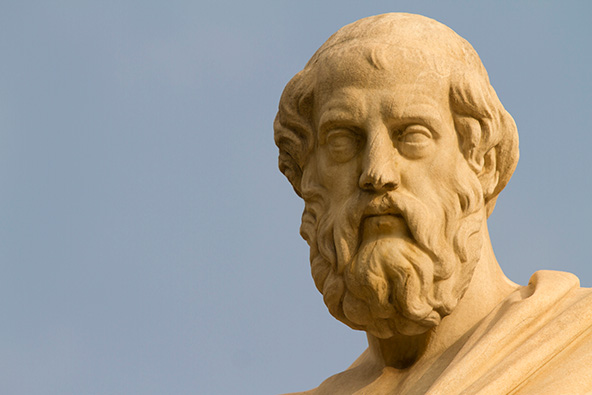
 (Photo by iStock/scotto72)
For centuries, Greece was the cornerstone of Western philosophy,” says Donald Robertson, founder of Plato’s Academy Centre, a nonprofit dedicated to preserving the nation’s philosophical history.
“To walk where philosophy originated, to walk in the footsteps of Plato and Socrates,” he observes, is “to imagine how this tradition began.”
Robertson’s interest in philosophy began when he was a teenager and continued through his undergraduate and graduate studies at Aberdeen University, where he completed degrees in philosophy before segueing into postgraduate degrees in psychotherapy. Author of How to Think Like a Roman Emperor: The Stoic Philosophy of Marcus Aurelius, Robertson homed his training in ancient philosophers because he believes they offer more practical wisdom and insights into life than modern ones. Aurelius, Aristotle, and Plato, among other ancients, helped him to process the tragedy of his father’s death. This personal experience, which reified his belief that philosophy teaches invaluable coping mechanisms, inspired him to establish Plato’s Academy Centre in December 2021.
The center’s mission is to make ancient philosophy—from the Socratic method to Plato’s dialogues that illustrate the method in practice—accessible and easily digestible to the public. Courses currently in development will be tailored to modern-day concerns and points of interest, from self-improvement and well-being to business leadership. To reach as many people as possible, the nonprofit will provide both in-person and online learning opportunities. To generate interest, Plato’s Academy Centre currently offers a free online course consisting of six lessons on the Socratic method.
In May 2021, Plato’s Academy Centre held its first virtual conference on the theme of practical applications of philosophy, which was attended by approximately 500 people. Philosophy scholars featured as speakers included classics scholar Robin Waterfield, University of Crete philosophy professor Chloe Balla, and University of California, Santa Barbara, philosophy professor Voula Tsouna. University of Sheffield philosophy professor Angie Hobbs delivered a keynote address that explored how the rhetorical techniques of ancient sophists compare to those of social media influencers. Public donations allowed the center to make admission to the conference free for all attendees.
The event’s success prompted Robertson to begin working on an in-person conference scheduled for fall 2023 at Plato’s Academy Park. An international archaeological site in Athens, the park is visited by both locals and tourists, and for this reason Robertson believes it is the perfect location for this event, which is intended to convene philosophical discussions in the public square.
The nonprofit’s educational mission also includes an agenda to fuel economic growth by engaging in Greece’s lucrative tourism industry, which accounts for 18 percent of the nation’s GDP and employs one-fifth of its population. During the COVID-19 pandemic, tourism worldwide took a major hit, and Greece’s already struggling economy was further debilitated.
The tourism industry was forced to pivot in the pandemic by leveraging technology to take travel and educational adventures online. Plato’s Academy Centre plans to capitalize on this trend with its online course offerings and conferences, through which it hopes to entice people to travel to Greece. The intention, says the center’s communications director, Kasey Robertson, is “to bring international business to Greece and build up an area that could use some development.” She says that the nonprofit will add jobs to the economy by employing local youth to assist with event programming.
The center receives funding from the Aurelius Foundation, an organization that shares similar goals about the preservation of philosophical integrity and the pursuit of knowledge. “We are partnering and supporting the Plato Academy project, as this initiative fits squarely into our mission,” says Justin Stead, who launched the foundation in 2019 to promote Stoicism. “We are looking to increase the awareness and application of Stoicism within younger generations,” he says, including CEOs and business leaders who could apply Stoic principles to “the development of their strategic plans, tactical executions, and cultural/teamwork initiatives.”
In addition to the in-person conference in 2023, the center will officially roll out both virtual and in-person events in Athens with the continued support from the Aurelius Foundation, individual donations, and volunteers. The nonprofit also aims to raise enough funds to create a new conference facility near Plato’s Academy Park to host all future events—even, potentially, the 2023 conference.
Robertson is optimistic about the center’s potential to spark interest in both ancient philosophy and Greece in general. “Our hope is that the online community grows to become a hub for academic experts and best-selling authors to interact with a wider community who are interested in Greek philosophy’s relevance today,” he says.
Read more stories by Aisha Malik.