


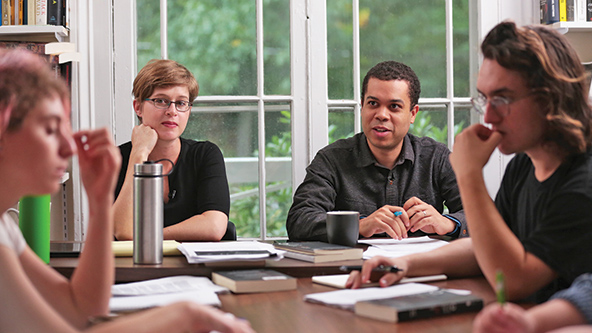
 Activist Graduate School cofounders Chiara Ricciardone and Micah White teach the course “How to Change the World.” (Photo courtesy of the Activist Graduate School)
The social unrest of the past year has magnified the importance of activism in creating political change. As one of the cofounders of Occupy Wall Street, Micah White knows the power of protest. After the Occupy movement dissolved in 2011, he reevaluated his approach to activism and studied the pedagogy of it. Seeing a need to teach people how to become activists in the tech-driven, globalized 21st century, he cofounded the Activist Graduate School with Chiara Ricciardone, a postdoctoral fellow at Bard College’s Hannah Arendt Center, in 2018.
“When I surveyed the field, I just felt like the level of sophistication that we have as activists when we think about the process of activism just seems low relative to other disciplines, other ways of thinking,” White says of why he established the school.
Course offerings include “Why Do Protests Fail?” and “Housing Justice Activism and Protest: Past, Present, and Future.” White hopes the curriculum will generate critical assessments of protest and refine how people engage with social and political movements. The ideal Activist School student is someone who has already been involved in activism in some capacity. “What we’re aiming at are people who are activists in their own experience ... and then they’re also self-critical and self-aware,” he explains.
It is important to White that the school is not ideologically biased but equips anyone on the political spectrum with the tools to participate in social movements, unlike many forms of activist training, which tend to be attached to a particular cause—such as the highly organized Freedom Riders of the 1960s. “We’re trying to take activism and its role in the process of history and social change seriously,” he explains, “[and to] not get stuck in these silos and ideological kind of circles.”
The school is funded through a combination of grants, subscriptions, and partnerships with other educational institutions, such as Princeton University (all classes provided by this partnership are free and open access), Bard College, and the University of California, Los Angeles, where students gain access to the Activist Graduate School tutorials through joint programs. People not enrolled at an accredited college or university can purchase a subscription online. The Activist Graduate School is currently unaccredited and does not award attendees with degrees directly; instead, students from partnered colleges will receive degrees from those institutions.
While the Activist Graduate School’s partnerships with accredited universities have been fruitful in many ways, they also have created some of its biggest challenges. “Trying to manage the expectations of students from more traditional backgrounds can be difficult,” White says. But the school’s unconventional approach is what he believes sustains these partnerships. The tutorials are largely conducted by activists, rather than professors who are professionally trained in the pedagogy of activism. Those who teach the courses are compensated by the university partnerships, and the Activist Graduate School is responsible for the filming and production of the video tutorials.
Some activists, however, are not convinced of the need for a formal education for activism. Jamel Mims, a New York-based organizer who has worked with movements and coalitions like Refuse Fascism and the Revolutionary Communist Party, is one such skeptic. For Mims, activism is fundamentally about “emancipating humanity,” and if the Activist Graduate School takes “the same form as a lot of the graduate schools at these elite institutions,” then you actually exclude large swaths of the population.
“You aren’t really going to have a situation where, like, a Black mom from the ’hood with multiple kids is going to be able to participate in the same way that somebody who isn’t from that background is or someone from a more privileged background is,” Mims explains. Tertiary education is almost by definition predicated on inequality, he adds, and is subsequently part of a larger system he has pushed back against through his activism. From his perspective, the very concept of an activism school runs the risk of participating in a system of inequity rather than helping to dismantle it.
But for White, the school’s value proposition is that there is no other organization seeking to do what the Activist Graduate School is doing. He believes the school brings some much-needed reflexivity to the activist space. “What we’re trying to do,” he says, “is to bring a new level of a kind of rigor to the practice of activism.”
Read more stories by Noor Noman.