


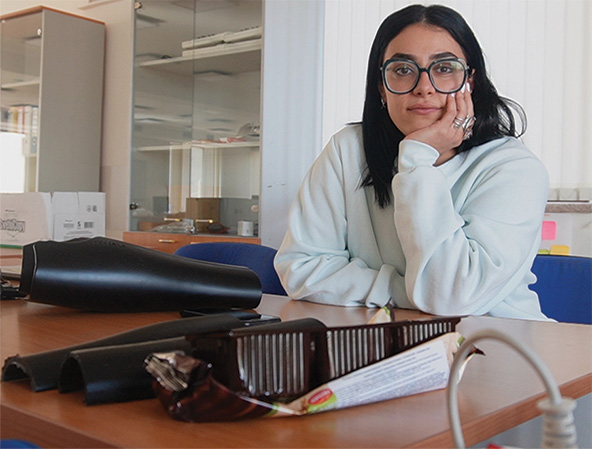
 Oqni cofounder and COO Haikouhi Oroudjian sits at her desk with a lower-limb prosthetic cover. (Photo courtesy of Hugh Bahone)
Armenia lost 3,825 soldiers and roughly 75 percent of its territories in and around Nagorno-Karabakh to Azerbaijan in the 2020 Nagorno-Karabakh War. The country’s poor health-care infrastructure and medical technology and services severely limited its ability to provide adequate care to the 5,000 civilian and military amputees from the war.
Given the overwhelming need to help amputees, venture capitalist Hajk Bagradjans and psychologist and AI data scientist Haikouhi Oroudjian founded oqni in 2020. The NGO provides amputees with free bionic upper- and lower-limb prostheses and psychological support for their rehabilitation.
Oqni is structured as an egalitarian collective rather than a leader-based hierarchy, and it employs about a dozen staff who work as mechatronic engineers, physiotherapists, or medical experts. “We made a promise to ourselves and to the people who joined the team that we would consider each other as a group and never as an individual because ultimate power is a terrifying thing,” Oroudjian explains.
The NGO’s founding was partly inspired by Oroudjian’s grandmother, who was an amputee. “It is an issue that’s close to my heart,” she says, “and I am excited to get to do something that can help people like her.”
Whereas traditional prostheses require physical exertion, which can lead to spinal deformities and other complications, bionic prostheses place less demand on the body. The prostheses are built with neurological sensory-feedback technology, which communicates with the user’s nervous system to adapt to the body’s muscle memory and gives the user the feeling of having their lost limb returned.
Oqni’s prostheses are produced in the capital city of Yerevan. The bionic limbs are made at TUMO Labs, an educational and manufacturing facility that trains Armenia’s IT professionals. Oqni uses a 3-D printer to sand, prime, and paint the prosthetic covers inside its headquarters in Engineering City, the nation’s technological center. Each prosthesis costs up to $7,000 and has an average life span of three years—consequently, oqni conducts ongoing fundraising to cover its expenses.
Bagradjans and Oroudjian initially raised €23,956 ($23,295) from a GoFundMe campaign in 2020. They then broadened their outreach and by the end of the first year gained the financial support of organizations like Calouste Gulbenkian Foundation and the Saint Sarkis Charity Trust, as well as from individual donors. Emile Ghessen, a former British Royal Marines Commando and filmmaker of 45 Days: The Fight for a Nation, donated to the NGO because, he says, “it is not just giving someone a limb, it is giving Armenian breadwinners their life back to provide for their families.”
Social media and word of mouth helped oqni to connect with amputees. Trust was established almost immediately, Oroudjian says, because “once we started creating our products and meeting with amputees, people believed in what we were doing.” The oqni team meets with amputees—either at its headquarters or at an amputee’s residence—to get an amputee’s measurements via 3-D scanners to begin the prosthesis-production process.
Because oqni believes that rehabilitation entails more than just providing free prostheses, they also meet with each amputee to discuss the best course of psychological support tailored to that individual’s needs. Oqni produced a rehabilitation guidebook for amputees and their families, which includes information on a range of topics, from prosthetic care to how to manage post-traumatic stress disorder, as well as written testimonials by other Armenian amputees. The guide was designed for people from smaller towns who can’t access the medical services found in bigger cities. It is available in print and online and is published in Armenian and English.
In 2022, the NGO launched the trial stage of Oqni Physio, a free, gamified fitness app for at-home physiotherapy. The app helps amputees manage their mental health as well as find community through interactive games. Oroudjian notes that the gaming features “make the healing process more fun.”
This year, the collective is expanding into Europe with a for-profit digital platform, called MOD, to sell its prosthetic covers. “A portion of the proceeds,” Oroudjian says, “will go to oqni to make our NGO self-sustainable so that we can continue to help as many people as possible.”
Read more stories by Leonardo Delfanti & Hugh Bohane.