


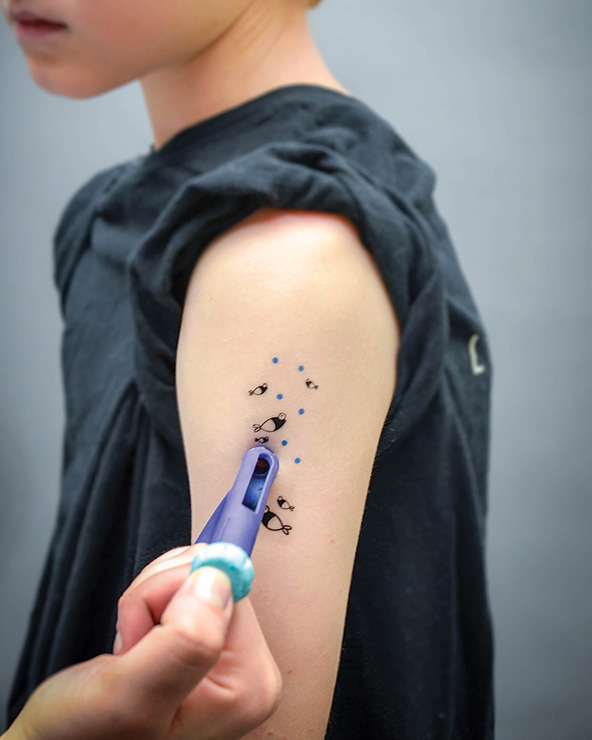
 Stylish temporary tattoos indicate the distinct sites where children can self-inject insulin. (Photo courtesy of Thumy)
When the Philadelphia Museum of Art organized a competition to design toys for kids in 2016, Renata Souza, a student at Parsons School of Design, jumped at the opportunity. She turned to her nieces and nephews for inspiration and consulted her cousins about what would be useful and fun for their kids. At that time, her nephew Thomas, who was nearly 5 years old, had just been diagnosed with type 1 diabetes. So, Souza invented the first model for Thumy, an insulin kit to help children with type 1 diabetes like Thomas feel comfortable injecting themselves with insulin.
Thomas is among the nearly 1.9 million Americans who have type 1 diabetes, of whom about 244,000 are children and adolescents. In the United States, rates of new cases or incidences of type 1 diabetes have increased nearly 2 percent annually—and for type 2, about 5 percent annually—between 2002 and 2015 in children and young adults under the age of 20, according to a 2020 report by the US Centers for Disease Control and Prevention.
For children, taking multiple injections daily can be upsetting and tiresome. And for teens, these feelings are compounded by a sense of frustration about being dependent on adults. Jordan Spillane, now 22 years old, was diagnosed with type 1 diabetes 11 years ago. She started using pens and needles for injecting insulin before transitioning to an insulin pump as a teenager. Back when she was a child, her mother and sister helped her inject. “I wish it was easier to inject myself because, like most children, the thought of getting jabbed with a needle isn’t very appealing,” she says.
Souza designed Thumy to solve this problem by gamifying insulin injections so that children can take the injections independently. Most insulin injections are difficult for children to use because they’re designed for adults, only shrunk down for children’s smaller hands without accounting for other factors, such as a child’s ability to grip and screw on the needle. Thumy’s insulin kit has two components to address the physical challenges and emotional frustrations of injections: an insulin pen ergonomically designed for children’s hands and temporary tattoos to indicate where to inject insulin.
“To provide the best absorption of the insulin, it is crucial to rotate the injection sites between the arm, tummy, leg, etc., and also within the injection site—not to inject in the same spot,” Souza explains. “The tattoos targeted this specific problem,” and they do so in a visually appealing manner.
The insulin pen also adds a thermal chromatic plastic that covers the release dial. If the insulin isn’t stored correctly and gets too warm, the color of the covering will change from blue to green to indicate that the insulin is no longer usable. And, when a child injects the insulin, the color begins changing from blue to green, serving as a distraction for the child.
“It’s something fun,” Souza says. “If you have a super-fun toothbrush, you’re going to want to brush your teeth. [The logic] is the same thing here.”
The temporary tattoos are simple yet innovative. Souza designed a system based on black ink and color dots so that a child knows not to inject the same spot twice. After a child applies the tattoo to a particular body part, the child then pinches one of the colored dots to inject the insulin into that spot. After, when the child uses an alcohol swab to clean the spot, the colored ink wipes off too, so that, eventually, all the colored dots from a tattoo get erased, which informs the child that he or she needs to choose a new area on the body to inject the insulin.
Catherine Thompson, mother of 9-year-old Chloe, who was diagnosed with type 1 diabetes a year ago, remarks that a product like Thumy is a lifesaver. “It would help a lot, in the long run, to not continue using the same area, causing injection-site problems down the road,” she says.
Despite widespread interest from parents and families of kids with type 1 diabetes, Souza has faced challenges getting the product launched. She is still awaiting approval from the US Food and Drug Administration for a De Novo classification, which is required for novel medical devices. Currently, only Thumy stickers are available for purchase in the United States. While Souza cannot sell the kits in the United States, she has distributors targeting the Mexican market and hopes to expand to more of Latin America and Europe in the future.
Read more stories by Nayanika Guha.