


 (Illustration by Jason Holley)
Daron Babcock did not have a plan when he first visited Bonton.
It was 2011, and he was searching for meaning after a difficult decade. After his wife died at 31, he battled depression and drug addiction, then became subsumed by a frantic work schedule while raising his two kids alone. He was introduced to Bonton, a neighborhood of Dallas, Texas, as a weekly Saturday volunteer in a Christian program called BridgeBuilders, which helped men seeking to turn around their lives.
After several months of participation, Babcock felt a calling to discard his comfortable life and work in Bonton. His frenzied travel was deeply unsatisfying, and his weekly two hours of volunteering in the neighborhood were not having a significant impact on the residents. So he decided to change course dramatically. Once his two children were off to college and the Marine Corps, he sold his home in the upscale Frisco neighborhood just outside Dallas, gave up his high-income job at a private equity firm, and moved into a Habitat for Humanity house in Bonton with a two-time convicted felon, all so he could engage with residents by, in his words, “doing life together.”
Living in the neighborhood, Babcock quickly realized how little he had known about the place or its people. Almost everybody had been to prison, and while they all wanted jobs, their poor health, lack of transportation, and prior convictions stood in the way.
“I had no exposure to this kind of world before, so I was really ignorant to it,” Babcock says. “I didn’t understand how poverty impacts transportation … [and] I learned that we have communities of people who are sick and dying because they just don’t have a way to get to food.”
Babcock decided to start a small farm that would provide for the neighborhood. But it became far more than that over time. He established a thriving institution, Bonton Farms, which he used to catalyze the development of other institutions and activities to uplift the neighborhood and its residents.
The organization that Babcock helped to found has transformed Bonton’s social system. Today, residents have a place to congregate, work together, learn, earn money, and volunteer. Bonton Farms’ goal is always much more than plants and pigs—it is about building a strong social support system from within the neighborhood, equipping an ever greater number of residents with skills and networks to take on leadership roles, and then working with them as a bridge to connect with outside institutions to advance the area’s interests. Creating a partnership between what residents and outsiders can offer is much more beneficial for people trying to lift themselves up from poverty or move past a history of crime and drugs than siloed services can ever be.
“Piecemeal approaches to transportation or affordable housing or access to healthy food continually come up lacking, but there is hope when you change your approach and focus on empowering the people and the community,” writes local transportation engineer Daniel Herrig. “So there is hope for the future in Bonton as jobs and investment from within begin to return to the neighborhood.”1
A particular neighborhood may end up disconnected and isolated, with weak or unsupportive social ties and institutions, for many reasons. Sometimes the cause may be circumstantial, as when a company town wakes up one day and finds its anchor has relocated, taking the best social and economic ties with it. Other times this disconnection is actually part of the original design, a legacy of segregation. Located four miles southeast of downtown Dallas, Bonton has been such a place from early in its history, an example of how neighborhoods can weigh down people. But because of Bonton Farms’ efforts, it is now a model of how such places, and the people who live in them, can be transformed.
Forms of Disconnection
Conceived and constructed as a place for Black workers, Bonton was built in the early 1900s on the Trinity River floodplain in such a way that it would not only flood whenever the river did but also serve as part of the city’s protection against such water damage. The city’s own floodgates were built just outside the neighborhood to trap floods inside. (A levee protecting the area was finally built in the 1990s.) The construction of the C. F. Hawn Freeway in the 1960s divided and further cut off the neighborhood, contributing to rising crime and blight in ensuing years.
“Growing up in Bonton was like growing up in Afghanistan or Pakistan,” recalls Danny George. “People were shot and killed daily. My mother would cover me with her body when the shooting would start.”
As segregation loosened its grip in the region, those with the means or opportunity to move away from Bonton did so.2 The result, as a 2005 neighborhood redevelopment plan observed, left Bonton “strikingly isolated from the rest of city by highways, railroad tracks, and levees. It is characterized by a lack of development and attention, which has effectively abandoned the area to evolve without any external investment of money, time, and effort for over forty years. … Its isolation, both physical and metaphorical, has ensured that it has gradually slipped off Dallas’ radar.”3
Amid dilapidated public housing, disinvestment, and disconnection, Bonton saw a growing concentration of poverty, violence, and drug addiction. In the mid-2000s, from which the best pre-Bonton Farm data are available, about half of residents were in poverty, and the per capita income of $24,445 was about two-fifths of the city average.4 Residents experienced regular bouts of crime and lawlessness, as well as broken families and destructive role models.
“Growing up in Bonton was like growing up in Afghanistan or Pakistan,” recalls Danny George, who was raised in the neighborhood and eventually returned to become a manager at Bonton Farms. “People were shot and killed daily. My mother would cover me with her body when the shooting would start.”5
The disconnection was palpable on a daily basis. Limited public transportation and the fact that local shops sold only alcohol and overpriced, out-of-date, highly processed foods meant that almost two-thirds of residents lacked an easy way to reach a grocery store with healthy, affordable produce because they did not own personal transportation. The result showed up in residents’ health: In the mid-2000, the rates of cardiovascular disease (86 percent), diabetes (123 percent), strokes (63 percent), and cancer (71 percent) for area residents were all significantly higher than the city average.6 Childhood obesity, diabetes, heart disease, cancer, and other major illnesses were more than double the rate of the rest of Dallas County.
As a transplant to the Bonton neighborhood, Daron Babcock encountered the various challenges Bonton residents face as forms of disconnection. “The vulnerable population we desire to support and lift up,” Babcock writes, “disproportionately come from environments that were intentionally designed not only to separate us from each other but, more devastatingly, to separate them from the goods, services, resources, and tools” that others take for granted.7 His observations—gleaned while living alongside longtime residents—sparked and shaped his vision to work with them to creatively address Bonton’s disconnection institution by institution, transforming the dynamics of Bonton over time.
People- Versus Place-Based Approaches
Social scientists such as Raj Chetty, William Julius Wilson, Robert Sampson, and Patrick Sharkey have shown that neighborhood effects drag down everyone living in them.8 Concentrating social problems in a single place has a cascading impact that makes each harder to address. And without healthy neighborhoods, school systems cannot improve educational results, health-care agencies cannot improve health outcomes, and police cannot make streets safe.
Despite this proven neighborhood effect, policymakers, philanthropists, and nonprofits have long viewed poverty through an individualistic lens, seeking ways to relieve material want one person at a time. This effort has led to a focus on poverty alleviation deficiency by deficiency; the US federal government has spent more than $1 trillion annually on housing, food, health care, and other support.9 This individualistic focus alleviates material want—at least in the short term—but it has often failed to lift up those targeted, as evidenced by declining economic mobility, rising homelessness, and the growing geographical concentration of disadvantaged Americans. Despite substantial federal and state spending to address poverty, the number of urban neighborhoods with concentrated poverty in the United States has more than tripled since 1970, and the number of low-income individuals living in them has more than doubled.10
 (Illustration by Jason Holley)
The nonprofit sector has come together to boost performance of the service model through a variety of initiatives that follow a collective-impact approach. Such a strategy seeks to improve service delivery by better coordinating relevant institutions and organizations, including nonprofits, community-based organizations, government, and businesses. Collective impact establishes a common agenda among the parties, a shared measurement system to track improvement, and a means of steady communication. It also typically employs a backbone support organization to manage and coordinate all the parties.
Collective-impact initiatives, even though they can have real impact, have downsides—especially if implemented without a complementary strategy to enhance the relevant neighborhoods. With its focus on service delivery, collective impact emphasizes alleviating deficits at the individual level. Targeted metrics can demonstrate improvement even if conditions in the places people live mostly do not improve. Take, for example, the many collective-impact initiatives working to boost social mobility. They seek to help every child succeed in school and life by enhancing collaboration across a wide range of organizations and focusing them all on a small number of key metrics of success (e.g., kindergarten readiness). Under this model, many youth may do better—but will also be more likely to move away from their homes, leaving their neighborhoods (or rural areas) bereft of their leadership and resources. Moreover, some young people may be hard pressed to take advantage, given the contexts in which they live (e.g., unsafe streets make learning hard; thin social networks limit incentives to improve). In addition, some service organizations might focus inordinately on particular metrics while other areas deteriorate (safety, family stability).
By contrast, organizations working on place instead of individuals seek to change the fundamental conditions in which people live and thrive, understanding that by improving the socioeconomic context “all boats will be lifted” simultaneously. Purpose Built Communities (PBC), which works holistically to revitalize neighborhoods that have been historically underserved, bases its efforts on four pillars: high-quality mixed-income housing, an education pipeline to careers, community wellness, and economic vitality. The goal is to transform fragile neighborhoods into flourishing ones that better residents’ lives and are self-sustaining. This strategy is based on the understanding that individual problems do not exist in isolation but rather feed off each other. Poor quality of schools and lack of employment opportunities contribute to high crime rates, prevalent crime contributes to a dearth of retailers and potential employers, and isolation and lack of opportunity may prompt an exodus of the more capable members of the community. To successfully address one of these issues means also addressing the others at the same time.
Place-based models have a larger impact because they focus more directly on the social determinants in a given locale—including the nature of relationships within and between households, across neighborhoods, and with organizations inside and outside it—and offer a way to target the drivers holding back particular places. They try to lift up everyone living there by changing the ecosystem that residents inhabit, rather than by prioritizing parts or aspects of the neighborhood (such as youth). Moreover, a focus on neighborhoods seeks to catalyze self-sustaining change so future interventions will not be necessary and so struggling neighborhoods can become successful ones. On the other hand, transformation this ambitious is harder to achieve because it requires a multifaceted approach over a long time horizon that works against the grain of how many government departments and nonprofits operate.
As such, the most successful place-based model, PBC, cannot reach most neighborhoods. PBC has achieved success in 25 different neighborhoods across 14 states, but the network is concentrated in the Midwest and South, and it reaches only a small portion of the estimated 825 distressed urban neighborhoods11 in the country, let alone the many more suburban and rural distressed locales. The PBC model confronts four limiting factors: Neighborhoods may be too isolated from the dynamic parts of cities, making change under this model harder to achieve; critical stakeholders (including many in the government and leading nonprofits) may not commit to breaking down silos and redirecting resources; funding to launch an initiative may not be available; or neighborhoods may be in regions where civic leaders or funders simply do not prioritize these areas in the same way (as appears to be the case in the Northeast and West).
Sometimes PBC receives interest from potential local partners but cannot convince key actors working on housing, education, real estate, and other sectors to adopt a common place-based vision. In these cases, the organization decides not to move forward. “Our success to date has been largely dependent on our ability to engender this type of collaboration,” former PBC CEO David Edwards says. “The efforts we have had to abandon are largely attributable to a failure to persuade one system player or another to join in an effort.”12 So, even as we conclude that place-based approaches like PBC’s are needed and effective, the PBC model may not be scalable to many distressed neighborhoods or to areas that are not easily connected to a dynamic economic center.
The Bonton Farms Model
Poverty-alleviation efforts thus need another place-based model, one that can cut across far more neighborhoods—including residents of suburban and rural areas—than PBC can currently reach. If such a model were centered on addressing disconnection—that is, weak or unsupportive social ties and institutions—it would encompass more than just the poorest neighborhoods, given that disconnection afflicts an ever greater share of neighborhoods. Bonton Farms offers a vision of such a new model. As Babcock writes, “We … tend to treat people as if the human condition rests on a single issue. If we just solve this one issue, things will be better, but human beings, like seeds, need an ecosystem where the parts all work symbiotically to elevate the whole.”13
The Bonton Farms model demonstrates how two types of institutions matter. Bonds within the neighborhood depend on strong families; robust interfamily networks; an abundance of informal microinstitutions (such as play groups, neighborhood gatherings, watch groups, and volunteering) that organically emerge and nourish one another, encouraging mutual, enhancing support; and a wide range of local associations and institutions (including churches, small businesses, and civic groups) made up of and serving local residents.
Bridges require strong local institutions and leaders capable of connecting with and navigating influential social groups and larger organizations (various government offices, as well as those entities offering economic opportunity, finance, health care, and education) that are typically located outside the neighborhood. The more connected—through social networks, transportation, and access—a particular neighborhood is with these actors and organizations, the higher that neighborhood’s bridging social capital is likely to be.
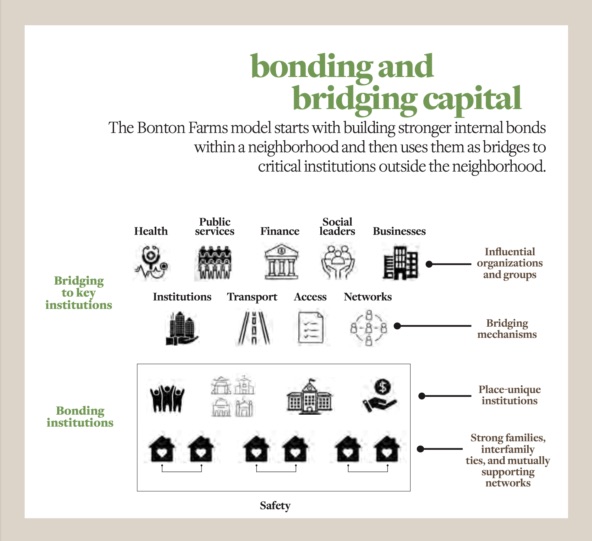
In this approach, while material change may be necessary, the goal is to strengthen a neighborhood by increasing its bonding (internal) and bridging (external) connections (social capital) first and foremost. Bonton Farms shows how this might be done. In contrast with PBC, which was started by a major real estate developer looking for a vision to achieve transformation, Bonton emerged much more bottom-up, through a series of piecemeal initiatives designed to solve neighborhood problems and increase social capital. Whereas PBC works from a blueprint, Bonton is more distinctly inside-out and focused on collaborating with residents to identify problems and innovate to build the right institutions and connections to address them. This strategy is more incremental—progress is defined by the removal of barriers to flourishing for residents—than large-scale transformation, even if the ultimate goal is similar. The emphasis on engagement first and foremost also yields a different posture. It may not be a new category, but it is a more flexible template that can be used in a wider set of locales.
Fostering Relationships
Babcock began within the neighborhood, building bonding connections, expanding his reach incrementally, and keeping his focus on learning from the residents about the systemic challenges the area faces. “Moving into the community changed me in profound ways,” he recalls. “Without that physical proximity, I would have missed many vital learning opportunities.”14
At first, he had just a garden in his yard, and then chickens in the alley. Before long, others noticed what he was doing and sought to help him grow. First, Habitat for Humanity donated two empty lots at the edge of the South Dallas neighborhood for him to expand the farm. Later, the city government added six additional lots behind them, giving the farm two acres of land in all. As he got to know his neighbors—starting with people like David Richie, whom he met at a BridgeBuilders meeting he started in his house—Babcock began collaborating with them to address larger challenges facing the neighborhood. Later, Fred Treffinger, an owner of a concrete company who read about Babcock’s efforts in the newspaper, donated 20 unused acres across from his business to start what is now called the Bonton Farm Extension. After seeing the work, the Treffinger family purchased the 20 adjacent acres as a donation, giving the new location 40 acres in all. With this land in hand, Babcock built one of the country’s largest urban farms. Bonton Farms produces an assortment of vegetables, including tomatoes, eggplants, collard greens, and a wide variety of peppers; premium meat from hogs; meat, cheese, and milk from goats; and poultry and eggs from chickens. The nonprofit sells these to Dallas restaurants such as Meddlesome Moth, Café Momentum, and Flora Street Café, as well as to the Dallas Cowboys’ training facility.
From this base, Bonton Farms generated much more change than is possible when nonprofits focus on service delivery in a siloed manner and have no stake in the specific locale. The farm sells or barters food to residents in the community so they eat better and get healthier. It offers neighbors who might not find jobs elsewhere opportunities to work and build their résumés. With the help of one of its growing number of partners from around the city, Bonton Farms even helped residents start a honey company, Bonton Honey. And when the neighborhood clearly needed more amenities for residents, Bonton Farms opened a farmers’ market, café, and coffeehouse. It has become a community within a community, and a destination for many beyond it.
“There’s community everywhere, whether I’m at work or at home,” says Lance Carter, a farm manager who could not even prove his identity when he came to the farm because he had lost all his paperwork as a result of addiction. “I’m in community 100 percent of the time—where addiction does not have a chance to thrive.”15
Babcock’s approach contrasts with an earlier effort by the city. Dallas tried to lure grocery stores with economic incentives to one of more than 40 places in the city designated by the US Department of Agriculture as a “food desert.” The effort—one that targeted a single material deficiency in a siloed manner—failed. The numbers simply didn’t work for grocers large enough to take advantage of the program, so they didn’t come.
Just as changing the environment affects plants’ ability to thrive, changing the nature of personal relationships to institutions transforms residents’ relationships to one another and to broader society. “The parallels between soil seed and plants and life are intricately linked,” Babcock says. “We have a lot of men who grew up without the right nutrients to build a quality life. … The farm exists to provide that.”16 All neighborhoods have talent, but they may not have the right environment to cultivate talented people to play a leadership role or even to stay. Enhancing the environment not only encourages people to stay but provides openings for them to lead. Otherwise, they leave for better locales.
Within the community, Babcock’s personal, relational approach differed from the way nonprofits had tried to help people with services. Babcock worked alongside fellow residents to reweave the social fabric by setting an example day in and day out, living and working side by side with the men and women in the neighborhood. Such bonding relationships not only lift people up but protect them from a wide variety of risks. And, over time, as residents see what works for them and others, they join in, replicating the power of example and motivating many more people to take leadership roles.
Babcock also organized a string of activities that brought people together in such a way that would build trust and ties between them. While many of these activities were secular in focus, he also stepped into his Christian faith in a new way, teaching and modeling a new, highly relational way of living while actively participating and partnering with local churches. Residents prayed and learned together on a regular basis, fostering trust for the daily conversations that naturally opened people up while working together on practical problems. The intimate scale to nurture close relationships mattered. In a small neighborhood with only 5,500 residents, this kind of engagement made a real difference in norms, expectations, and actions on a communal level. Stronger ties make residents more able to police their streets and work together to better their neighborhood. “Back then [before 2010], we had everything—drugs, killings, streetwalkers,” recalls Doris Young, member of a multigenerational Bonton family and Bonton Farm employee. “Any unlawful activity, you could see it in Bonton. But now we have a community coming together.”17
Bridges to the Larger World
Within the community, Babcock, Bonton Farms, and neighborhood leaders strengthened their bonding connections. In time, the emboldened community was better able to access the greater Dallas metro area and larger world through bridging connections from the neighborhood outward, to health-care, wellness, economic, housing, education, and finance institutions. Babcock and the Bonton Farms team, which includes the nonprofit, the Citybuild community development corporation (which handles any real estate development), and around 50 employees, perceived and cultivated, in Babcock’s words, the ability of “those closest to the problem to define the root-cause issues and barriers, so we can collaboratively innovate ‘right-sized’ and scalable solutions that replace those barriers with effective tools.”18
Babcock initially sought to help residents by establishing his own passenger-van route to take them to and from their most important appointments at locations not served by public transportation. However, he soon realized that this tack was insufficient and that the best solution would bring institutions that had previously been distant and often unresponsive directly into the neighborhood—as he himself had done with the farm. Embedding within a place physically and relationally has far more impact than simply delivering a service from a distance. And this neighborhood lacked everything from its own schools to supermarkets to health-care facilities to finance institutions.
While many people helped Babcock think through the bridging challenges residents faced, Daris Lee, now the health-and-wellness manager at Bonton Farms, stood out. As Babcock recalls, “He is probably the greatest contributor to the knowledge I gained as I walked with him through the turbulence of his returning home from prison and the onset of late-stage renal failure due to undiagnosed high blood pressure.” Sentenced to 16 years in prison for aggravated robbery and drug possession, Lee spent almost 6 years in jail and came out with $37,000 in accumulated debt. His debt was such a burden that he often felt as if he “should have stayed in prison.”19 Lee says of Babcock, “Everything we do down at the farm starts with seeds. [He has an] ability to see the seed in people … to see the potential in a person—not what they have done and what they have been through, but what they can be.”20 The feeling is mutual. “We use each other like stencils to build and learn and feed off each other,” Babcock says. “I am grateful for that friendship.”
From residents like Lee, Babcock learned which institutions were the most important and what barriers were keeping people from reaching them. Then, through Bonton Farms and working with local leaders, he tried to address each one. In many cases, this problem-solving meant locating external partners that could help the neighborhood and developing innovative solutions to fit the specific context.
Too often, fragile neighborhoods are disadvantaged because public and private institutions marginalize the place and the people living there, keeping them from the institutions they need to thrive. Public transportation is not prioritized in a city like Dallas, designed for automobiles—which many low-income residents do not have. Public services are too distant to reach easily or require time and knowledge to access that disadvantaged residents may not have. Financial institutions make it difficult for low-income residents to use their services because of various fees and background checks. Bridging connections depend on everything from the location of physical offices and the availability of transportation to how people are treated when they show up to whether rules regulating access to institutions inhibit them from receiving the kind of support they need.
Babcock’s experience demonstrates how addressing place-based disconnection may require challenging mainstream mindsets about how innovation itself occurs. What works in wealthier places can be counterproductive in poorer places. One manifestation of this is city regulations that may make sense in wealthier areas but can easily make life harder in a place like Bonton. Babcock encountered some of these barriers as soon as he tried to move into the neighborhood. When Babcock sought first to buy a modest home in Bonton, he failed to find an option because of many properties’ difficulty of establishing ownership (a slew of foreclosures were caught up in red tape) and limits on selling to non-low-income residents (keeping the place high poverty). Over time, Babcock learned how to fight many of these regulations by combining his network within the neighborhood with the social connections, professional training, and economic status he brought from without. Before the community fought for changes in city regulations, it was illegal to sell produce grown on your property—one of the workers on the original plot of land got a $70 ticket for doing so.
Bridging capital came in the form of a series of educational institutions that could uplift residents. The city education system was often unresponsive and not working to meet the unique local needs of the neighborhood—it had closed the neighborhood elementary school as part of a larger consolidation. Babcock worked with local leaders to start a preschool for the neediest kids, partnered with several organizations elsewhere in the city to start a fully subsidized private school (which is currently up to fifth grade and planning to add more grades) tailored to the needs of the neighborhood kids (who have experienced a lot of trauma), and established a basic job-skills-training program for adults.
The Bonton schools now focus on strengthening social bonds through parental engagement. Research demonstrates that the relationships between parent and child and parent and school are critical to educational achievement. Given that 85 percent of the men in the neighborhood have been to prison and more than half of the residents don’t have a high school diploma, it is perhaps not surprising that the public schools rarely emphasized parental engagement.
Instead of merely seeking to secure better health-care access for residents, the community is building the Bonton Farms Wellness Center right down the street from the farm. Scheduled to open in 2025, it will provide medical care; host health fairs; offer classes in exercise, nutrition, cooking, and disease prevention; and use the latest advances from medical research to improve community health.
Banks typically do not provide financial resources to low-income residents. So Bonton Farms is also building, in partnership with a host of local and national banks, a financial wellness and resource center—a community bank—to serve the area. This center will enable residents to learn personal finance (including repairing credit and managing debt) and access small loans, and will give them opportunities to build wealth through homeownership and training in entrepreneurial skills. The goal is, according to the Bonton Farms credo, to “build a ladder where it takes no risk for people to reach for the next step … the next right dignified step.”21 The center will replace the predatory lenders that currently fill gaps with payday loans, pawnshops, and title loans. With high fees, high interest rates, and highly unfavorable terms, these products often trigger debt spirals and leave borrowers with little redress if they lose their assets. The financial center will be housed in the same facility as the health center—right in the middle of the neighborhood—and may eventually transition to more traditional banking products.
To expand the range of healthy food items available in the neighborhood, the community has partnered with supermarket chain Kroger to enable free delivery for residents. The company has donated several computers to set up a central ordering-and-delivery hub so that anyone in the area can easily access its full inventory of food and other supplies at a good price. Orders are delivered once a day to a single site in Bonton, where most people come to pick theirs up once it is ready; there is also local delivery service for the elderly, single moms, and others who cannot reach the site easily. Seeing the possibilities in this model to serve a new clientele, Kroger plans to roll out the program in many other neighborhoods in Dallas and beyond.
Lastly, Bonton Farms sought to fill the gap of housing-related institutions. “Unfortunately, Dallas was built to attract people with wealth,” Babcock says, “so we haven’t really innovated housing solutions that are beautiful and dignified for people who may find themselves at the bottom of the socioeconomic platform.”22 He worked with local leaders to develop a whole new housing product, the Roommate House, and built relationships with local banks and social impact funds to ensure that residents could access low-interest mortgages in a way that was not previously possible. Each house requires no subsidies and consists of a 1,300-square-foot, two-bedroom home with two studio apartments in the back. The studio apartments don’t have full kitchens, but, with a hot plate, microwave, and bathroom, they are like hotel rooms that can be rented out for around $250 per month. These apartments provide a much needed, inexpensive option for renters while enabling resident-owners to earn enough income to help pay off the mortgages over 15 years and subsequently help grow the owners’ wealth. In addition, they developed 339-square-foot tiny houses that residents could rent inexpensively, with the idea of eventually establishing the Bonton Tiny House Village—a microcommunity that can serve as a model for cities across the country seeking to address the challenges of affordable housing. Its goal is to keep rent under 20 percent of income to encourage saving. (Low-income housing targets 30 percent and typically requires government intervention.)23
All of these bridging efforts have grown from the bonding connections that have developed, and together they have transformed the neighborhood. The streets are safer; the amenities and schools have improved; and the number of local social, civic, and economic institutions has increased markedly. With its low housing prices, proximity to downtown, and large park abutting it, Bonton is attracting outsiders who never would have considered it a desirable place to live and who are in turn making it more racially and socioeconomically diverse. Poverty is declining (now 28 percent24), employment rates are increasing, and children are doing better in school. The median household income has doubled, and the amount of people in the population with a high school diploma has risen from 54 to 77 percent.25 Vacancy is down, and house prices are rising, as newly renovated units in the area demonstrate. The median owner-occupied housing value climbed from about $44,000 in 2005 to more than $100,000 in 2022.26 Even Bonton’s image has changed dramatically, from that of a neighborhood visitors would avoid to that of a place worthy of emulation as it yields lesson after lesson for government and a wider range of organizations. And Bonton Farms now has a $4 million budget, around 50 employees, and 10,000 annual volunteers contributing to its work.
Change From the Inside Out
Neighborhood-based approaches have a proven track record of success when well executed. But just as many different neighborhoods have different contexts, we need a broader set of approaches than PBC to reach the full scope of places in need.
Bonton ultimately teaches us that every neighborhood needs both bonding and bridging connections to catalyze and sustain flourishing. Each resident is a person, not just a consumer of services.
The Bonton model offers a way to reach more places than we can with the PBC model, which pursues transformation using a tried-and-true framework—something that can be achieved only when the right conditions are in place. Bonton’s model, which is more driven by the actual experiences and needs of people living in a place, is more flexible and incremental, and thus more applicable to more neighborhoods. By identifying problems together with residents and then designing market-based solutions with an array of partners both in and outside the neighborhood, the Bonton model seeks solutions that can be adapted and applied in a wide range of different contexts.
Whereas most nonprofits program for internally determined goals, Bonton is more about a posture for engagement with residents. It seeks a collective effort to remove the barriers preventing people from uplifting themselves and their neighborhood. Notably, it seeks to strengthen internal bonds before extending bridging connections to the larger world. In addition, whereas PBC—like most nonprofits—has a relatively clear agenda from the start, Bonton’s emphasis on relationships, changing government rules and norms, building or extending new institutions, and experimentation means its progress has so far been more piecemeal but also particularly useful in the harder-to-reach places that do not meet PBC’s preconditions for success.
The Bonton model also offers many lessons for other organizations working to uplift people and their places. First, government, philanthropy, and nonprofits need innovation, but the way these sectors operate too often restrict, rather than uplift. Change will require following another principle in the Bonton credo: “Go deep, not wide. Invest … in a few [areas] and fight for true transformation and self-sufficiency [and] then others will naturally follow.”27 This vision can be very difficult to pursue, because most philanthropists use narrow metrics of success that value the quantity of people served and the cost per person. In contrast, the Bonton model requires a long horizon and metrics based on the quality of relationships with institutions and neighbors. Instead of focusing on serving individuals, neighborhood-based change efforts address the underlying causes of disconnection, jump-starting a virtuous cycle of positive momentum that feeds into economic development. Jobs are created, residents gain access to opportunity, and more institutions are established within the neighborhood.
Second, for neighborhood uplift to occur, social entrepreneurs and civic leaders need to remove the obstacles to bottom-up innovating and to advancing the lives of people in poorer or less connected neighborhoods. Too many government regulations, public-service norms, corporate policies, and nonprofit benchmarks have been designed in ways that disadvantage the people in these places. Take, for example, the struggle to sell produce or build housing in Bonton. Or the rules for applying for funding from philanthropic or government programs that make it hard for tiny nonprofits run by less well-connected leaders to access them. Or financial institutions that design products and expense schedules that work for only some classes of people and locales. Or government departments that ignore the needs of more physically and socially disconnected neighborhoods—as happened when the education and transportation authorities in Dallas made decisions about resource allocation that didn’t consider impacts on disconnected and disadvantaged neighborhoods like Bonton.
Third, catalyzing leadership from within communities is essential to improving places. Instead of looking for more efficiencies in how government departments, nonprofits, and philanthropies operate, perhaps social sector officials should be asking, “Why aren’t more leaders emerging in the places most in need in our society?” We may need to rethink how we view these places and consider how we can provide the skills, network, and environment for leaders to emerge—or return. For instance, Kimberly High, who managed the 20-acre farm extension for many years, grew up in Joppa, a neighborhood just south of Bonton. She had left the area and established a successful professional career, working for Allstate Insurance Company for 31 years, and never imagined she would want to come back. “I wouldn’t have chosen to be a farmer. I like getting my nails done,” she says. “But Bonton Farms restored my health. … People think I’m crazy, but I’ve been in an office all my life. That’s not how I want to spend my last days.”28 In 2021, after working for Bonton Farms for several years, she shifted her energy to nearby Joppa to start her very own urban farm on a property that was her grandmother’s. Community entrepreneurs, place-based stewards, and committed leaders can build connections and capacity in a way that uplifts neighborhoods in need. When outside actors are required, they must act as catalysts for bonding and bridging relationships that ensure local flourishing, rather than crowding out local initiative and leadership.
Fourth, instead of seeing low-income neighborhoods as uniquely troubled, we should look to them for what we can learn about the growing problem of disconnection, which affects an ever greater part of our society. All neighborhoods, rich and poor, sit on a continuum from those least connected to those most connected, so a more inclusive framing might incorporate the rising challenges of social poverty. This approach would not only reframe the difficulties facing low-income areas but end their stigmatization. Middle-class neighborhoods may be materially better off and yet also at risk of various social problems, such as death by suicide or drug abuse. On the other hand, some low-income neighborhoods—such as those with recent immigrants—may be socially vibrant, able to address their various challenges, more likely to see rising incomes, and less at risk of social problems.
Bonton ultimately teaches us that every neighborhood needs both bonding and bridging connections to catalyze and sustain flourishing. Each resident is a person, not just a consumer of services—a neighbor, not just someone in need. As Dr. Martin Luther King Jr. wrote, “We are caught in an inescapable network of mutuality, tied in a single garment of destiny. Whatever affects one directly, affects all indirectly.”29
Read more stories by Seth D. Kaplan.