


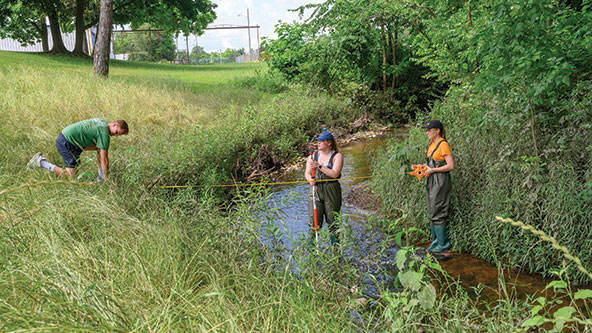
 Student interns from the Center for Civic Innovation and BCe2 survey an area of Bowman Creek. (Photo courtesy of Barbara Johnston/University of Notre Dame)
Ask people what first comes to mind when they think of South Bend, Indiana, and they may mention the University of Notre Dame and its legendary football team. But the city is also famous for being an early-20th century industrial power that housed the Studebaker automotive company and other manufacturers, and where the St. Joseph’s River played an important role facilitating commerce for the city throughout the Midwest.
The gradual decline of the nation’s manufacturing sector that began in the late 20th century and hit the Rust Belt hard also impacted South Bend. The city’s economy eroded, and its natural environment followed. These problems were especially difficult for residents of the city’s Southeast neighborhood, where a loss of jobs and rise in pollution combined with an increase in housing vacancy and criminal activity.
“The Southeast was an abandoned side of town with a lot of drug houses, prostitution, and gangs,” says Rickardo Taylor Sr., senior pastor of Mount Carmel Missionary Baptist Church and who has called South Bend home for more than two decades.
For residents like Taylor, Bowman Creek, a two-mile-long tributary of the St. Joseph’s River that runs through the neighborhood, symbolized those woes.
“The only time the creek ran is when it would rain,” says Taylor, who notes that the sole part of Bowman Creek that previously looked presentable was a short section running past the nearby Studebaker Park public golf course. “It was a neighborhood that was forgotten about, and that creek was forgotten about 100 percent.”
Four miles to the north sits the campus of Notre Dame. That distance might seem greater to some Southeast residents given the very different surroundings of the two places. But as the 2010s approached, some faculty members of the university’s engineering department were very much aware of the environmental problems plaguing the creek and were exploring novel approaches to help start a restoration.
Prior to the beginning of the decade, engineering faculty and students had collaborated with community organizations on various individual projects, including those related to public works. But, a few years later, a new idea was conceived: getting high school and college students involved not just in learning science, technology, engineering, and math (STEM) skills, but also in applying those skills to lead projects of their own.
Launched in 2015, the Bowman Creek Educational Ecosystem (BCe2) brings together local high schools and higher education institutions, community organizations, and private and municipal entities for the goal of developing sustainable solutions to social, economic, and environmental problems in South Bend. The collaboration has gained the support and admiration of many in the community, including the city’s mayor, 2020 US presidential candidate Pete Buttigieg.
Restoring the Creek
The roots of BCe2 actually go back to 2010. Gary Gilot, who then was the city’s public works director, and Jay Brockman, an associate director at Notre Dame’s College of Engineering, started a collaboration among Notre Dame, the city, and James Whitcomb Riley High School for the purpose of addressing solutions to environmental problems at the creek, which is located near the high school. Among those initially recruited to help were Arezoo Ardekani, an engineering professor at Notre Dame, whose research interests in water physics and general interest in community outreach dovetailed with Gilot and Brockman’s ambitions for a revitalized Bowman Creek.
“I wanted to start an outreach project that not only focuses on the education of high school students and attracts them to STEM fields, but also has a positive impact on the society,” Ardekani says. “When I heard about the challenges that Bowman Creek faced, I immediately decided to work on it.”
In 2012, Ardekani and some of her students partnered with city engineers to teach students at Riley—a public high school—how to test the water quality of a nearby section of the creek. The curiosity of Riley’s students, who hail from diverse backgrounds and who received no funding for this initial endeavor, was piqued. They provided such a suitable pool of researchers for the project that its leaders saw an opportunity for BCe2 to expand its offerings.
Brockman quickly recognized the potential for building upon the initial experiment, which coincided with a 2013 study co-sponsored by the city that detailed solutions for restoring the creek, which contained elevated levels of E. coli, ammonia, and phosphorous. The experiment would now be dependent on all entities involved working together on an effort that was becoming considerably greater than just a one-off endeavor.
“One of the big things I always have in the back of my mind is the importance of building the right team and the culture you want to build within that team,” he says.
BCe2 would also have to balance community improvement goals with the realization that it was still very much a project with pragmatic objectives.
“We were working in a neighborhood that’s had a long period of decline,” Gilot says. “And before you change momentum, you have to focus on little wins. We’re not swinging for the fences.
Building on Community Roots
With grants of $15,000 from the National Science Foundation and almost $20,000 from local nonprofit organization enFocus, BCe2 officially launched as a summer internship program in 2015. It had nine participants. Interns, consisting of a mix of local high school and college students, worked on STEM projects such as producing 3D physical and digital design models and learned about drone technology for the purpose of assessing the creek’s environmental quality.
Increased funding, primarily through local and federal grants, has enabled the internship program to continue expanding. When the program returned the following summer, more projects were added, which enabled student participation to rise to 21. In 2019, 39 students participated in the eight-week program.
Students outside of South Bend are welcome to apply; majoring in engineering or another STEM field is not mandatory for admission. The program neither requires candidates to have an excellent academic record nor prior experience working in STEM fields or initiating STEM academic projects. Those selected are provided with an overview of each project for the upcoming summer and are assigned to a specific group of 3-4 people based on how they rate their interests in the projects and where their skills fit best.
“We’re looking for people that have a sense of commitment to a community, and who know themselves well enough to want to be a part of something like this,” Brockman says. “We know what our projects are going into the summer, and we know the different skills, talents, and backgrounds we want in the mix.”
For the 2019 program, two projects in particular focused on the continued restoration of Bowman Creek and the surrounding area. In one project, a group worked with EmNet, a local water utility management company, and Notre Dame to develop a weather station atop the clubhouse of Studebaker Park golf course. Data from the station feeds into an online dashboard that allows the public to view conditions of the creek in the stretch by the course. Additionally, interns launched a beautification project at the site to remove weeds, branches, and graffiti to facilitate the planting of 250 native floral plugs.
In the second project, another group addressed concerns about heavy rainfalls potentially creating bottlenecks in the city’s sewer system and possibly spilling over into both the creek and the St. Joseph’s River. The group also partnered with the city and EmNet to create cost-effective sensors placed at different points in the creek. They used lasers to survey and collect data for a cross section of the creek where the sensors were located.
Interns further used statistics on the creek obtained from the US Ecological Survey’s database and developed a model for a website they created to provide the public with a gauge of water conditions. Additionally, the site allows local high school students taking STEM classes to learn about conditions and trends in the creek for their own studies.
“There hasn’t ever been a comprehensive effort to make a network that’s focused specifically on Bowman Creek, and which gives a holistic picture of where the water is on the creek,” says Finnian Cavanaugh, a senior civil engineering major at Notre Dame who worked on the latter project. “The key of this is to open the data to the public, because this is something that hasn’t really been done before.”
“The Bowman Creek project is what education should be,” says Seth Ponder, a teacher at Riley High School and one of BCe2’s 40 mentors, who has been involved with the program since 2016.
“It’s community engaged, it’s networking with professionals, and it’s making a change by the end of the summer,” he adds. “You have a project that you can show off that betters the community, and maybe even betters your own family.”
Branching Out Beyond the Creek
The growth of BCe2 has allowed for the creation of other summer projects in addition to those concentrating on the creek’s restoration. This year’s program included eight additional projects that branched out beyond the creek to the larger Southeast neighborhood and the city.
In the Southeast, one project saw interns working on a marketing plan to promote home ownership for a neighborhood community-development corporation. Housing was also a focus for a separate team project that conducted a study aimed at reducing lead exposure in homes throughout town.
Another effort included interns working on a cost-effective model for local businesses to comply with an Environmental Protection Agency mandate next year to retain storm water on their properties and disable their downspouts. A further project had a team working on research to develop an app for formerly incarcerated individuals seeking social services.
BCe2’s increasing focus outside the Southeast neighborhood resulted in the creation last year of a pilot program called the Western Educational Ecosystem (We2), where teams initiate projects in the western section of the city. For 2019, We2 projects included interns working on a computer chip to create a digitized neighborhood oral history archive, acquiring vacant lots for the purpose of transforming them into sustainable nurseries, and lending assistance to ongoing community development efforts in two neighborhoods.
Benjamin Capdevielle was one of four group members this summer who took part in a We2 project in LaSalle Park, a low-income neighborhood. Unlike most BCe2 projects where there was a precise challenge already identified for interns to tackle, the initial job of Capdevielle’s group was to get to know LaSalle Park residents and find out their most pressing concerns. From community meetings to networking functions with residents and key stakeholders, a common concern the group heard was the poor quality of sidewalks.
“At the beginning, there wasn’t a lot of specific direction for our project,” says Capdevielle, a senior at Trinity School at Greenlawn, a private Christian junior high and high school in the city. “A lot of the direction came after we met with people and talked with them about what kind of vision they had for what we could accomplish.”
South Bend homeowners are responsible for paying for sidewalk maintenance outside their homes, but many in LaSalle Park cannot afford the renovations. While there are city-backed programs to help with repairs in certain neighborhoods, LaSalle Park was one not previously targeted for funding.
Capdevielle and his team landed meetings with city planners, who told them that a city database that contained information on the sidewalk quality of different neighborhoods did not have any data on LaSalle Park. Officials subsequently gave the group the opportunity to help them update the database with information for LaSalle Park. They were trained to go around the neighborhood using iPads to rate the quality of sidewalks based on city-set criteria.
“Historically, LaSalle Park was often neglected by municipal government,” notes Kira Pratico, a South Bend native and sophomore double major in business and Spanish at the University of Florida, who was one of Capdevielle’s project team members.
A traditionally African American neighborhood in a city where housing discrimination was once rife due to restrictive residential covenants, LaSalle Park was built atop a former hazardous dump site, contributing to the belief many had of it as being a place just as disregarded as the Southeast.
Although the Fair Housing Act of 1968 was designed to correct such discriminatory practices, economic disparities nationwide continue to make it difficult for many African Americans and Latinos to move to higher-income neighborhoods. In South Bend, many African Americans still live in lower-income areas like the Southeast neighborhood as well as the western part of the city, where many Hispanics are also concentrated.
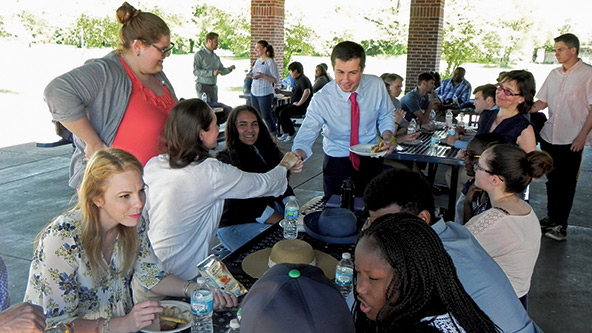 South Bend Mayor
Pete Buttigieg greets BCe2
interns at the annual kickoff
picnic. (Photo courtesy of the Center for Civic Innovation)
South Bend Mayor
Pete Buttigieg greets BCe2
interns at the annual kickoff
picnic. (Photo courtesy of the Center for Civic Innovation)
Pratico says it can be difficult for some colleagues to grasp that their efforts will not make the sweeping change they had in mind when they started the program. Instead, she stresses patience to colleagues on their projects. “Maybe [our project] didn’t have a direct and obvious impact in the eight weeks we were working on it,” says Pratico about her team’s assignment. “But in the long run, updating that database is what council members and the city will look at when allocating funds.”
Building Bridges to a Better Future
Many area residents who have interacted with BCe2 are deeply impressed by its mission and work. Among those admirers is one nationally prominent South Bend native: Mayor Pete Buttigieg.
“One of the most compelling things is that it breaks the mold of a traditional college-related service project,” Buttigieg says. “While there have been plenty of programs over the years that took students from Notre Dame and brought them into downtown or other parts of the city to do something, this is the first one I’ve seen that brought together every layer of the community.”
Like other colleges, Notre Dame has long faced criticism by local residents of not caring about the larger town it calls home. The mayor, however, feels that BCe2 has made strides bridging philosophical divides between the city and the school.
“I think the most important thing it did was that it helped people on the university side look at the community as more than a service project,” Buttigieg says. “The people they got to know and work with in the community really challenged them.”
BCe2 also has dealt with questions from residents who are skeptical of their intentions. Taylor said that he initially heard from many of his neighbors who believed BCe2 was nothing more than a means to gentrify the largely African American Southeast neighborhood, and price homeowners out of the area in the process.
“These kids walked into the inner city and met challenges,” says Taylor of local residents’ initial resistance. He has since become a BCe2 mentor as well as helping to establish 466 Works, a neighborhood community development corporation that has worked with BCe2 interns.
It didn’t take long for Taylor to be impressed by BCe2’s interns. Eventually, other residents felt the same. “Those kids never backed down to do the work they were called to do,” Taylor says. “And when the people that doubted them got around them, they discovered the students were not there to look down on the neighborhood but were there to make a difference.”
Taylor and others acknowledge more work remains in bridging the town-and-gown divide, an effort BCe2 cannot fix on its own. They also realize the importance of consistent funding to continue to work toward the program’s objectives.
“We’ve been successful with grants,” says Gilot, who is now the assistant director of community engagement for the Center of Civic Innovation, an initiative at Notre Dame’s College of Engineering that launched this year to build upon the work of BCe2. “But people will give you money to prove a concept, but then not give you money every year to keep it going.”
Another challenge is that most of BCe2’s activity occurs during the time period of the internship, before students resume their regular academic obligations in the fall. Some community partners and interns who are still in town will continue to work on a number of uncompleted projects through the new academic year, though not to the same capacity as during the summer.
BCe2, which launched a pilot program this summer in nearby Elkhart, Indiana, plans to replicate its work in other towns. It also would like to maintain the momentum of its summer projects year-round.
“In the same way we’re building vibrancy in the neighborhoods, you need that vibrancy in the summer to continue in the academic year for a variety of reasons,” says Danielle Wood, an associate director of research at the Center for Civic Innovation.
For now, Bowman Creek’s small wins include stabilizing a section of the creek with native plants to help prevent soil erosion and the placement of concrete crosses to keep banks intact during floods. Their efforts are also allowing the creek’s crawfish population to thrive, making the area a hospitable recreational spot after years of neglect. And throughout the Southeast, BCe2 has inspired the efforts of neighborhood organizations like 466 Works, which is currently working with city officials to promote financial investment in the area.
“I’m always attracted to projects like this where working on science and engineering has a direct impact on the society,” says Ardekani, who in 2014 left Notre Dame for Purdue University, where she is currently an associate professor of mechanical engineering. “I learned that it was also important for my students.”
And if you ask the interns about the work they have done with BCe2, more likely than not they will say that the results are and will be bigger than them.
“I would hesitate to say that there’s something special about us,” says Cavanaugh. “I think there’s something special about South Bend.”
This article appeared in the Winter 2020 issue of the magazine with the headline: "The Creek Will Rise"
Read more stories by Kyle Coward.