


 (Bridge Photos by iStock (7))
In 2008, the level of maternal mortality in the Philippines was three times as high as the target set by the Millennium Development Goals (MDG), and half the time allotted for achieving that goal had passed. Although Philippine infant mortality statistics were improving, maternal mortality was not. The Zuellig Family Foundation sponsored an effort to reduce maternal mortality in three regions of the country where the problem was particularly severe. Over the next three years, maternal mortality in those regions dropped by 40 percent to 70 percent; all three regions are now expected to reach the MDG target by 2015.
Achieving that transformation depended on innovations in health system coordination that enhanced the responsiveness of regional health services, and those changes in turn required cooperation across the boundaries that separate local government officials, health-care providers, community leaders, and client mothers. To increase such cooperation, leaders of the initiative used workshop materials and program designs created by the Synergos Institute and the Mirant Center for Bridging Societal Divides at the Asian Institute of Management.
The crucial factor in this initiative was a process known as “bridge-building.” By building connections between important stakeholders, participants brought about changes that dramatically reduced maternal mortality and its devastating impact on families and communities. Bridge building is a form of multi-stakeholder cooperation that catalyzes systemic change to confront complex social problems. It allows people to achieve social transformations that extend across various organizations, institutional sectors, and levels of society. (Multi-stakeholder partnerships of this kind have produced positive results in a wide variety of contexts.1)
A “social transformation,” in my use of the term, refers to a change that fundamentally and sustainably improves larger networks and entire communities. Social transformations encompass changes in social boundaries and social practices—changes that increase problem-solving capability at a system-wide level.2 Boundary changes alter the patterns of communication and cooperation among diverse stakeholders, including public officials, community leaders, and citizens. Practice changes alter how stakeholders do their work; such changes lead to innovations in service delivery, client participation, and the like.
Bridge-building initiatives are hard to launch, challenging to maintain, and difficult to expand and institutionalize. But by mobilizing the resources and energies of diverse stakeholders, they create the potential to solve intractable social problems. A world marked by globalization, expanding expectations, proliferating diversity, and ever more limited resources creates increasing demand for solutions that involve diverse interests. Bridge-building that enables social transformation can be critical to meeting that demand.
The Origins of Bridge-Building
For more than two decades, I have worked with colleagues at the Synergos Institute—an organization that promotes social change by facilitating partnerships—to study a wide variety of multi-stakeholder initiatives. Initially, we studied cooperation among grassroots groups, NGOs, and governments in Asia and Africa to determine which factors were linked to successful problem solving.3 Later, Synergos worked with partners from around the world to promote bridge-building and to train “bridging leaders” who are able to tackle problems of social, economic, and political development. In 2001, Synergos created a Global Task Force on Bridging Leadership to develop case studies of leaders who fostered cooperation across organizational, sectoral, and social boundaries.4 A long with partners at the Asian Institute of Management in the Philippines and the Esquel Foundation in Ecuador, Synergos helped catalyze a wide variety of multi-stakeholder initiatives in those countries.
At about the same time, Synergos began to use Theory U as a framework for launching such initiatives. Its partners in exploring that framework included Generon Consulting, Reos Partners, and the Presencing Institute. Theory U (developed by Peter Senge, Otto Scharmer, and other scholars) outlines a process that enables innovation by fostering individual, group, and organization-wide engagement with challenging problems.5 The U Process helps diverse stakeholders recognize shared concerns, analyze complex problems, explore possibilities for change, and create prototype innovations. (See “The U Process: A Framework for Multi-Stakeholder Cooperation” below.) Successful bridge-building initiatives change interpersonal relations among participants, alter existing organizations or create new ones, and reshape the boundaries that separate organizations, institutional sectors, and levels of society. For that reason, Synergos leaders had come to see that a tool like the U Process was essential to their work.
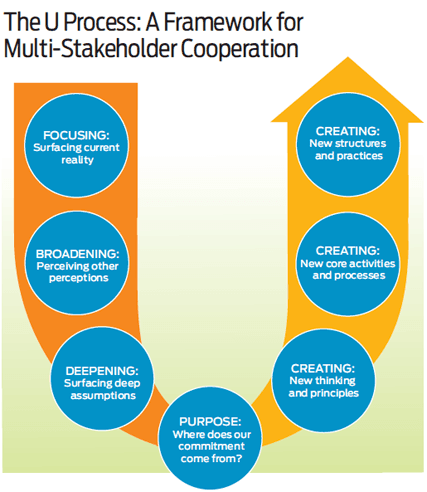 (Diagram adapted from C.Otto Sharmer, Theory U: Leading From the Future as it Emerges, San Francisco: Berrett-Koehler Publishers, 2008.)
In developing its approach to bridge building, Synergos and its partners also began to use multi-stakeholder workshops to help build relationships across system boundaries, to create a sense of shared purpose, and to promote new thinking and new practices. Sometimes these workshops also catalyzed significant personal transformations, as participants grappled with their own sense of commitment and their own perspective. In each initiative, facilitators adapted the design of workshops to fit local contexts and concerns.
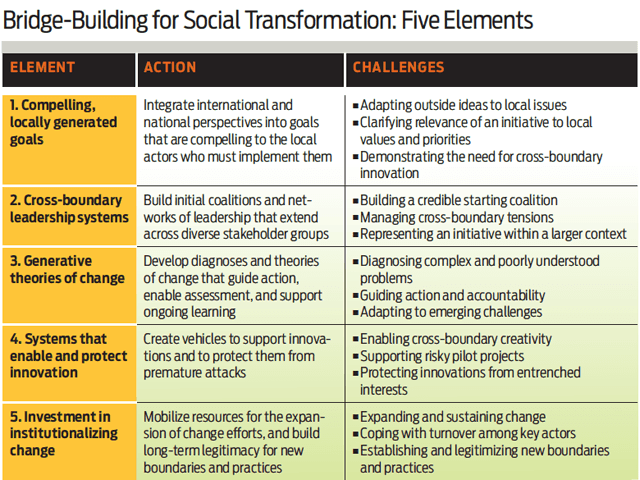
Since 2012, I have worked with Synergos and its partners to study more than 20 bridge-building initiatives in five countries (Ecuador, India, Namibia, the Philippines, and South Africa). Each initiative involved creating a platform for dialogue among diverse stakeholders—government agencies, community groups, civil society organizations, business firms, and so on—in order to enable cooperation around a complex social problem. Not all of the initiatives that Synergos sponsored resulted in sustainable transformations, but some did. (Many initiatives produced positive outcomes for participants, even if they didn’t result in sustainable large-scale change.) By comparing these initiatives, my colleagues and I have identified factors that distinguish more-successful efforts from those that were less successful. Through that analysis, we have identified five elements associated with social transformation. (See “Bridge-Building for Social Transformation: Five Elements” below.) This article describes those five elements.
Element 1: Compelling, Locally Generated Goals
Initiatives that catalyze social transformations find ways to fuse outsider and insider perspectives into goals that motivate sustained cooperation among stakeholders. To be sure, bridge-building initiatives benefit from international inputs—including ideas (the U Process, for instance) as well as financial support. But cooperation across social boundaries can be difficult. Ideas that come from outside parties are not always compelling to actors on the ground, and financial resources cannot substitute for local understanding and commitment. Too much outside support, particularly from impatient donors, can short-circuit the kinds of discussions that are necessary for cooperation. Too much reliance on external support can also undermine sustainability. Bridge-building and the U Process, therefore, emphasize the value of bringing together local actors to articulate a sense of shared purpose and to pursue joint action.
In 2007, for example, representatives of Synergos, McKinsey & Company, and the Presencing Institute, with funding from the Bill & Melinda Gates Foundation, undertook a project to build capacity in the Namibian Ministry of Health and Social Services. Many stakeholders recognized that the existing system was broken: Maternal health measures were worsening, even after Millennium Development Goals had focused attention on that issue. McKinsey conducted an assessment of the ministry’s existing capacity and performance level. The project team then initiated the Leadership Development Forum, a series of discussions in which ministry leaders could discuss that assessment. Those discussions improved relations among the leaders, who had long been known for running their departments as independent fiefdoms. Eventually, those leaders agreed on the need for more interdepartmental cooperation and for improved maternal health services.
That experience inspired ministry leaders to commit to holding further top-level meetings and enabled them to enhance ministry performance in many areas related to maternal health. If the project team had moved to promote action immediately, cooperation among those leaders would have been much harder to achieve. In addition, the ministry leaders’ growing commitment to this kind of bridge-building made it possible for the team to draw on national resources to help sustain the project.
In some cases, participants develop a set of compelling goals before substantial political or financial support emerges for an initiative. In South Africa, representatives of Synergos, Reos Partners, and a local NGO launched the Leadership and Innovation Network for Collaboration in the Children’s Sector (LINC) in 2007, after the HIV/AIDS epidemic created an unprecedented wave of orphans and other vulnerable children whose needs threatened to overwhelm available service capacity. The LINC coalition used a small grant from a local foundation to interview government, business, and civil society actors who provide services to children and then brought those groups together to discuss the need for greater innovation and cooperation. In those discussions, some participants challenged the coalition’s initial focus on children with HIV/AIDS and voiced concern about other groups of vulnerable children. The coalition widened the focus of the initiative to include those groups, and that move set the stage for achieving new levels of cooperation among government agencies, local communities, civil society organizations, and other institutions that deal with the plight of children.
Element 2: Cross-Boundary Leadership Systems
Coalitions that combine credibility among diverse stakeholders with an ability to manage differences creatively are a central feature of bridge-building initiatives. Many such initiatives begin as efforts by individuals or small coalitions, often with support from international partners. In the long term, however, those initiatives must develop cross-boundary leadership systems that mobilize important stakeholders, resolve tensions that exist between them, and connect their activities within a larger context. That is how many of the Synergos-affiliated initiatives evolved: Initial coalitions organized workshops that used the U Process to create new leadership systems, and those systems provided an institutional base for promoting continuity in relations among stakeholders.
In South Africa, as noted previously, a small coalition organized a cross-boundary workshop that led to the formation of LINC, which functions as a multi-stakeholder leadership system. Attendees of those initial workshops were stakeholders who shared an interest in enhancing services to vulnerable children, and the workshop discussions helped heal interpersonal rifts that had prevented cooperation among them. LINC also used workshops and coaching to expand the pool of bridging leaders and to launch cross-sector efforts to help children. A grassroots group of childcare activists, for example, worked with government officials whom they met in LINC workshops to obtain support for expanding a community-based childcare initiative.
In other cases, initiatives expand or repurpose existing organizations to provide cross-boundary leadership. In Ecuador, the Esquel Foundation sought to reform a fragmented and anarchic national leadership culture that had produced decades of political paralysis, economic dysfunction, and social crisis. Toward that end, the foundation began working with Synergos in 2000 to develop the Integrating Leadership Program. The program created workshops in which local and national leaders could collaborate with their constituents to define political needs and to explore problem-solving strategies. Over the course of a decade, the foundation supported dozens of such workshops. Some of them were local in scope. The goal of Local Civil Dialogues, for instance, was to build understanding between citizens and their elected representatives. Others were national in scope: A series of discussions called Constructing the Us aimed to foster shared goals and shared expectations among national political leaders. These workshops catalyzed various spin-off innovations, ranging from citizen-led efforts aimed at influencing government officials to the Constituent Assembly, which drafted a new national constitution in 2008.
The initiators of multi-stakeholder projects often use personal relationships to link diverse stakeholder groups, and such forms of collaboration are vulnerable to leadership turnover. As leadership systems evolve, however, they can create more stable cross-boundary linkages. As the Integrating Leadership Program and its spin-off entities grew, for example, the Esquel Foundation recruited trustees who had credibility with various national constituencies. Indeed, as the program became more visible throughout Ecuador, it reshaped the identity of the foundation and increased the foundation’s ability to respond effectively to emerging challenges.
Element 3: Generative Theories of Change
Bridge-building workshops emphasize the need to diagnose problems and to develop theories of change by focusing on current realities, by taking into account many different perspectives and assumptions, and by cultivating shared goals among stakeholders. Here again, bridge-building draws on Theory U, which holds that innovation emerges from a deep understanding of complex problems and from creative insights into potential solutions. The U Process uses extensive observation and analysis to diagnose such problems. Successful bridge-building initiatives use that process to create generative theories of change that define the scope of desired progress, guide pilot projects, hold stakeholders accountable, foster learning from experience, and allow for creative responses to unexpected challenges.
Consider again the initiative to reduce maternal mortality in the Philippines. In that effort, preliminary analysis indicated that many actors in that country’s health system—including government officials and community leaders, as well as mothers and their families—would need to alter their behavior in order to change outcomes. The program used multi-stakeholder workshops to identify shared goals and to develop “health leadership roadmaps.” These roadmaps made explicit an underlying theory of change that focused attention on activities that would reduce maternal mortality. They detailed the responsibilities of mayors, municipal health officers, and community health teams in promoting awareness, in improving health services, and in mobilizing mothers to use those services. They made it possible to hold participants accountable by setting clear goals, assigning responsibilities, and setting expectations for results.
By setting expectations about interventions and outcomes, generative theories of change also enable “initiative learning”: When results deviate from expectations, initiative leaders can learn from those deviations and develop new implementation strategies. Initiative learning is particularly critical when problems are complex, poorly understood, or subject to unknown patterns of development—characteristics that are common to issues that call for multi-stakeholder cooperation.
Similarly, an inadequate theory of change can cause an initiative to produce disappointing results. In the Philippines, for example, another bridge-building initiative launched by the Mirant Center focused on bridge-building itself. The center sought to “mainstream” that practice by teaching faculty members at other universities to use the design and materials that the center had developed for its bridging leadership workshop. In the end, however, participants in the initiative did little to spread bridge-building skills and concepts, and the Mirant Center team concluded that an improved theory of change would emphasize several activities and incentives that its initial approach had omitted: enabling faculty research, training faculty in case-teaching skills, building a community of practice based on peer support, and framing bridge-building as a way to advance the institutional priorities of each university.
Element 4: Systems That Enable and Protect Innovation
Stakeholders bring different interests, capacities, and values to a bridge-building initiative, so working together can be difficult even when there is an agreement on goals. Successful initiatives, therefore, find ways to enable and protect innovations until participants can demonstrate the value of those innovations to outsiders. Through bridge-building workshops, these initiatives put a premium on convening stakeholders in settings where they can explore their differences, agree on common goals, construct shared analyses, and collaborate on new projects. But the more innovative a multi-stakeholder project is, the more it may need protection from premature attack by incumbent interests and institutions. Beneficiaries of existing arrangements may see an innovation as a threat; other parties may see it as having costs that exceed its benefits.
In India, for example, the Bhavishya Alliance convened a multi-stakeholder workshop called the Maharashtra Change Lab. The workshop, launched in 2006, brought together business executives, government officials, and civil society leaders to work on the problem of child malnutrition. Independent facilitators helped participants to navigate their differences, to explore their personal commitment to reducing child malnutrition, and to develop pilot projects that incorporated their various resources and agendas. The Change Lab initiative illustrates the advantage of using “containers”—social systems that allow diverse groups of participants to build understanding and a shared sense of commitment within a protected setting.
But the Change Lab story also illustrates another challenge: The boundaries that protect the innovation process may get in the way of securing acceptance of an innovation by stakeholders who are not part of that process. Some participants in the Change Lab, for instance, had difficulty in persuading their home organizations to adopt their project proposals, and several months of further negotiations were required before they could start those projects. In fact, a container that facilitates cooperative innovation among some stakeholders may lead others to be skeptical of that effort.
When a container structure includes influential decision-makers, protection against outsiders may be less critical. Constructing the Us, the project in Ecuador that was part of the Esquel Foundation’s Integrating Leadership Program, brought together 30 national political leaders from different constituencies. Launched in 2004—after a decade of political fragmentation, leadership turnover, and institutional chaos—the project involved a series of monthly conferences where those leaders could discuss political and institutional challenges that the country was facing. During these meetings, leaders identified a wide range of issues and possible reforms, built consensus on some of them, and started discussions that led to the creation of a new national constitution. The meetings created a multi-party dialogue that was itself an innovation: They created a space for political analysis and relationship-building that influenced the national discourse for the next decade. By supporting the emergence of shared concerns and views, these meetings allowed ideas to form that became important themes in subsequent political regimes. In addition, participants went on to play central roles in national politics as movement activists, party leaders, and government ministers. (One participant, in fact, later became president of Ecuador.)
Element 5: Investment in Institutionalizing Change
More than one successful change project has been derailed by the departure of key leaders or by the advent of a new leader with different priorities. Long-term sustainability, therefore, depends on integrating successful initiatives into established institutions. Initiatives that produce social transformation mobilize political, financial, and organizational resources to expand their impact; they cope with turnover among influential individuals and groups; and they build legitimacy for new boundaries and new practices. These elements of bridge-building coincide with later phases of the U Process. But they take place largely outside the scope of bridge-building workshops and often involve actors who were not part of the original initiative.
Ensuring that successful initiatives survive even after their original leaders have moved on requires a significant investment in shifting stakeholder expectations both about cooperation across boundaries and about implementing new practices. The maternal health initiative in Namibia, for example, increased cooperation across the boundaries that separated ministry departments and developed new practices in community and health staff engagement. The initiative increased women’s participation in promoting their own health, and it improved ministry responsiveness to their concerns. Initiative leaders created a Regional Delivery Unit to coordinate services across regional departments, and that new structure was so successful that the Ministry of Health and Human Services made it central to implementing the program in other regions.
In many cases, institutionalizing change involves shifting the roles of outside and inside actors. Although external consultants and outside resources are often critical to defining goals, diagnosing problems, constructing innovations, and articulating change strategies, it is insiders who must integrate those efforts into institutions that will shape ongoing cooperation. Much of the existing literature on bridge-building has been written by outsiders who helped launch multi-stakeholder innovations. But sustainable transformation depends on insiders who can adapt outside ideas to fit local realities and legitimize new institutional arrangements. The Namibian initiative, for instance, not only had financial support from international donors but also relied on political support from ministry leaders. As new leaders assumed senior positions in the ministry, the initiative actively recruited their support as well and worked with them to obtain internal resources to continue successful programs. At one point, moreover, initiative supporters had to persuade the ministry’s new permanent secretary to continue support for the Leadership Development Forum, despite his skepticism about that project.
Not all bridge-building efforts succeed in expanding or institutionalizing the cross-boundary cooperation or the innovations in practice that they initiate. Consider the effort by the Bhavishya Alliance to reduce child malnutrition in India. Pilot projects undertaken by the alliance improved day-care availability, enhanced child nutrition, empowered teenage girls, and demonstrated that cross-sector collaboration could improve child nutrition. But corporate sponsors of the initiative decided to leave the challenge of expanding and sustaining those pilot programs to government agencies. Consequently, the alliance did not mobilize additional financial and political resources, nor did it integrate its early achievements into a sustained multi-sectoral campaign against malnutrition.
The Challenge of Social Transformation
These five elements are central to multi-stakeholder efforts that aim to catalyze sustainable social change. Together, they form an approach to bridge-building that recognizes the importance of changes at many levels—individual, interpersonal, organizational, inter-organizational. That approach equips people to deal with conflict, to cope with emerging challenges, and to build long-term support for new boundaries and practices.
Some of the bridge-building initiatives undertaken by the Synergos Institute and its partners have produced sustainable changes in social boundaries and social practices; others have not. The five elements were all present in sustainable transformations; one or more elements were missing from less successful initiatives. The maternal health programs in the Philippines and Namibia benefited from having all five elements in place, and as a result they have improved the lives of thousands of poor mothers. The child malnutrition program in India and the program to promote bridging leadership in the Philippines were less successful because the absence of one or several elements made it difficult to sustain or expand those programs.
The tools needed to implement the initial stages of bridge-building are now widely available. Workshops and other vehicles to promote cooperative analysis and innovation—the U Process, for example—can foster relationships among stakeholders, allow for the creation of widely shared goals, help participants to assess complex problems, enable problem solving, and facilitate learning from experience.
Building upon successful pilot projects has proven to be more challenging. Even when those projects are clearly successful, efforts to sustain or expand them often encounter serious obstacles and may require more resources and more creativity than participants have anticipated. Opponents may attack such projects as threats to established interests, as unacceptable challenges to existing boundaries and practices, or as unnecessary disruptions of well-established routines.
The challenge of overcoming such resistance partly accounts for the need to incorporate all five of the elements that I have outlined. Where bridge-building initiatives succeed in doing so, they can create deep and lasting solutions to urgent and otherwise intransigent problems.
Read more stories by L. David Brown.