

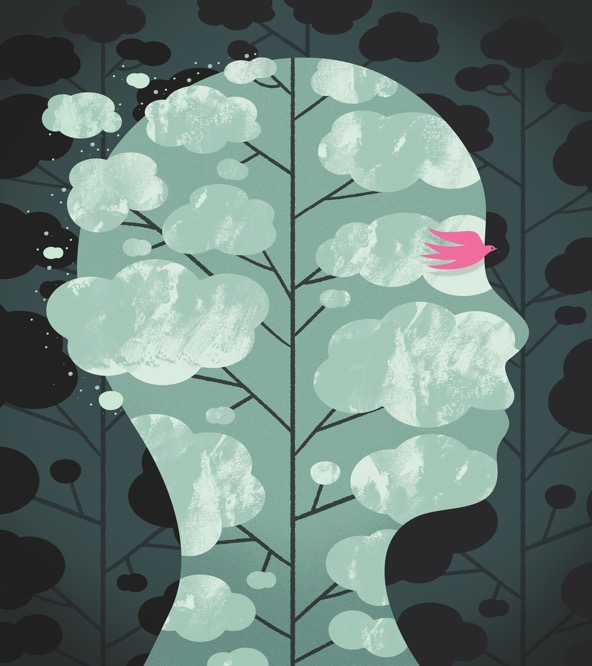
 (Illustration by Vicki Turner)
The irony of the ecological crisis is that unlike the asteroid that ended the reign of the dinosaurs, we are causing it ourselves—which means we can stop it. Why are we finding that so difficult? Perhaps we need to look more deeply at why it has happened in the first place.
The eco-crisis has many dimensions: technological, economic, political, psychological, and more. Is it also a crisis of meaning? Here, “meaning” does not simply refer to having a personal purpose or goal. It also means understanding our place within a larger web of life and the responsibilities that arise from that relationship.
Ecodharma (or ecobuddhism) is an emerging field that applies traditional Buddhist teachings to help us understand and respond to the ecological crisis. Because the various traditions of Asian Buddhism are premodern, none directly address our contemporary predicament. Yet there is a striking parallel between the Buddhist teaching that our ordinary sense of self is an illusion—an inner construct that makes us feel separate from the world around us—and our collective alienation from the rest of the biosphere. This connection raises an intriguing possibility. Is the ecological crisis a collective version of the same dualistic delusion: the conviction that we stand apart from the world?
According to Buddhism, our sense of self is a psychological and social construct that has a basic problem: Because it arises from ever-changing mental and physical processes and has no fixed reality of its own, it is inherently insecure. We often experience this insecurity as a sense of inadequacy or lack: the feeling that something is wrong with me, or that I’m not good enough. Modern consumer societies did not create this insecurity, but they often amplify it, continually encouraging us to seek fulfillment through acquisition, status, and achievement.
In response, we can become preoccupied with what might be called lack projects, pursuits we hope will make us feel more whole, more real. Can such projects provide the ego-self with the grounding it craves? “If only I had enough money, more things … if only I were famous or powerful enough … if only I were more handsome or beautiful … then I would be OK.” From a Buddhist perspective, such preoccupations address only the symptoms. We can never get enough of what we seek because it is not what we truly need. Self-centered lack projects often reinforce the underlying problem—our sense of separation from others—while orienting us toward the future and reducing the present to a means to achieve something later.
The Buddhist response to this predicament involves seeing through the delusion of separateness and realizing our interdependence. Whether or not we approach this insight from a Buddhist perspective, many people recognize what it means to live as though we exist apart from one another and apart from nature, rather than as participants in a web of relationships. This recognition can be cultivated through forms of mindfulness practice. The Japanese Zen master Dōgen Kigen (1200–1253) encouraged “forgetting oneself” by becoming absorbed in meditation, allowing the sense of self to “let go” and revealing that we are not separate from the rest of the living world. This is how Dōgen described his own enlightenment: “I came to realize clearly that mind is no other than mountains and rivers and the great wide earth, the sun, and the moon and the stars.”
Realizing that we are not separate from one another or from the biosphere from which our species evolved has profound implications. When this insight becomes integrated into how we live, it can transform the meaning of life from “What’s in it for me?” to what Buddhism calls the bodhisattva path, which asks instead, “How can I make this a better world for all of us?”
There is an obvious similarity between our individual sense of separation and our collective sense of estrangement from the Earth. Natural selection, the basic mechanism of biological evolution, favors short-term attention on reproduction and survival, not long-term concern for the health of the ecosystems in which we are embedded. Our now-global civilization has amplified this tendency, treating much of the natural world as a collection of resources to exploit, with little regard for the well-being of other species. Sooner or later, a civilization organized this way must confront the limits of the biosphere. Are we at that point now?
Better technologies may be an important part of the solution, but our characteristic reliance on technological salvation is also symptomatic of the larger challenge. Increasing dependence on sophisticated and ever more powerful technologies can further distance us from the natural world and reinforce our sense of separation from it.
Historically, many human societies understood themselves as embedded in nature. Over time, modern civilization came to view the natural world as something outside ourselves—something to manage, extract, and control. As this separation deepened, we increasingly looked to consumerism and continual economic, social, and technological “progress” for fulfillment and security. When societies define success primarily through continual economic growth, consumption, and technological mastery, they risk reinforcing the very assumptions of separation that contribute to ecological decline.
Technology and economic growth are powerful means for accomplishing things, but they cannot answer the fundamental human question of what makes life meaningful. In the absence of a deeper source of meaning, we have increasingly come to equate progress with ever-greater wealth, consumption, and technological achievement.
But what if we understood ourselves as neither separate nor special? What if other species were our siblings and the Earth not merely a temporary home but our collective mother, connected to us by an umbilical cord that is never cut?
Notice again the parallel with our individual predicament. Lacking the grounding that comes from knowing our place and role in the cosmos, we have tried to create our own security by remaking the Earth to serve our purposes, until everything else becomes a “resource” subject to our will. Ironically, this collective lack project has not provided the meaning we seek. Humankind has become more anxious and confused, not less. Seen this way, the ecological crisis reflects not only environmental degradation but also a deeper uncertainty about what prosperity, progress, and a flourishing society are ultimately for.
If this account of our collective situation holds, the solution cannot be to “return to nature,” because we never left it. The biosphere is not merely a place where we happen to live. Our civilization, like our species, has always been an expression of something greater. The air in my lungs, like the water and food that enter my mouth, is part of a larger system that flows through me. Our lives are dissipative processes that depend on and contribute to this never-ending circulation. The same is true collectively. And when we befoul our own nest, there is nowhere else to go.
If our collective alienation from the Earth is the basic problem, what is the solution? That question brings us to a final parallel with our individual predicament. In Buddhism, awakening to our interdependence with the world involves a fundamental shift to a life devoted to helping “others.” Today, the ecological implications are clear: To follow the bodhisattva—or perhaps ecosattva—path is to work for the well-being of the entire biosphere. We can find the meaning and the sense of purpose we seek in the ongoing work of repairing the rupture between us and Mother Earth—a process of healing that will transform us as well.
Buddhism developed long before the ecological crisis, and its traditional texts cannot offer specific guidance about what to do today. Meditative practices may help us work with the grief and despair we sometimes feel. More focused contemplative practices can help us discern where to direct our efforts:
- Given my abilities and circumstances, what do I have to offer?
- What possibilities follow from that?
- Among those possibilities, what am I drawn to? What calls to my heart?
These questions are not only for individuals. For organizations, communities, and policy makers, they invite a similar reflection. Beyond asking how environmental problems can be solved more efficiently, we might also ask how our institutions can cultivate relationships of reciprocity, responsibility, and care with the living systems that sustain us.
In these ways, an ancient spiritual tradition may offer more than personal consolation. It calls us to reconsider the assumptions that shape our economies, our institutions, and our relationship with the Earth. If the ecological crisis is also a crisis of meaning, then healing our relationship with the living world may begin with rediscovering that we have never been separate from it.
Read more stories by David R. Loy.