


 MoringaConnect cofounder Kwami Williams. (Photo courtesy of MoringaConnect and Harambe)
Kwami Williams intended to become a rocket scientist, not a social entrepreneur in West Africa.
But one school trip to Ghana in 2011 upended this plan. The aerospace engineering major at the Massachusetts Institute of Technology (MIT), who even landed a coveted internship with NASA, was inspired to move to his parents’ homeland to help poor farmers in the country’s North.
His mother, who at the time was working two jobs to put herself through nursing school, sobbed uncontrollably when he told her.
“You’ve made it, this is everything we’ve sacrificed for, and you want to let it all go to move back to Ghana and work with farmers!” he remembers her saying through tears. “You don’t even know anything about farming!”
“Rural poverty was a bigger monster than I had ever realized,” Williams says. “Development statistics can be ignored when they are numbers. But when they become the people you spend time with, and eat with, and share life with, they become harder to ignore.”
During his trip, he saw poverty everywhere—in orphanages, in hospitals, and in his own meetings with local polytechnic college students, most of whom subsisted on a single meal per day. But the farmers stayed on his mind the most. Despite being responsible for more than half of Ghana’s GDP, most of them, who live and work in what’s known as the breadbasket of the country, could barely feed their families.
In addition to maize and potatoes, many of the farmers were cultivating a plant Williams had never heard of: the feather-leafed Moringa tree. He learned that aid organizations had told the farmers to plant them because they had staggering nutritional properties—more vitamin C than oranges, more vitamin A than carrots, more calcium than milk, more iron than spinach, and more protein than yogurt. But the funding dried up and the aid organizations abandoned the project, leaving the farmers unable to process the leaves or find buyers.
This story gave Williams the seed of an idea—but pursuing it would mean giving up a lot. “If aerospace engineers can help put a man on the moon, then there has to be something more I can do to put food on the table for the families that I got to meet and fall in love with,” he recalls thinking at the time.
The seed began to bloom when, in 2013, Williams cofounded MoringaConnect with Harvard University-trained economist Emily Cunningham, whom he met through MIT’s D-Lab, a design-thinking center for global poverty research. MoringaConnect is a company that connects Moringa farmers—many from the region he first visited—to a global market for their Moringa-based products. The company has two branches: Minga Foods, which turns the leaves into nutritionally dense powder for tea and energy bars, and True Moringa, which uses cold-pressed Moringa oil from the seeds to create high-end, all-natural beauty products. It also sells Moringa oil and powder in bulk for companies to make their own products.
In 2014, Williams committed fully to his new life and Ghanaian roots by joining the Harambe Entrepreneur Alliance, a network of 304 entrepreneurs from 34 African countries (with significant representation from Nigeria, South Africa, and Kenya) who are determined to lift Africa out of poverty through business for good.
More Than a Network
The gambit has paid off for Williams. Natural-health-and-beauty wholesaler Pharmaca stocks True Moringa, and Whole Foods stores in New England carry its products. MoringaConnect’s next step is to expand sales across Africa. Investors have taken notice, and the company has raised more than $4 million. But profit, he believes, is only half the battle.
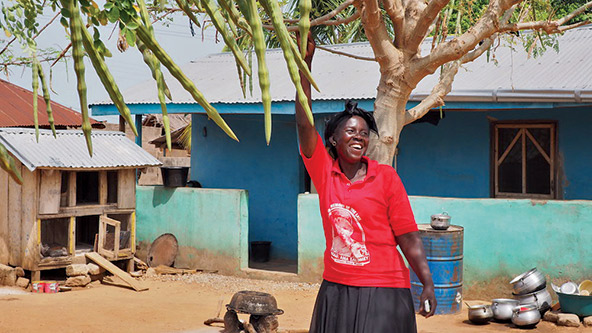 MoringaConnect farmer Akosua Krah stands underneath her Moringa tree. (Photo courtesy of MoringaConnect and Harambe)
“When we started out, I actually didn’t know the phrase ‘social enterprise’ or ‘social venture.’ We just did what felt right—making sure farmers had a part in designing the solution that would impact their lives and their families,” Williams says of his company’s dual agenda. “I think doing good while doing business have been pretty aligned for us from the beginning.”
Williams changed the trajectory of his life because he wanted to help farmers. He chose to make it a business because it seemed like a more effective way to help Ghanaians than the aid industry. MoringaConnect works with more than 5,000 farmers across northern Ghana, guaranteeing them a market and a fair price for their product and also providing services like financial literacy to help them save and invest the money they make from Moringa.
Williams didn’t know it when he launched MoringaConnect, but he was part of a trend sweeping the continent, one that continues today. Thousands of young African entrepreneurs are making a different choice than their parents did: Instead of fleeing the continent’s problems for greener, Western pastures, they are returning (or never leaving) to try to solve these problems—and many of them are hoping to make a buck in the process.
The Harambe Entrepreneur Alliance is trying to amplify this trend by boosting the ideas and ventures of some of the continent’s most talented young people, some of them born and raised in Africa and others who are repatriates, like Williams. Each Harambean, as they are called, is committed to eschewing the opportunities of the West in exchange for a shot at making a difference on the continent, using business as their vehicle.
The vision for Harambe began in 2007 with Okendo Lewis-Gayle, an Italian-Costa Rican student at Southern New Hampshire University (SNHU), who created the alliance as an informal network of entrepreneurs who shared a common set of values: servant leadership, deliberate audacity, and enduring optimism. These values mean each individual is committed to work that helps people, is unafraid to pursue goals others deem unrealistic, and remains optimistic in the face of the daunting challenges of doing business in African countries.
Harambe has grown in prestige and formality. Every two years, the alliance hosts the Harambe Vatican Forum in Rome, where members receive trainings on fundraising, networking, and team building from business leaders and social entrepreneurs—some of whom are Harambeans themselves. The organization also helps connect entrepreneurs to venture capitalists and angel investors who can help them to scale their business. The organization now receives thousands of applications per year from entrepreneurs eager to join the network.
But, as any Harambean will tell you, having access to a robust network is only one aspect of the alliance. Above all, Harambe, and being a Harambean, is an ethos, crystalized in the Harambe Declaration: “We publish and declare our intention to work together as one to unleash the potential of our people and fulfill the dream of our generation.” Written by Lewis-Gayle, it continues, “We will check our road and the nature of our battle, yet in the end, the Africa our generation desires can be won, it exists, it is real, it is possible, it is ours.”
The declaration is signed by every new Harambean admitted each year in a ceremony at the Bretton Woods Symposium, held at the Mount Washington Hotel in Bretton Woods, New Hampshire—the same place where, in 1944, 44 allied nations assembled at the Bretton Woods Conference and created The World Bank and The International Monetary Fund.
“Becoming a Harambean is not about you and your business, and if that is what is driving you, this is not the organization for you. It doesn’t matter how successful your venture is—this isn’t for you,” says Michele Rivard, former director of special initiatives at the United States African Development Foundation and current fellow at Village Capital, who has mentored several Harambeans over the years. “This is about community, it’s about generosity of spirit, it’s about helping if someone calls you, asking for help.”
The organization’s name, a Swahili word often translated as “let’s pull together,” reflects this ethos. In Kenya, where it is the national motto, it’s used as a rallying cry at community fundraisers where everyone chips in to cover otherwise insurmountable bills—whether funeral costs, medical expenses, or tuition for a kid from the village who’s snagged a spot at an elite university.
The network of Harambeans paints an impressive picture of a continent on the rise. Collectively, Harambeans are responsible for creating more than 3,000 jobs, raising more than $400 million in capital, and running companies that are together valued at more than $1 billion. The alliance has received widespread media attention, from The Economist to Vanity Fair to The New York Times. The network has also caught the attention—and dollars—of Silicon Valley powerhouses such as Y Combinator and the Chan Zuckerberg Initiative.
The 2019 class of 20 hails from nine African countries, with degrees from educational institutions around the world, from the University of Nairobi to Yale University. Their entrepreneurial ventures are vast, reaching across industries—including a company that sells locally produced toilets for low-income Ghanaians, an online platform for selling ethically sourced products by African designers, and a loan program that helps Nigerian farmers acquire agricultural assets. One company even makes high-end products for men’s beard care. What unifies the ventures is their founders’ core belief that if Harambeans pull together, their businesses will transform Africa.
Historical Challenges, False Promises
For Harambeans, business is not only a new path forward but a viable solution for a long-troubled continent. Poverty in Africa has stymied aid workers and development economists for decades. The diverse continent is made up of 54 countries, somewhere between 1,000 and 2,000 languages, and a staggering landmass larger than China, India, the United States, and most of Europe combined. It is bound together by the legacy of European colonization that decimated its land and people, rendering it the poorest region in the world. Most African countries, in fact, were not liberated until the 1960s. While poverty in Africa is starting to fall for the first time since 2015, some 88 percent of the world’s poorest are still expected to live on the continent by 2030.
 Harambe founder Okendo Lewis-Gayle speaks to the new class of Harambeans at the 2019 Bretton Woods Symposium. (Photo courtesy of Harambe)
Africa faces interlocking systemic challenges. In total, the continent loses more than $50 billion in illicit financial flows annually (tax evasion and the corrupt practices of multinational corporations being the primary culprits); poor infrastructure means that sub-Saharan Africa has half as much electricity access as the rest of the world; scientists expected the continent to experience the effects of climate change first and most dramatically; and it has more than three times as many youth who enter the job market as jobs created each year.
“If, 20 or 30 years from now, the dream of our generation is not fulfilled and the Africa that we love is not realized,” Lewis-Gayle says, “those who have signed this declaration will have no one but ourselves to blame. The buck stops here.”
Lewis-Gayle is undaunted because he knows that, despite these challenges, business interest in the continent is growing. According to The Brookings Institution, Africa has more than 400 businesses with annual revenues exceeding $1 billion, and these organizations are faster growing and more profitable than their counterparts around the world. On top of that, 6 of the 10 fastest-growing economies in the world are in Africa, and 5 of the 10 most improved countries for business regulation on The World Bank’s 2019 Doing Business index report are in Africa.
Whether that business interest will create social good, however, is another question. Whether the issue is environmental degradation, unequal access to health care, or poor technological infrastructure, the private sector is responsible for many of the problems these entrepreneurs are seeking to solve. Nestlé and Hershey continue to use child labor along the Ivory Coast, Heineken supported the Burundian government, which is likely responsible for war crimes, and Shell Oil Company recently reached a $1.3 billion settlement for using bribery to illegally explore for oil in Nigeria.
Myth-Making Leadership
Born in Costa Rica, Lewis-Gayle moved to Italy as a child and was raised in Rome, “in the shadow of the Colosseum,” as he likes to say, which inspired his early love of the classics. In conversation, he’s quick to point out that he studied Aristotle and Plato in the original Greek.
He compares the 304 Harambeans to the 300 Spartans who nearly defeated the vast Persian army at the Battle of Thermopylae.
In his youth, Lewis-Gayle’s knowledge of Africa was sparse, although he was aware that his family’s origins in Costa Rica were the result of transatlantic slave trade more than 400 years ago, when 25 to 30 million Africans were abducted from their homes and enslaved around the world. This knowledge fueled his conviction that it was black people’s “collective opportunity and responsibility to do something” about Africa’s problems.
Lewis-Gayle’s ambition took him to the United States for college. At SNHU, he worked as a staff writer at the college newspaper and quickly emerged as a leader on campus. A single issue of the newspaper from February 2006 encapsulates Lewis-Gayle’s ambition and frenetic drive toward social change. One article mentions a talk he gave to local high school students on poverty and social activism, as part of a day of service. Another details campus visits he helped organize as part of a Martin Luther King Jr. Day of Action, including those by Rosa Parks’ cousin Deborah Redfern and Martin Luther King III. In an op-ed, Lewis-Gayle announces his intention to run for student body president—an election he went on to win, becoming the first black student president at a largely white school. Also in the Opinion section, Lewis-Gayle details the nonstop, 24-hour drive to New Orleans he made with two other students to patch roofs, staff soup kitchens, and strip homes of moldy carpeting in the months following Hurricane Katrina.
In the midst of all this, the idea of Harambe was born when Lewis-Gayle and Prince Soko, a Zimbabwean and one of the few other black students, organized a fundraiser to send computers to Soko’s mother’s home village to connect his community with the world.
“I really started learning about Africa and its challenges and opportunities,” Lewis-Gayle recalls. “The talent is there and the opportunities are there; all they needed was the change and the right leadership.”
He and Soko started Harambe as an informal network of African students in 2007. One year later, it had 60 members from the country’s top universities.
At his graduation in 2007, Lewis-Gayle shared the commencement stage with then US senator Barack Obama, who had just launched his historic presidential campaign.
“Senator, I, too, was told that the campus of SNHU may just not be ready to elect a president with a funny name like Okendo and the tinge of the skin like my own. Don’t let them stop you,” Lewis-Gayle said to Obama onstage.
In return, Obama told the crowd that he was relieved that Lewis-Gayle wasn’t running for president—yet.
Scrutinizing Foreign Aid
Lewis-Gayle’s pivot toward Africa occurred at the same time a sea change was happening in ideas about foreign aid to the continent. Economist William Russell Easterly’s 2007 book, The White Man’s Burden: Why the West’s Efforts to Aid the Rest Have Done So Much Ill and So Little Good, published the same year that Harambe was created, encapsulated the critique of foreign aid most notably.
The book—named after Rudyard Kipling’s poem that encouraged America’s colonization of the Philippines as a civilizing mission—is a comprehensive attack on a patronizing and ineffectual aid industry. The central question is how could an aid industry responsible for $2.3 trillion in spending still have failed to save the lives of nearly one million African children who died of malaria each year? A mosquito net treated with insecticide, after all, costs less than $5, and, barring that, $2.50 worth of medicine can treat the disease.
Easterly railed against the common exhortation—epitomized by the 1985 Live Aid concert, where musicians ranging from U2 to Joan Baez performed and raised more than $125 million for famine in Ethiopia—that Western charity could eradicate poverty in Africa. Too often, however, money was pumped into ambitious, large-scale projects in Africa before their efficacy was rigorously tested. And that was Easterly’s point: Africa didn’t need more aid—it needed more effective aid.
Williams’ studies of aid’s failures at MIT’s D-Lab changed the way he thought about doing good—namely, he realized that outsider-determined, top-down solutions weren’t the best way to solve Africa’s problems. He cites PlayPumps International, an organization that built merry-go-rounds in rural villages that pumped clean water when children played on them, as an example. The Guardian and PBS Frontline revealed what seemed like a community-conscience intervention—netting $16.4 million from diverse foreign actors such as the US government, the Clinton Foundation, and Jay-Z, who held a benefit concert for PlayPumps—as a hasty venture compromised by oversights and setbacks. Among them were the fact that thousands of pumps lay in disrepair, and that children would have to “play” on the merry-go-rounds for a continuous 27 hours to produce enough water. (In some cases, the women in the villages were tasked with toiling on them for hours to squeeze out water for their families.) After the media’s reports, the funders ended the program.
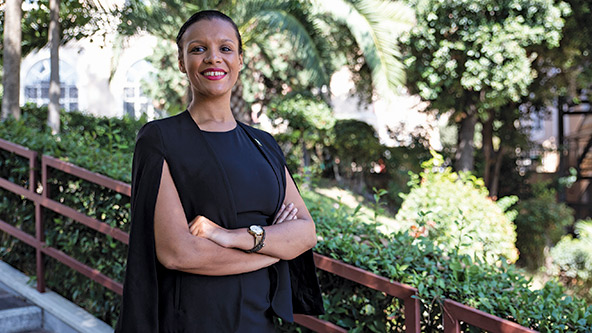 German-Ghanaian Yasmin Kumi
joined the Alliance in 2016. (Photo courtesy of Harambe)
German-Ghanaian Yasmin Kumi
joined the Alliance in 2016. (Photo courtesy of Harambe)
For Williams, the pitfalls of PlayPumps were similar to those of the aid organizations that encouraged farmers to plant Moringa trees and then pulled out when funding ran dry.
“People create technologies that are supposed to save the world, and then they ship those technologies to a place in need, only to find that they are not really what the people themselves want, and that the people actually know a lot more about how to solve their problems than those of us in the Western world,” Williams observes.
In his first attempt to help the farmers after college, Williams used his engineering background to build a machine to extract valuable oil from Moringa seeds. When he delivered the machine to Ghanaian farmers, they stared at him blankly. Without a guaranteed buyer, they couldn’t waste precious time pressing seeds, and without a connection to global markets, they couldn’t incur the financial risk.
For many young people trying to fix Africa’s problems they associate with aid, their solution has been a surprising pivot to the private sector. “I think that for anyone who is an idealist, and certainly I’m an idealist, the aid sector seems like the right place to be,” German-Ghanaian Yasmin Kumi (Harambe ’16) notes. Kumi began her career as an intern at the Bill & Melinda Gates Foundation but quickly found herself frustrated with the aid sector’s inefficiencies. Not only was it staffed predominantly by Americans and Europeans who drew large, often untaxed salaries with generous benefits, but it also didn’t place enough emphasis on transferring the staffers’ skills to local Ghanaians. She then took a job with international consulting firm McKinsey & Company, but after a couple of years she grew tired of helping large, multinational companies steamroll African companies, so she created her own African consultancy for local businesses.
Young African entrepreneurs aren’t the only ones who are moving away from aid and toward the private sector. The money that flows into poor countries from abroad is increasingly for business investments, rather than charity. Researchers at the Center for Global Development recently found that in low-income countries (including 19 in Africa), aid as a share of GDP has declined significantly, while the share of private capital flows has increased. In many African countries, the two now provide about equal amounts of finance.
Investing in Africans
Harambe is now starting to realize its ambitions, thanks to an increasing number of partnerships with American foundations.
Its early years were ad hoc. Harambeans had to pay their own way to the annual conference (something Lewis-Gayle says he still does to reward self-starters), and Lewis-Gayle persuaded the Mount Washington Hotel to cut them a deal and string together grants of a couple thousand dollars from various MBA programs for conference costs.
His relentless networking landed initial opportunities, including summer 2012 grants that GlaxoSmithKline and Pfizer gave to Harambeans studying health care, and grants for Harambeans to do a fully funded master of international business or master of arts in law and diplomacy at Tuft University’s Fletcher School and a master of business administration at Yale University. So far, two Harambeans have received Yale scholarships and three have received Tufts scholarships.
Opportunities like these made the alliance increasingly attractive to entrepreneurs, and, paired with Lewis-Gayle’s popularity, made Harambe an advantageous organization for foundations and corporations by association.
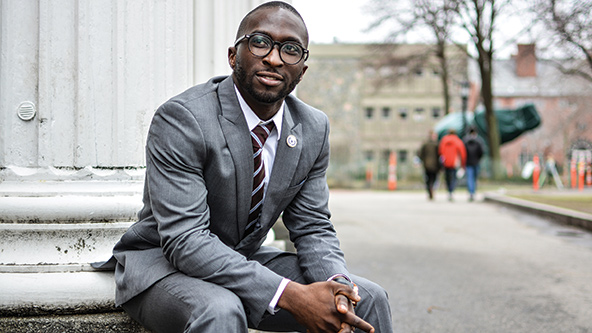 Seni Sulyman, a Nigerian entrepreneur, joined Harambe in 2015. He serves as Andela’s vice president of global operations. (Photo courtesy of Harambe)
“He is so compelling and charismatic,” says Charu Adesnik, the deputy director of the CISCO Foundation, the technology company’s corporate social responsibility arm, which became Harambe’s first formal partner in 2017 with a $5 million grant. “He has a great idea, but he’s also a great storyteller—and he has a great story to tell, and a lot of the success to date is attributable to him.”
It’s a common sentiment.
“I vividly remember the first time I met Okendo, because everyone remembers the first time they meet Okendo—he’s just a force of nature,” says Jeremy Johnson, the CEO of Andela, a company that identifies and trains software developers in Africa and matches them with global companies. “I couldn’t tell at first whether he was an entrepreneur or a preacher, and I soon came to learn that the answer does not have to be either/or,” Johnson adds.
Lewis-Gayle’s knack for identifying talent before other people, however, was what cemented one of the organization’s most important partnerships.
Iyinoluwa Aboyeji applied to Harambe in 2010 with a venture he called Bookneto.com, an online educational platform that Lewis-Gayle describes as “a rickety idea that didn’t work.” Lewis-Gayle, however, believes in investing in people—not their business ideas. Business on the continent is difficult, and he wants to make sure that at the “first hurdle, [entrepreneurs] won’t crumble.” He believes that people’s ability to execute their idea matters more than the idea itself, especially when they are in the early stages of a business, as most Harambeans are. After becoming a Harambean, Aboyeji founded Flutterwave, which helps African companies make and receive international payments, before he cofounded Andela with Johnson.
Andela’s vice president of global operations is another Nigerian entrepreneur, Seni Sulyman, who became a Harambean in 2015. The company’s recent $100 million Series D funding round constitutes a significant portion of the total capital Harambean-founded companies have raised.
Adesnik says Cisco is helping Harambe transform from a “scrappy startup nonprofit to a grown-up and professionalized organization.” This development includes financially supporting the growth of a management team, a board, and fundraising structures.
Beyond Lewis-Gayle’s charisma, social entrepreneurship is a desirable investment for Cisco, which wants to make sure its dollars positively impact as many people’s lives as possible. Investing in entrepreneurs, who theoretically require only startup capital, is a more attractive prospect than constantly shelling out cash to charity.
“What was really appealing to us was this ecosystem that has a multiplying and transformative effect, not just for each Harambean but for their businesses, for the people they employ, for their communities, and for their countries,” Adesnik explains.
Cisco’s grant to Harambe is part of the company’s goal to improve the lives of one billion people by 2025, so it will measure the success of its financial support primarily by whether Harambean businesses improve social indicators—like health, gender equity, and hunger.
A major part of the $2 million Cisco grant will be allocated for the Harambe Prosperity Fund, which launched in 2019. Lewis-Gayle intends to disburse $100,000 investments to 20 Harambeans who have already raised at least $1 million.
The first entrepreneur, Nigerian Ikenna Nzewi (Harambe ’17), cofounded Releaf, an online marketplace that helps connect agribusinesses to customers and that has participated in Y Combinator, an American seed accelerator for early-stage startups. The other is Adetayo Bamiduro (Harambe ’15), who founded MAX.ng, a Nigerian ride-hailing service known as the “Uber for motorcycles,” and announced that his company raised $7 million in funding last summer.
The IDP Foundation, a private nonprofit foundation that focuses on global issues through both grants and investments, got involved soon after Cisco. Its goal is to catalyze the growth of Harambe businesses through increased partnerships, knowledge, and funding. The foundation signed a two-year agreement with Harambe in 2017 to give $100,000 each year to three Harambeans to grow their businesses, as well as to create an entrepreneurs’ institute for Ghanaian junior- and high school students taught by Harambeans. It also committed $100,000 to start the Global Access Program (GAP) to support the travel of Harambeans who have already raised at least half a million dollars to attend conferences, workshops, and meetings with potential funders—a program the IDP Foundation renewed for another year. Williams, for example, says he was able to attend meetings through his GAP fellowship, and that those led to new investments in MoringaConnect.
IDP’s CPO, Allison Rohner Lawshe, says that Harambe is helpful for organizations that don’t have the capacity to ensure that they are making a good investment. “We have a small team, so due diligence, digging deep and understanding, or finding an entrepreneur in Ghana working in technology” are beyond IDP’s current bandwidth, she explains. Harambe provides a credible, accessible network, and Lewis-Gayle’s ability to attract top talent makes investors confident their money will be well spent.
Another goal of IDP is to inspire other donors to get involved with Harambe. That aim came to fruition this year when the Oppenheimer Family Foundation became Harambe’s latest major donor with a multimillion-dollar commitment over the next three years. Harambe will use the money to disburse the Knowledge Transfer Initiative Fellowship, which, like the IDP fellowship, will give select Harambeans funding for travel, as well as a $5,000 stipend.
Lewis-Gayle believes this partnership will act as a pipeline for future Oppenheimer investments. While the businesses receiving the grants are still getting off the ground, if they continue to show promise, Oppenheimer might invest in them directly in the future, with the hope of a financial return.
Doing (Good) Business
Social entrepreneurship is a young field everywhere, but in Africa it’s particularly nascent.
“Most entrepreneurship is still in its infancy across Africa,” Lewis-Gayle explains. “The best practices are not yet on the books. They reside mostly in the people who are doing them, and here at the alliance, we have access to those people.”
He regards the more successful and established Harambeans as resources to grow the network’s reach and impact. Sulyman and Aboyeji, for example, have taught classes at the annual symposium and have mentored Harambeans.
Mentorship is fundamental to the “social” element of social entrepreneurship. “If private-sector companies are going to drive long-term economic development, they need essentially two things to do that rapidly and effectively: They need access to capital, and they need access to the skills and network to learn how to build private-sector companies,” Johnson says.
These two factors mirror a tension inherent in social entrepreneurship, between ethical action for social good and turning a profit. It is a tension expressed in the varying opinions of Harambeans themselves. Sulyman and Aboyeji, for instance, hold a different perspective about whether entrepreneurs should focus on maximizing profit than Williams, who runs MoringaConnect first as a vehicle to get more meals on Ghanaian farmers’ tables.
“Fairly early on, I didn’t really know what entrepreneurship was, but I realized that a lot of the organizations that were fundamentally changing the world were private-sector companies,” Sulyman says. “Some of the best ideas—some of the game-changing products, solutions, and services that could advance human potential or the social and economic conditions in multiple countries—were created by individuals seeking profit.”
Sulyman began his career at Hewlett-Packard, then moved back to Nigeria to head a startup before joining Andela, where much of his view on entrepreneurship was born. He believes that he has a slightly different opinion on the subject than a lot of people—and perhaps other Harambeans—which is that given the levels of poverty in Africa, anyone building a business will inevitably improve poor people’s lives.
“I think by default you’re creating public good: You’re employing people, you’re creating economic mobility for those people, you’re making life easier for your customers, whether they’re businesses or individuals,” he asserts.
In fact, Sulyman finds patronizing the relentless attention on whether or not African entrepreneurs are “doing good.” “Even in business school, you don’t find a lot of people who think about doing business in Africa as a purely commercial venture,” he explains. “We’ve overindexed on that, to the point where the first question people ask you is what the social good [of a business] is, as opposed to what value you are creating for the world, or for the countries you’re operating in, or for the customers you’re serving.”
South African Nneile Nkholise (Harambe ’18) agrees: “We try to drive ourselves so far toward social good that we end up building these kumbaya models,” she says.
Nkholise joined Harambe with the dream of building a business that helped low-income survivors of breast cancer get breast prosthetics after a mastectomy. She changed her plan, however, when she realized she was destined to forever operate at a loss because her niche market couldn’t afford the prosthetics. It’s a reality that can be tough to square for a lot of social entrepreneurs: Often, social good is inherently about helping people who do not have the money to pay for the product. Unless they can cut costs and scale rapidly to a mass market, running a profitable business can be elusive.
Now, Nkholise owns a business that builds products to help professional athletes predict injury risk. She plans to add crowdfunding campaigns for low-income athletes to her business but admits they aren’t the focus. “The very fact that we identified a problem in society and are addressing it is in itself a social good,” she says.
Even companies with a large market can struggle. In September 2019, Andela ended its developer training programs in Nigeria, Kenya, and Uganda—250 developers lost their jobs immediately, and another 170 are at risk of layoffs. Andela is retaining only the Rwanda program because the government is subsidizing it. The culprit is a saturated American job market for junior engineers, causing Andela to focus on more senior engineering positions—unattainable to the thousands of young Africans entering the workforce every year.
Aboyeji is no longer at Andela. He recently stepped down from the company and is spending time with his family in California’s Napa Valley and thinking about what the future of the sector should look like. As one of African entrepreneurship’s brightest stars, he’s thinking about how he can steer it forward.
“A lot of people pretend there’s a big gap, as if making money and doing good in Africa are directly at odds with each other,” he says. “I find that dichotomy false and manufactured.”
Aboyeji is focused on creating an enabling environment for business on the continent, pushing for free trade in Africa and battling with the governments he sees as stifling innovation. One of his sources of inspiration for the change he envisions is David Koch, the recently deceased conservative billionaire who poured millions into right-wing causes, largely through the political advocacy group Americans for Prosperity. Like Koch, Aboyeji believes prosperity through free enterprise is the bedrock of society.
The Prosperity Paradox
The idea that creating markets that target people who will pay for a product is a better way to solve poverty than traditional aid is the “road map” for Harambe. Rather than continuing to focus on aid interventions to help the poor, the organization believes that innovation and entrepreneurship are what will create an enduring path out of poverty. This is the central argument of The Prosperity Paradox: How Innovation Can Lift Nations Out of Poverty, written by Efosa Ojomo (Harambe ’17) and Harvard Business School professors Clayton Christensen and Karen Dillon.
“It may sound counterintuitive,” the coauthors write, but “enduring prosperity for many countries will not come from fixing poverty. It will come from investing in innovations that create new markets within these countries.”
It’s a perspective Ojomo reached after the failure of his own aid project, which he started after hearing stories about poverty in his home country, following eight years of living in the United States.
“I did what I think most or many people do when their heartstrings get tugged by stories of poverty and dying kids: I started an NGO.”
Ojomo raised $10,000 and started building wells in Nigeria—most of which soon broke. His story isn’t unusual. By some estimates, one-third of rural water supply projects in Africa are not working within a few years, representing a lost investment of more than $1.2 billion.
He turned to microloans and then to funding primary-school education, but he wasn’t satisfied with how much money he poured in without getting a return.
“We had to keep begging people for funds, and I was throwing all of it into a system that wasn’t regenerative in any way, and that’s what led me to business school.”
Harvard Business School is where Ojomo met Christensen. The two began studying examples of what they call “market-based innovations” that created long-term growth. One example the book cites is Mo Ibrahim, who was the technical director for British Telecom when he decided to create a mobile telecommunications company for Africa in the late 1990s. When Ibrahim announced his plan to his colleagues, they laughed him out of the room. “Everybody said Africa is a basket case,” he told the authors; they claimed “it’s a dangerous place, it’s full of dictators, it’s full of crazy people … who are all corrupt.”
But, the coauthors write, “instead of seeing just poverty, he saw opportunity.” With very few employees and little financial backing, Ibrahim set about filling in infrastructure gaps himself—building his own roads, using helicopters, and sometimes providing his own power. Six years later, Celtel was operating in thirteen countries and had 5.2 million customers. The authors argue that it was the vanguard for what is now a robust mobile telecommunications industry, today estimated to be worth $214 billion.
The idea that an entrepreneur can make a lot of money by inventing a new product, or a new way of distributing a product, and thereby create jobs and infrastructure and improve people’s daily lives is the thesis behind what Lewis-Gayle believes: Harambeans aren’t just building companies, they’re building nations.
The Harambean Horizon
The ability to spot talent is what Lewis-Gayle believes is Harambe’s “secret sauce.” He sees its future as a kind of African Y Combinator, paired with a three-month grooming process to help entrepreneurs hone their ideas. While the funding helps, it’s the Y Combinator stamp of approval that really makes a difference, by signaling to other investors that an entrepreneur is worth their attention—and money. For investors eager to get involved in an unpredictable and often opaque African startup scene, the Harambe brand is their guiding light.
Signs indicate that Harambean businesses could attract the kind of investments that would make them internationally competitive and put African startups on the map. Breakthrough Energy Coalition, a $1 billion-plus clean-energy fund with private investors like Jeff Bezos, Bill Gates, and Mark Zuckerberg, as well as capital from global corporations, has invested in MAX.ng and sent representatives to the most recent Vatican forum.
Next year, Harambe will host its first Global Summit in South Africa. It will be the alliance’s first major event held on the continent, and it will be open to African entrepreneurs, philanthropists, and investors, in the hope that Harambe can continue to strengthen Africa’s entrepreneurship ecosystem.
But for other investors to get on board and for Harambe to become the leader in African entrepreneurship, the pressure is on Harambean businesses—particularly its Prosperity Fund recipients MAX.ng and Releaf—to start turning a significant profit.
“The question is, can we take Harambe from cute to relevant?” Lewis-Gayle asks.
Like Harambe itself, many Harambean ventures are upstarts with a charming story and a charismatic founder, with varying degrees of early success under their belt. Lewis-Gayle sees this moment as a turning point for the alliance, “the official end of the beginning.”
Now, these ventures will have to prove whether they’re able to compete with billion-dollar companies. The Global Summit will also be a testing ground for whether socially minded startups can make serious cash while still having a positive social impact on a very poor continent. On an international business stage, where relevance is measured in valuation and social impact is considered a bonus, it’s likely to be a Herculean task.
But if it is possible, then Harambeans will be the ones to do it.
This article appeared in the Winter 2020 issue of the magazine with the headline: "Can Harambe Transform Africa?"
Read more stories by Abigail Higgins.