


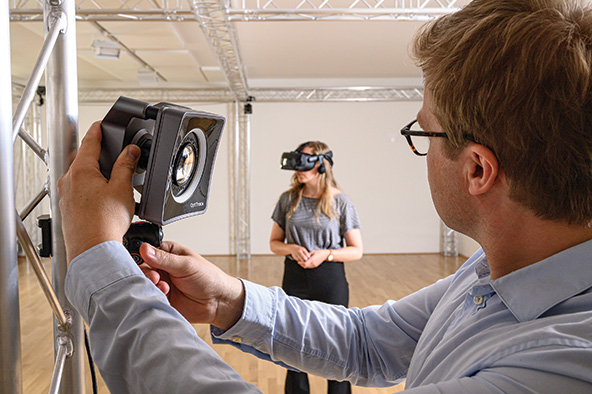
 Doctoral candidate Aniek Siezenga (center) tests out the MAXLab’s VR equipment. (Photo courtesy of MAXLab)
Formerly incarcerated people who try to reintegrate into society are often set up to fail. Recidivism rates around the world are high in no small part due to societal barriers that prevent them from securing jobs, accessing education, and affording housing. Unemployment is the number one factor determining whether someone will commit another offense, and in the United States, nearly 60 percent of formerly incarcerated people are jobless in the months following their release and more than one in four remain so over the long term, according to the US Department of Justice. One Indianapolis-area study, for example, found that only 26 percent of formerly incarcerated people who are employed reoffend compared with 42 percent of those who are unemployed. In addition, many struggle to access stable housing: Formerly incarcerated people are 10 times more likely to be homeless than the average American, according to a 2018 report by the Prison Policy Initiative.
A research lab launched in July 2022 wants to change these statistics. MAXLab Freiburg—the virtual reality (VR) arm of the criminology department at the Max Planck Institute for the Study of Crime, Security, and Law in Freiburg, Germany—is at the forefront of a movement to use VR technology to understand, deter, and prevent crime.
“Crime is a tremendous societal problem,” says Jean-Louis van Gelder, head of the MAXLab and director of the institute’s criminology department. “We’re trying to come up with solutions to reduce it.”
The Max Planck Society for the Advancement of Science—Germany’s premier research network, headquartered in Munich, with a $2 billion annual budget funded almost entirely by state and federal funding—recruited van Gelder to lead Freiburg’s criminology research division in 2019. The institute invested €50,000 (around $50,000) to renovate a space in central Freidburg and outfitted it with computers and VR headsets. The institute’s criminology department employs approximately 25 researchers, including psychologists, sociologists, and one statistician—half of whom are now involved with the MAXLab.
The department is exploring preventive solutions to crime through VR scenarios that invite incarcerated men in the Netherlands to strap on a VR headset to meet their “future self.” According to the early findings, these men self-reported that one week later they were less likely to violate the terms of their probation such as alcohol use, and less likely to reoffend after meeting their future selves. Further, teens who met virtual versions of themselves also self-reported that they were less tempted to cheat on a test. But whether such interventions would make them less likely to commit crimes in the real world remains unknown.
Nudging Behavior
For nearly three decades, scientists around the world have used VR to study behavior—most notably at Stanford University’s own Virtual Human Interaction Lab, founded in 2003. Van Gelder became fascinated with VR in the 1990s, but it wasn’t until he attended a Law and Society Association conference in 2009 that he learned about a study in which people who met age-progressed avatars of their future selves in VR saved more money for retirement than those who hadn’t. Considering these findings, van Gelder posited that the same technology could be used to deter people from committing crimes.
This idea inspired his first FutureU study in 2013, which found that “participants who wrote a letter to their future self were less inclined to make delinquent choices” and that “participants who interacted with a realistic digital version of their future, age-progressed self in a virtual environment were less likely to cheat on a subsequent task.” In his next study, van Gelder’s Virtual Burglary Project placed convicted burglars in the Netherlands into a virtual neighborhood and asked them to explain which houses they’d break into, how, and what they would steal. The study, published in 2017, found that convicted burglars made similar decisions when burglarizing virtual houses as in real life.
In 2019, the Netherlands’ Ministry of Justice invited van Gelder and his team to participate in a project to make neighborhoods more resilient against burglary. They are currently nearing the conclusion of a study—the results are expected next year—in which they recruited 160 convicted burglars, put them in a VR replica of a Dutch neighborhood, and observed whether motion-detecting streetlights that brightened automatically as they approached would deter them from committing a burglary.
In June 2021, the Freiburg team ran an experiment they called the Virtual Bar Fight to test what makes men intervene, or remain bystanders, in incidents of sexual harassment or violence. Researchers rented a bar in Amsterdam and hired actors as bargoers who performed a scene of sexual harassment as well as a confrontation that led to a fight. They then put hundreds of test subjects—mostly Freiburg college students—into that setting in VR to observe how they would react and then asked them to report about their experience. The team is currently analyzing the results, which will likely be published this spring. Next, they’ll run the study with a new set of participants to measure heart rates, eye motion, cortisol, and other metrics in the hopes of learning how likely test subjects are to intervene to stop criminal behavior, report it, ignore it, or even participate in it themselves.
By observing how participants react to criminal behavior in VR, MAXLab hopes to discover ways for people to intervene or stop harassment.
“Traditionally, we think people are rational actors,” explains MAXLab senior researcher Tim Barnum, “but emotions cloud our judgments. Using VR, we can put people into scenarios that are as close to offending as possible, to see if these things affect their decision-making.”
It’s possible, for instance, that an entire bar full of people are witnessing sexual harassment but are hesitant to intervene to stop it. Criminologists call this the bystander effect and have studied this behavior for more than a century, particularly to understand why millions of Germans remained complicit during the Holocaust. Now, by observing how participants react to scenes of harm in VR in their lab, MAXLab hopes to discover ways to nudge people to intervene to stop the harassment or de-escalate a situation.
“If five people are looking and all interpreting the same behavior as harassment, we need to find a way to communicate with each other to intervene,” van Gelder says. “Once you understand the dynamics of when and how people intervene, you can move toward increasing the likelihood that people will do so.”
Deterring Crime
Much of the lab’s research is based upon the psychological principle that the impulse to commit a crime often originates from short-term, as opposed to long-term, thinking—immediate gratification privileged over farther off, less obvious consequences. For example, a person might steal food because they need to eat or they burglarize a house because they have an urge to steal a TV. But no matter the legitimacy, they often make a quick decision, giving limited thought to the long-term trade-offs.
“If I steal now, I have the benefit now, but if I get caught, the consequences manifest later—I go to jail, get kicked out of school,” van Gelder explains. “The FutureU project revolves around the idea that by having an encounter or an interaction with your future self, you’re less likely to engage in self-defeating behavior.” In the results of a recent intervention, published in February, van Gelder’s team “observed a decrease in self-defeating behavior” such as alcohol abuse and overspending among men who had a conversation with their virtual future self in VR to talk about their future life goals. They’re now replicating the experiment in a prison in Pennsylvania. “Imagine if, after 10 VR sessions, you recidivate 10 percent less,” van Gelder says. “That would be huge.”
But is meeting our “future self” enough to persuade us to behave differently in the present?
Aniek Siezenga, a doctoral candidate in criminology working on the FutureU project, noted that a similar study of college students in the Netherlands showed that one week after a session with their virtual selves participants drank less and were less likely to spend beyond their means. The objective of the MAXLab’s FutureU study, Siezenga says, is to discover if and how “people will be more goal-oriented when they are more future-oriented.” While conducting the study in the Netherlands in 2021, Siezenga comments, she “was surprised by how many people [mention] anxiety, self-confidence … 18-, 19-year-olds are sharing these deep worries.”
Some VR interventions are already changing—and possibly saving—lives. In the Netherlands, a government project called “Don’t forget me” is using VR to try to reduce recidivism among domestic abusers by showing convicted offenders the impact that their actions can have on their victims. The program is based on a 2011 study in which a team of researchers placed Spanish men, who had been convicted of domestic violence, into a VR scenario in a woman’s body to witness aggressive behavior from her perspective. The rationale for this virtual gender swap, the authors wrote, was that “men who have perpetrated [intimate partner violence] have difficulties in taking the perspective of their children or the victims.” As a result of this VR effect, the study found, several men who previously failed to correctly interpret the fear in their partner’s face were able to do so, which might make them less likely to commit future assault.
Spain’s government is now putting that research into practice. As part of their probation, offenders are placed into VR scenarios in which children are present. They then witness the precursors to violence in VR through the children’s eyes. By shifting their perspective, researchers hope to determine whether such an experience could reduce the likelihood that the person will commit abuse in the future.
It is important to note that interventions like the one with domestic abusers in Spain or MAXLab’s virtual bar fight are based on the belief that VR can help increase our empathy toward others. However, this may not be the case. A 2021 meta-analysis of 43 VR studies found that “VR can arouse compassionate feelings but does not appear to encourage users to imagine other peoples’ perspectives.”
Improving You
VR is also being applied to improve health outcomes. In the United States, VR therapy is already helping military veterans overcome post-traumatic stress disorder (PTSD) and may soon be used to rehabilitate stroke patients. And medical experts are considering how it can be useful for combating attention deficit hyperactivity disorder (ADHD) and autism.
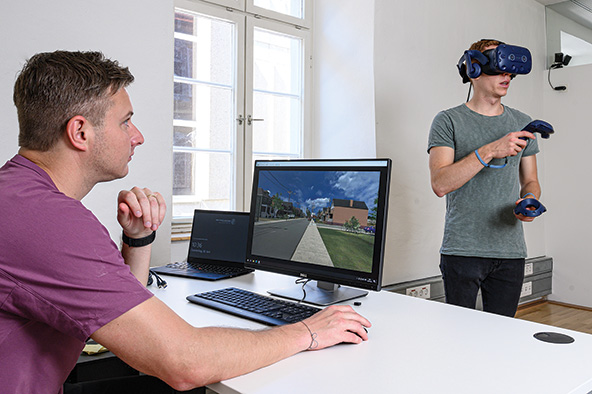 Senior researcher Tim
Barnum (left) is involved
in the lab’s Virtual Bar
Fight studies. (Photo courtesy of MAXLab)
Senior researcher Tim
Barnum (left) is involved
in the lab’s Virtual Bar
Fight studies. (Photo courtesy of MAXLab)
For Maggie Webb, a visiting researcher at the MAXLab working on the FutureU project, one of the biggest benefits of VR may be in alleviating depression and preventing suicide.
“One part of depression is it can be difficult to think about the future,” Webb says. “Virtual reality could sort of create that—activate that ability to think about the future.”
She’s currently designing a trial in which adolescents with depression use VR to meet their future selves at a future positive moment in their lives, such as at their high school or college graduation, or while on vacation. By “having that positive experience in a vivid, real way where they can interact with themselves and see their future self experiencing that positive outcome,” Webb says, people may be spurred to think about the life experiences that they’d miss out on if they were not alive.
Webb imagines a future in which your next visit to a psychologist’s office might involve a VR conversation with your future self. It’s even possible that such experiences could be integrated into daily life. For example, video gamers—who are already well immersed in augmented worlds—might experience a VR segment on suicide prevention in lieu of an advertisement. Such experiences might even be integrated into the games they already play.
Therapists have long used exposure therapy to help people overcome phobias like fear of heights or of spiders by exposing them to these things in safe, controlled, low-dose environments. But “VR can be used as a supplement or substitute for going with your therapist in real life to experience things they’re afraid of,” Webb explains. “With VR you can stand right on the edge of a building. It allows you to have that really scary stance without actually having to go and do it.”
From this work, Webb wants to then examine whether the insights of the MAX-Lab could be used to improve mental health and reduce recidivism among young people behind bars in the United States, who are about four times as likely to have mental health disorders as youth who are free.
“At ages 18-24, your brain is still developing, especially the regions relating to self-reflection. And that’s a prime age range for being in prison in the United States,” Webb observes. By putting young offenders in VR to meet and speak with virtual versions of their future selves, Webb hopes to decondition the mindset of short-term thinking and to help people make better long-term decisions.
Systemic and Ethical Concerns
While VR seems like a promising tool for improving mental health, its usefulness for predicting and preventing crime is still largely unknown. Likewise, its application to crime and the minds of criminals has been subject to debate.
Throughout its 150-year history, criminology—the study of who commits crimes and why—has faced controversy due to its reductive focus on an individual’s decisions as the cause of criminality. The field has also been slow to recognize how society creates “crime” and “criminals” through structural inequality and racism—and, in a more literal sense, by writing the laws that define what constitutes a crime and how to punish it.
To study whether people can be induced to behave unethically, American criminologists in the 1960s and ’70s devised elaborate—and sometimes sensational—sets in which to observe the dynamics of obedience, or how people can be induced into doing extraordinary or even unethical things. The most famous were Stanley Milgram’s 1963 obedience experiment, in which participants were persuaded to administer electric shocks to others, and Philip Zimbardo’s Stanford Prison Experiment, in which participants assigned the role of prison guards abused the prisoners. (In 2018, the Zimbardo study was debunked as fraudulent and unethical.)
“Virtual reality is not only about re-creating the real world,” van Gelder says. “It’s also about creating a different world.”
In 2006, a team of psychologists in London re-created the Milgram experiment by implementing a virtual electric shock to test men in their 20s and 30s. The team found that participants—who did not know that neither the trainee nor the shocks were real—showed similar levels of distress as had the participants in the 1963 experiment. Therefore, they concluded, if other VR studies turn out to be equally accurate replicas of in-person ones, it would “reopen the door” to an array of experiments that wouldn’t be possible to conduct in the real world.
Critics worry that today’s criminologists are merely applying a new technology—VR—to the questions that they’ve never really answered, and perhaps never will.
“There’s a drive to link personality traits to criminal behavior, and VR might be the new tool to ask some old questions,” says Daniel Harley, a VR ethics professor at the University of Waterloo. “But the new tool is always going to be insufficient if we’re not also considering structural events that go beyond the individual: effects of systemic racism, colonialism, or structural inequality.”
In fact, VR may even distract us from tackling systemic issues such as greater police oversight, prison reform, institutional racism, and disparities in access to social safety nets like health care and housing. “The danger is that it makes it seem like the problem is with the individual and the solution is with the technology,” Harley adds.
Harley argues that VR is unlikely to fix the underlying causes of discrimination in the justice system. A system set up to criminalize and incarcerate certain categories of people deemed “deviant” or who display “deviant” tendencies is unlikely to keep a man with a prior conviction from stealing again if he has no safety net—a job, stable housing, and food. The problem arises if “we’re not also considering structural effects that go beyond the individual—effects of systemic racism,” he says.
Against these odds, the biggest challenge facing MAXLab researchers and other VR criminologists will be to demonstrate that VR can incentivize individuals in ways that lead to a reduction in crime. By using VR, criminologists are trying to overcome the challenge of not being present when crime happens.
The “true power” of virtual reality, van Gelder says, “is you can stage credible events in safe and ethical ways.” He adds that all the lab’s studies are reviewed by an ethics commission at the Max Planck Society to ensure that the lab’s VR interventions don’t put participants at risk of trauma, PTSD, or other negative psychological effects.
Yet, other VR interventions have raised ethical concerns, such as those that placed jurors into virtual versions of crime scenes to witness crime scenes for themselves rather than relying on notoriously unreliable witness testimony or on juror memory. A 2021 study found that when participants were placed in virtual crime scenes, they were better at remembering where items and evidence were located than jurors who had to rely on photographic evidence. Some defense lawyers worry that placing jurors in a VR crime scene may give them the incorrect feeling that they’re experiencing all the inputs that factored into the defendant’s mind. In reality, they might be missing integral contextual clues—not just smells and sounds that may have put them on edge but even fear stemming from a prior negative interaction with police.
“VR and AR [augmented reality] will present challenging issues for the law,” legal scholars Mark Lemley and Eugene Volokh write in a 2018 article for the University of Pennsylvania Law Review. “The visceral nature of VR will challenge the lines the law draws between physical presence and remoteness, between conduct and speech, and between physical and psychological harm.”
But these are precisely the lines that van Gelder and his team at the MAXLab are exploring as part of their mission to discover new ways in which VR can be harnessed as a tool for social good.
“Virtual reality is not only about re-creating the real world,” van Gelder says. “It’s also about creating a different world.”
Read more stories by Jacob Kushner.