


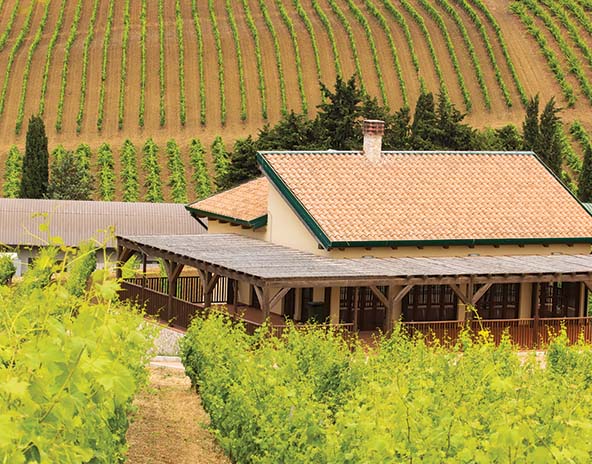
 Former Mafia-controlled land in San Cipirello is used for a wine vineyard planted by Placido Rizzotto. (Photo courtesy of Giorgio Salvatori)
The Mafia has had a stranglehold on southern Italy since the country’s unification in 1861, when the northern Kingdom of Sardinia annexed the rest of the states but the weak presence of the newly formed monarchy in the south allowed the Mafia to thrive.
It wasn’t until the 1980s that an anti-Mafia movement emerged in response to the Mafia’s pervasive violence—between 1978 and 1983 alone they were responsible for more than a thousand murders in Italy. Pio La Torre, a trade unionist and Sicilian politician, believed that the Italian government had to confiscate the Mafia’s wealth and properties to eradicate their power. A major reason why the Mafia was so powerful was that they created enterprises, from construction companies to farms, that offered jobs in exchange for loyalty, entrapping locals through clientelism. According to La Torre, if their physical and financial territorial presence were undermined, their hold on the people would weaken, too.
In 1982, the Sicilian Mafia, known as the Cosa Nostra (“Our Thing”), murdered La Torre after he proposed a law in parliament to fight organized crime. The parliament responded by approving the first legislation—the Rognoni-La Torre Law—that classified Mafia-related crimes as felonies and imposed the seizure of the Mafia’s assets.
Yet, seized properties laid abandoned in the hands of a highly bureaucratic state that was unable to manage them. The flourishing enterprises run by the Mafia that gave work to entire communities became neglected government-confiscated businesses—which, in some cases, continued to be operated (“unofficially”) by the Mafia.
“To really weaken the bosses, both economically and symbolically, it was necessary for the fruit of their dirty business to return to the community ... so that society as a whole benefited directly from that restitution,” says Don Pio Luigi Ciotti, a 75-year-old priest based in Turin, Italy. In 1995, Ciotti founded Libera, a nonprofit network of associations and social cooperatives fighting to delegitimize and disempower the Mafia.
In 1995, Libera gathered nearly a million signatures in support of a law to confiscate the Mafia’s assets and reallocate them to the affected communities in the form of public goods such as schools and social services. One year later, the government passed Law 109/96. Today, thanks to this law, more than 2,000 projects are based on confiscated lands, a tenth of which are cooperatives.
The Sicilian Cooperative Placido Rizzotto is one of those organizations that with Libera’s support have cultivated the reclaimed land using only organic agricultural methods. Founded in 2001, the cooperative employs women, migrants, and vulnerable teenagers who might have found themselves in the clutches of organized crime and provides them a brighter future. Since 2008, Placido Rizzotto has united with eight other cooperatives to sell their products—from pasta to wine—throughout Italy, under the Libera Terra (“Freed Lands”) brand.
“From that moment, many young people found a real, clean job that respected their fundamental rights,” Ciotti says. He believes a cultural revolution has occurred in these former Mafia territories. “The common good has triumphed over criminal selfishness, and the courage and determination of young people has swept away decades of silence and resignation.”
Building Cooperatives
National enthusiasm greeted Placido Rizzotto. Yet, hard work lay ahead. The 15 associates chosen by the Consortium for Development and Legality, the prefecture of Palermo and Libera, were not sufficiently trained by the government to manage the 156 hectares (385 acres) of the confiscated lands, some of which were owned by Totò Riina, one of the most ruthless Mafia bosses of all time, in Corleone, Palermo, Sicily—the stronghold of Cosa Nostra.
According to Gianluca Faraone, one of the associates, they had to learn how to harvest, prune, and sell crops to make the farm profitable, and they governed the cooperative by trial and error. “At that stage, there was a good deal of recklessness,” he admits.
Placido Rizzotto’s current president, Francesco Paolo Citarda, acknowledges that his cooperative experienced difficulties specific to being the first of its kind, including resistance from Mafia-loyal residents.
“The local community showed great skepticism toward our work with the Mafia-seized assets and toward the cooperative system in general,” Citarda recalls. He adds that Sicilian cooperatives were not self-sufficient and existed only to drain public funds.
However, crucial support came from a network of cooperatives from the northern Italian region of Emilia-Romagna. Unipol helped with insurance policies; the organic farmers corporation Alce Nero with product distribution; and others with financial, technical, and administrative support. From this support, Libera Terra became financially self-sufficient and competitive.
In 2003, Carlo Barbieri, then the commercial director of Coop supermarkets, began distributing Placido Rizzotto’s products—such as tomato sauce, lentils, and pasta—to stores throughout Italy, selling nearly half a million euros of product that first year.
“I immediately decided that they deserved support because it was one of the initiatives to combat the Mafia in the territories where they had originated,” Barbieri says. “It seemed to be a beautiful example of positive change for these territories.”
The Coop’s financial return from the product sales was negligible, but they gained, according to Barbieri, “credibility with our customers, because we were helping an important cause. People bought the products because they believed in the project, too.”
Soon support to Placido Rizzotto from other cooperatives and private enterprises increased so much that, in 2005, they formed Cooperare con Libera Terra. This association pooled all the technical support and knowledge that was being shared, so as to be useful to other future social cooperatives as well. In fact, today, about 70 partners offer expertise to the 9 social cooperatives gathered under the Libera Terra brand and support them financially as funding members.
Rita Ghedini, president of Cooperare con Libera Terra, says that the members of her association decided to participate in the project to take a stand against the Mafia. “What was a defensive action turned out to be a generator of new wealth, not only economical but truly transformational,” Ghedini explains. “The experience of Libera Terra is evocative in our country because it brought change to organized crime.”
Adversity and Backlash
Libera Terra has employed hundreds of disadvantaged people, paid them fair wages, and taught them skills to help them grow professionally. Theirs is a success story, according to Valentina Fiore, vice president of Placido Rizzotto.
However, things were not easy, especially in the early days. According to Ciotti, the Mafia hindered Libera Terra’s work because they knew that such an initiative would strip them of their wealth and power. Violence and intimidation took several forms: Mafiosi obstructed the transfer of assets, even destroying them—for example, by burning olive groves and wheat fields—and they intimidated the associates who managed the land.
The Mafia threatened people who considered lending their wheat harvesters to the cooperative. “In July 2002, during the first wheat harvest, there was not a combine harvester in the whole Corleonese countryside to be found,” Ciotti notes. Eventually, the police, following orders of the prefect of Palermo, intervened and seized a local business’s tractor for the cooperative’s use.
Despite these threats, associates and volunteers were not deterred. “Over the years,” Ciotti says, “there have been fires and boycotts of all kinds. But we have always responded to the threats by strengthening our cooperative, thanks to the encouragement, esteem, affection, and the active help of many.”
Libera Terra cooperatives also struggled upon entering the food-market industry. According to Citarda, their products in the early years were mediocre in quality and were purchased only by people who opposed the Mafia. The quality of their products—and, eventually, sales—improved after extensive product research and development and the creation of a Libera Terra brand.
Because the assigned confiscated lands contained vineyards, the associates began making their wine. In 2009, they built a winery in San Cipirello in the Upper Belice Corleonese using governmental funds and called it Centopassi.
“We don’t want to sell what we are, but what we do,” Citarda says. Placido Rizzotto is now competitive in the wine business, a tricky proposition where quality—not social cause—drives sales in Italy. Because the confiscated lands are decentralized, the Libera Terra’s winery totals 70 hectares of confiscated vineyards from all around Sicily. Today, Centopassi produces 11 wines and sells about 500,000 bottles per year.
Between 2001 and 2014, Libera Terra expanded the number of cooperatives from one to nine—throughout Sicily, Calabria, Campania, and Puglia—consisting of approximately 1,400 hectares of total confiscated lands and employing more than 170 people. In 2008, the cooperatives founded Libera Terra Mediterraneo, a nonprofit consortium that coinvests in the means of production to more efficiently use the land and to sell their products under one label. It didn’t make sense to open several wineries, pasta factories, or storage units—sharing infrastructure was more profitable. Today, the Libera Terra brand sells about 90 products and has a combined revenue of €7 million ($7.69 million).
In the last decade, they structured operations within the single cooperative and consolidated food productions and sales. Such organization helped them sustain business during the devastating economic impact of the COVID-19 pandemic. Thanks to their online sales platform and a diversified portfolio of products, their food sales increased by nearly 3 percent in both 2020 and 2021.
In the future, Fiore plans to invest all of Libera Terra’s profits in the land, physical and digital infrastructures, and human labor. She also believes it will be necessary to establish a solidarity fund to help their farmers cope with the agricultural effects of climate change.
Still, there is much work to be done. According to the federal Agenzia Nazionale per i Beni Confiscati (ANBSC), there are approximately 5,000 Mafia-confiscated properties throughout Italy still not reassigned. Ciotti hopes that those assets will soon be reclaimed by their respective communities.
“The restorative power of projects like Libera Terra is enormous,” Ciotti says. “They are worth investing in.”
Read more stories by Agostino Petroni.