


Various contraptions fill a cluttered lab in Sunnyvale, Calif. On one side, there’s a large blue incubator filled with flasks. On the center table, brine shrimp swim in circles inside a large cylindrical tank. In the back, a bioreactor tosses and turns a whitish brothlike substance, which becomes increasingly dense. These apparatuses drive the research of NovoNutrients, a startup that seeks to turn carbon dioxide (CO2) into food and feed.
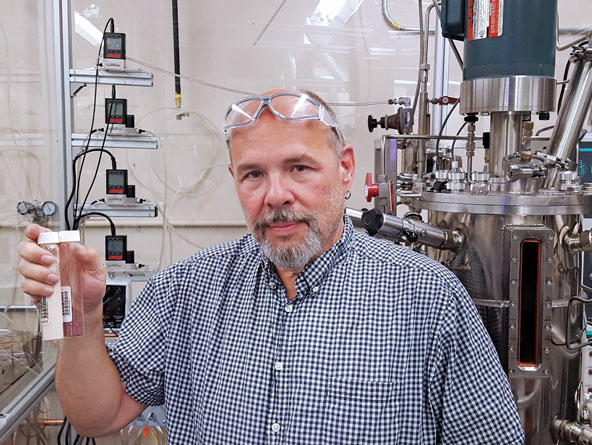 NovoNutrients founder and Chief
Technology Officer Brian Sefton holds vials of the feed products in the Sunnyvale, California, lab. (Photo courtesy of NovoNutrients)
NovoNutrients founder and Chief
Technology Officer Brian Sefton holds vials of the feed products in the Sunnyvale, California, lab. (Photo courtesy of NovoNutrients)
As catches from wild-capture fisheries level off and demand from the emerging global middle class increases, fish farms are projected to produce two-thirds of the world’s fish supply by 2030.
For that reason, there’s a large demand for fish feed, says Heyward Robinson, NovoNutrients’ vice president of corporate development. Current fish meal products are made with anchovies, capelins, or other fish closer to the bottom of the food chain, which contributes to overfishing. Additionally, the supply of these fish is sensitive to climate patterns such as El Niño. In recent years, this has resulted in shortages and price volatility for fish farmers.
“To meet the growing needs of the growing aquaculture market, we’re going to need new sources of feed that don’t rely on the wild capture of fish,” says Monica Jain, founder and director of Fish 2.0, a competition for sustainable seafood and aquaculture startups. “Solutions like NovoNutrients that are able to create fish feed and other products without taking seafood out of the ocean— they’re going to be required for us to grow our seafood supply to what’s needed to feed the world’s growing population.”
Finding more sustainable ways to feed farmed fish is critical, Robinson says. That’s where CO2 comes into play.
“There’s a big push in the aquaculture industry to find these alternate proteins to fish meal,” he says. NovoNutrients’ technology has the potential to convert millions of tons of CO2 waste into such products. The company is developing Novomeal, a high-protein fish feed alternative, as well as Novoceuticals, which are feed additives.
Plants create food from CO2; this fish feed works similarly. The company captures the greenhouse gas from smokestacks, targeting industrial sources such as cement, bioethanol, iron, and steel production plants. All gas emissions, including sulfur and carbon dioxide, are captured in pipes that directly connect industrial plants to an on-site bioreactor. Heavy metals such as mercury aren’t used, but plenty of industrial CO2 streams do not contain these materials.
NovoNutrients then uses a microbial fermentation process whereby the bacteria go through the Calvin cycle—the same chemical process used by plants—to convert CO2 and other gas molecules to food. Instead of using sunlight, these bacteria use hydrogen.
While other companies create fish feed from bacteria, NovoNutrients’ process is unique, using multiple strains of bacteria, which allow the different microbes to work together to convert CO2 into food.
“Plants have been doing this for millions of years,” Robinson says. “Microbes have been doing it for longer. We’re just taking ancient, billion-year-old technology and bringing it to industrial scale.” The magic happens inside the bioreactor, a large metal cylinder with protruding pipes. Bacteria process the CO2, and then NovoNutrients dries the microbial meal. “People have been looking at these bacterial proteins as protein sources,” says CEO David Tze, who has a background in aquaculture investing. “It’s only recently that with the economics and the global situation, it actually makes sense to produce protein this way.”
Tze takes out two small plastic cylinders of powder. One is the whitish prototype of the feed. The other is a reddishmaroon powder, a prototype of the feed additive. “It’s kind of like dried dog food and cat food,” Tze says. “Some of the ingredients are there to provide fat, and some are to provide protein.”
While CO2 is a problem gas, it’s also an untapped economic resource, Robinson says. “We have the potential to put a meaningful dent in the amount of CO2 emitted and put that to good use.”
Right now, NovoNutrients is continuing to develop its products. Jain, of Fish 2.0, believes NovoNutrients’ idea is promising but says that until the completion of their pilot, questions remain about scalability and whether customers and regulators will accept the product.
The company hopes to sell feed to smaller-volume companies and hatcheries by 2022 and move toward larger companies two to three years after that.
“We view this as a new dawn for the way protein gets produced,” Robinson says. “The more fish in the sea, the better for everyone.”
Read more stories by Rosalie Chan.