


Cheers and laughter filled the room on October 24, 2012, as a boisterous crowd of people from Washington, D.C.’s nonprofit and social enterprise scene descended on 9th Street, in the city’s trendy Shaw neighborhood. It was opening night for Cause, the first “philanthropub” to open in the nation’s capital, and supporters had every reason to be enthusiastic. Cause promised patrons an opportunity to be philanthropic while doing what they might have been doing anyway—going out for dinner and drinks. The new business had a simple, appealing model: It would operate in much the same way as a traditional restaurant and bar, but it would donate its profits to vetted social purpose organizations.
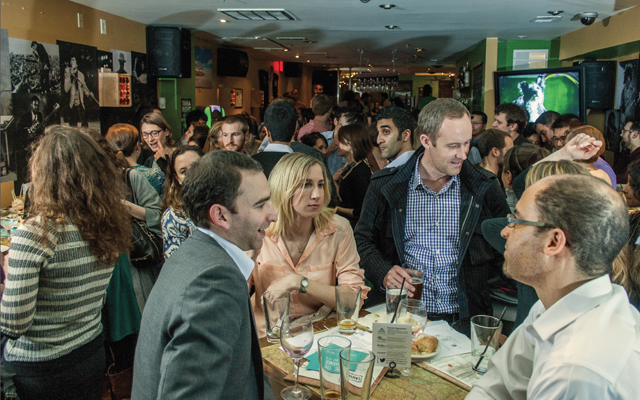 Patrons crowd into the upstairs bar at Cause in early 2013, soon after the restaurant opened for business. (Photo courtesy of Nick Vilelle)
The opening of Cause arrived with a great deal of anticipation. The new venture received early press coverage from Washingtonian Magazine, Washington City Paper, and Bloomberg Businessweek, among other publications. (Stanford Social Innovation Review, in fact, covered the establishment in its fall 2013 issue.) It also had a prime location, and it enjoyed the support of experienced restaurateurs—two important advantages for any effort to survive in Washington’s fiercely competitive restaurant scene. So the founders of Cause, Nick Vilelle and Raj Ratwani, had ample grounds for optimism.
Yet a mere 14 months later, Vilelle and Ratwani would shut down Cause. By then, the high expectations of that first night were long forgotten. The difficulties of managing the business had mounted, leaving customers and employees frustrated and the founders exhausted. What happened? Why did Cause—an icon of the Washington social enterprise scene—fail? Were there challenges unique to a social purpose business that might have contributed to its closure? What lessons can other social entrepreneurs glean from its brief history?
Practitioners in the social enterprise realm should not shy away from failure. On the contrary, they should embrace it. They should accept the fact that failure is always a possibility, and they should heed the lessons that failure can teach them. “Failure is obviously really hard,” Ratwani says. “But when you’re trying something very different like [Cause], you just have to be ready to take risks.” Those who believe in the principles of social enterprise, we believe, need to apply rigorous analysis to episodes such as the rise and fall of Cause. Only by doing so can they develop and refine best practices for this field. What follows, then, is an attempt to help aspiring social entrepreneurs to understand—and, we hope, to overcome—the challenges that they will inevitably face.
Start-Up
The inspiration for Cause grew out of a conversation that took place over a couple of beers. Vilelle and Ratwani were old college friends. One night in 2006, they were catching up after Vilelle’s return to Washington from Peace Corps service in Togo. Ratwani mentioned that he’d always had an interest in social issues but found that, as a working professional, he rarely had any time to dedicate to the causes that he cared about. As he chatted with Vilelle, he posed a question: What if people could make small contributions to worthy organizations just by engaging in routine activities—by going out for a burger and a beer, for example? He brought up the idea of starting a bar that would give some of its proceeds to social purpose organizations. Vilelle quickly became enthusiastic about the idea. Such an arrangement, he noted, would be a great boon for cash-strapped nonprofits.
Over the next few years, Vilelle and Ratwani pursued their respective careers. Vilelle worked as a consultant for international development organizations, and Ratwani was a medical research scientist. Meanwhile, they continued to entertain their idea—their vision for opening a philanthropub. The philanthropub model, Ratwani explains, “really fit with one of our big goals, which was to reach the particular demographic that goes to bars and restaurants. We very much wanted to hit a younger demographic that tends not to have a lot of money to donate yet is interested in social issues.” By 2011, he and Vilelle were ready to make that vision real.
From the start (and until the very end), Cause stayed remarkably true to the value proposition laid out during that first conversation between Vilelle and Ratwani: Cause would make an impact by enabling people to give to charity through an everyday activity; at the same time, it would provide much-needed funds to nonprofits. Each quarter, according to the initial plan, Cause would choose four organizations and distribute that quarter’s profits to those groups. In addition, Cause would help raise awareness of social purpose organizations and would serve as a community space where people could engage with issues of local and global scope.
Strategy
Vilelle and Ratwani spent the following year working to develop their business plan. Along the way, they made several pivotal strategic decisions. The first decision was to collaborate with professionals from the restaurant industry and to delegate restaurant-related functions to those partners. “It was never our goal to be an integral part of the day-to-day operations,” Vilelle notes. He and Ratwani, for their part, would formulate the overall direction of the venture and would take charge of working with nonprofit organizations. “We recognized that we had no restaurant experience, and we knew that to launch this idea, we would need really great partners [who had that] experience.”
Through friends, Vilelle and Ratwani connected with John Jarecki and Dave Pressley, two men who had operated successful restaurants—including the Light Horse, Vermilion, and Rustico—in Alexandria, Va., just outside of Washington. Jarecki agreed to manage Cause’s operations while continuing to oversee the operations of his own restaurants. (He even recruited an experienced staff member from one of those restaurants to become Cause’s general manager.) In addition, Jarecki recruited Adam Stein, the executive chef at Light Horse, to oversee the kitchen at Cause and to create its menu. Stein served in that capacity at both locations, and the two restaurants split the cost of his salary evenly. This arrangement not only brought high-level restaurateur expertise to Cause but also allowed Cause to maintain a manageable start-up budget. “The model,” Vilelle says, “was to find people with expertise who bought into the vision of what we were trying to create and let them do their thing.”
A second key decision was to incorporate Cause as a for-profit company. Vilelle and Ratwani decided against applying for nonprofit status. Because the primary function of Cause was to serve food, not to carry out charitable activities directly, qualifying for tax-exempt status would have been difficult. Even if the founders had structured Cause as a nonprofit, moreover, its food and alcohol revenue would likely have been subject to taxation as unrelated business income. For-profit status also gave Cause greater flexibility in donating funds to organizations (such as other social enterprises) that might not be nonprofits or to international NGOs that do not have US tax-exempt status.1 “The decision was around operational and logistical issues, and not a philosophical debate,” Ratwani says. Vilelle concurs: “We felt that it didn’t really matter at the end of the day, as long as we were transparent in what we were doing.” (He and Ratwani had resolved, for example, to publish quarterly financial statements for their business.)
That choice of legal structure contrasts with the choice made by another philanthropub. The Oregon Public House, a nonprofit restaurant and bar in Portland, Ore., opened in May 2013. Its operating model involves giving away all of its net profit—that is, its revenue after expenses—to other nonprofit organizations. In that respect, the model resembles the one that Cause adopted. Unlike Cause, the Oregon Public House is still in business. In its first year, it donated more than $25,000 to groups and causes. (Various factors may account for its relative success. Its leaders, for example, were able to draw on about $50,000 in grant funding to provide start-up capital.)
Finance
Equally important were decisions that Vilelle and Ratwani made about the financial structure of Cause. They adopted a bootstrapping approach that aligned with an assumption that was built into their model: Overhead costs should remain as low as possible in order to maximize the profits that the restaurant could give away. Toward that end, they vowed not to take a salary from Cause until the business had attained regular profitability. (Both of them would keep their day jobs throughout the life span of Cause.)
Another crucial decision was to build the restaurant—and then to run it—on a lean budget with limited start-up capital. Vilelle and Ratwani opted to remain the sole owners of Cause, and they supplied the majority of its capital by taking out a $100,000 business loan. That sum was far less than the industry average: Comparable new restaurant ventures typically raise two to three times as much capital before they launch, and the restaurant industry standard for reserves calls for keeping six months’ worth of payroll and expenses on hand.2
Cause raised additional funds through a campaign on the crowdfunding site Indiegogo. In the campaign, Vilelle and Ratwani raised $23,576 from the general public by offering prizes and incentives, such as T-shirts, bar stools engraved with donors’ names, and the chance to have a beer at Cause. The Indiegogo campaign not only brought in capital but also helped to cultivate customer loyalty before Cause even opened. “Early on, we didn’t see a huge need to look for outside investors,” Ratwani says. “We did fundraising, and we put in a fair amount of capital ourselves, so it wasn’t critically important for us to find outside capital.”
Vilelle and Ratwani also set up a separate legal entity, Cause Properties, which purchased the building on 9th Street where the restaurant would be housed for $930,000. They bought the property from an existing restaurant—a move that helped them save thousands of dollars in build-out costs. They then rented the space to Cause at about 20 percent below market rate, thereby allowing the restaurant to lower its overhead costs.3 In addition, Cause was able to leverage various pro bono services (carpentry and construction, graphic design, legal consulting) from supporters in the Washington area.
Even as they took these steps to operate Cause in a lean fashion, the founders were aware of the overwhelming odds against them: At least 60 percent of new restaurants fail, and most full-service restaurants take at least a year to get out of the red.4 All the same, Vilelle and Ratwani were confident that their social value proposition—their ability to generate free publicity by capitalizing on trends such as “conscious consumerism”—would provide them with a foundation for success. For the first year of their venture, they projected revenues of $1.2 million, a profit margin of 10 percent to 20 percent, and an overall profit of $100,000.5 (According to one local food industry expert, restaurants rarely make any profit in their first year, and a first-year profit margin of up to 20 percent would be a rare and difficult achievement.6) “People wanted it to work,” Vilelle recalls, and that sentiment “probably contributed to hopes that we were going to beat industry standards in terms of turning a profit.”
Setback
In one sense, Cause did well in its first quarter. Its reported financials indicated that the restaurant generated $220,000 in revenue and had a loss of about $8,000.7 For an ordinary restaurant, these results would be seen as promising—as a sign that the business had real potential. But for Cause, that loss presented a problem. If there were no profits in the first quarter, how would the organization be able to make donations to nonprofits? If it gave away no money, would it be violating its promise to customers and to people in the nonprofit community? (“We should have been smarter about our projections,” Vilelle says. “We were putting ourselves in a pretty tough position.”) In an effort to keep that promise, Ratwani and Vilelle decided to donate a small amount of cash to selected organizations ($8,445 in total) and to count sponsored events and other in-kind contributions as a form of charitable giving.
That move signaled a deeper problem with the founder’s underlying strategy. For Cause, the pursuit of a core mission was not an intrinsic feature of its business; it was a byproduct of its success. If its mission had centered on promoting the local organic food market or on employing at-risk young people, for example, then the mission would have been built into its operations. In that case, Cause would have achieved social impact just by staying open for business. Ultimately, of course, any social enterprise needs to succeed financially in order to have an enduring impact. But because of the way that Vilelle and Ratwani had structured their social benefit model, Cause not only had to succeed, it had to succeed quickly.
This problem also made another strategic problem harder to overcome. The founders’ decision not to solicit capital from outside investors had locked Cause into a lean operating mode. As a consequence, it was largely unable to engage in capacity-building efforts—a substantial marketing campaign, for instance, or an investment in hiring top-tier restaurant management. Similarly, the obligation to direct any profits toward charitable donations would prevent Vilelle and Ratwani from reinvesting those profits in the enterprise. “Raj and I probably should have been more aware of just how tough it was going to be for us to generate the revenues that we would need, given the amount of start-up capital that we had,” Vilelle acknowledges.
Management
Internal organizational challenges soon began to compound the challenges related to Cause’s mission-based strategy. Gaps emerged between the restaurant’s visionary founders and those who came on board to execute their vision.
The decision to work with restaurant experts like Jarecki and to employ experienced restaurateurs to run operations at Cause worked well initially. The experts, like the founders, put in a great deal of work for the organization and received no compensation for their efforts. But that arrangement was not sustainable, and Vilelle and Ratwani came to rely too heavily on the goodwill of people who were donating their time. They developed expectations about managerial roles and operational philosophy that differed from those of the professional restaurateurs. “One of the big challenges was ensuring that the complete management team understood the [lean] model, and I think that was an area where we failed,” Ratwani says. As a consequence, the restaurant professionals began to shift their priorities away from Cause.
Relations with members of Cause’s kitchen and wait staff deteriorated as well. In the early days of the venture, Vilelle and Ratwani assisted with the staff hiring process. They screened applicants to find employees who were passionate about the mission of Cause and who would help to create a unified and friendly team. “When we started, we did a good job, I think, of conveying to the staff what we were attempting to do, and we had a really motivated staff,” Ratwani says. But over time the glow of running a restaurant went away, and the founders became more and more disconnected from operations. Staff members would go weeks without seeing Vilelle or Ratwani, and over time they came to feel overworked and underappreciated.
Early financial challenges, Vilelle acknowledges, put additional pressure on a staff that was already “spread unbelievably thin.” Employees, meanwhile, noted that customers who attended events hosted by nonprofits often spent very little money and required a lot of time and effort to serve—a situation that proved to be especially frustrating for staff members who depended on tips to generate a decent income. Morale plummeted, and the quality of customer service declined with it.
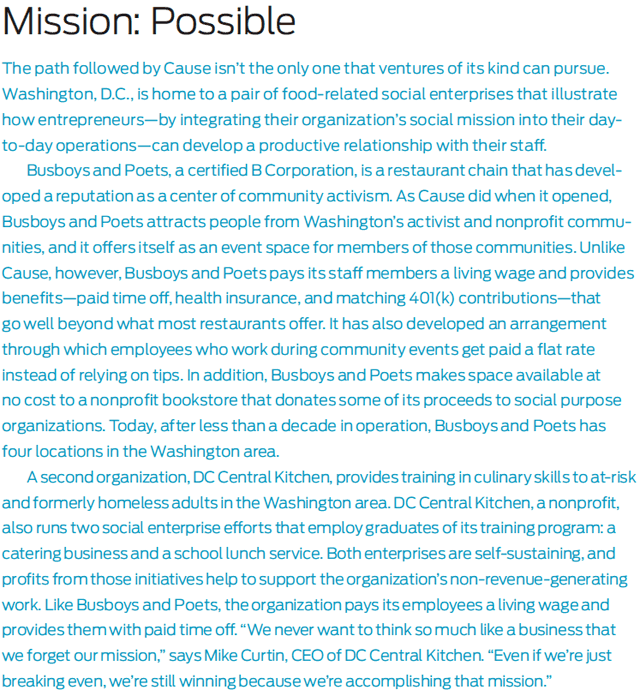
The leaders of Cause failed to make the restaurant’s mission a central component of its organizational culture. One benefit of running a mission-driven organization is that it can tap into the pro-social motivation of its employees. In a work setting, pro-social motivation—the desire to help other people or to contribute to a social cause—can generate positive outcomes such as personal initiative and organizational commitment. Yet in their relationship with staff members, the founders and managers of Cause made little effort to leverage its mission in that way. (See “Mission: Possible” above.)
Marketing
Vilelle and Ratwani envisioned a bar in which customers would be able to determine their own level of engagement with its social mission. “We knew that the concept alone would get people there once,” Ratwani explains. “But to establish a customer base and to get repeat customers, you have to have a product that they like and an environment that they’re comfortable in.” Cause, the founders believed, should be a place where you could walk in off the street without knowing anything about the bar and still have a great experience. The mission of Cause would be part of its identity, but the mission wouldn’t define that identity. Vilelle and Ratwani, in short, were clear about the type of bar that Cause would not be. But what type of bar would it be?
Over its 14-month life span, the establishment adopted a diverse array of identities: It was a community space, a sports bar, a brunch spot, a comedy club, a venue for live music, a happy-hour destination, a place to engage in board games and trivia contests, and more. “As we saw that we weren’t getting the revenue that we anticipated, we started to try lots of different methods to increase business,” says Ratwani. Testing various promotions and looking for new ways to bring people into the bar were necessary moves for the Cause team. But experimenting with so many different food and entertainment offerings led to the emergence of an indistinct brand image. As a result, Cause never stuck in customers’ minds as anything other than “a bar with a mission”—which is exactly the identity that its founders had wanted to avoid.
No less important than having a strong brand identity is having a clear understanding of who one’s customers are. Cause leaders, in effect, sought to target three distinct market segments: young professionals who didn’t have time to focus on social causes but who did have disposable income that they spent at bars and restaurants; members of the NGO community in Washington; and local bar-goers or restaurant patrons. The lack of a clearly identified primary market and a tendency to blur the lines between those market segments reinforced the sense that Cause leaders were pursuing a haphazard branding strategy.
In particular, Cause failed to attract a significant local clientele, and its inability to adapt to the needs of that customer segment strongly affected its core business. Cause became a destination spot—a great place to go once, or for a special occasion—but for most patrons, it never became a place to go regularly. “We didn’t succeed in getting a regular crowd,” Vilelle says. “We did fairly well during the week but were falling short on the weekends.” For that reason, the venture consistently struggled to develop the kind of customer base on which most restaurants depend.8
The founders of Cause also overestimated how much members of their primary target market would be willing to spend. “We came to realize that members of the nonprofit community—the first people to fall in love with Cause—weren’t exactly what you’d call big spenders. And who can blame them? Making $35,000 a year and living in DC isn’t easy,” Vilelle noted later.9 Consequently, the restaurant failed not only to get enough people in the door but also to generate enough revenue once customers had arrived.
Cause leaders faltered in their relations with another crucial customer segment: nonprofits, NGOs, and other community organizations. Aligning with those groups was central to the founders’ vision. Yet restaurant managers struggled to articulate a clear policy on using the Cause facility for sponsored events. Some customers assumed that Cause, given its social mission, would make its space freely available to worthy organizations. In one case, the representative of a prominent social enterprise group—an organization that had been an early ally of Cause—got into a dispute with Cause managers after they insisted that the group had to meet a minimum spending requirement for an event. The Cause model, after all, required the venture to generate steady revenue from its operations. The way that Cause pursued that goal, however, confused and alienated would-be supporters of the business.
Crisis
Perhaps the most telling example of Cause leaders’ misunderstanding of their target market came in the summer of 2013. The air-conditioning unit in the restaurant was malfunctioning. In a city known for its hot and humid climate, that was no small problem. At this point, Cause still had not achieved profitability and was dipping into its already limited cash reserves to stay afloat. The restaurant’s leaders needed a solution, and they needed it quick. Vilelle and Ratwani had successfully tapped into community support to help the restaurant open, and they thought they could do so again. They set up another crowdfunding campaign on Indiegogo, offering coupons for food and drink (redeemable once Cause re-opened) in exchange for donations. This time, however, the crowdfunding led to a backlash. The local blog DCist labeled the request a “bailout.”10 One nonprofit leader, who had supported Cause earlier, recalls losing faith in the venture: “I saw the first campaign as an investment in building capacity and was happy to support it. But the second campaign seemed to indicate, ‘Okay, the infrastructure is falling apart.’ At a certain point, it’s a question of whether the place can be sustainable on its own.”
The crisis that summer had a more direct impact on the frontline staff of Cause. While working to solve the air-conditioning problem, the restaurant’s managers shut down the establishment for nearly a month. Vilelle and Ratwani informed employees of the closure via email several days beforehand. For Cause staff members, it was another example of ineffective communication. Effectively forced into unemployment with less than a week’s notice, most of them decided to quit. Comments about Cause from the period before the closure tell a story of overworked staff members who were inattentive to customers: “I love the charity aspect of Cause, but that’s no excuse for a major failure of customer service. I’ll go back to cooler, friendlier venues and give a little more to charities of my choice,” one Yelp reviewer wrote in August 2013.11
Cause reopened in September 2013 with a crew of new employees and a new general manager, but by then the damage to its reputation had been done. Two months later, it closed for good. It had survived for 14 months—which is roughly the typical life span of a failed restaurant in Washington. Successful restaurants, in fact, usually take much longer to achieve long-term stability and profitability. Industry experts might argue that Cause was on a normal track but simply didn’t last long enough to realize its potential. But for Vilelle and Ratwani, it was too late. The temporary closure of Cause, together with the subsequent resignation of most of its employees, had dealt a powerful blow to their enthusiasm for the project. “We could continue to put money in, but ultimately we didn’t see a path forward,” Ratwani says.
Legacy
Cause started as a D.C. do-gooders’ dream, a space where people could contribute to important social causes just by sitting down and enjoying a meal together. But a little more than a year after its launch, the positive energy and good intentions that gave rise to the venture had all but drained away. Despite initial support from the local and national media, from the nonprofit and social enterprise communities, and from many neighborhood residents, Cause officially shut its doors in December 2013. In a message posted at the Cause website and on its Facebook page, Vilelle and Ratwani wrote: “It is with deep sadness that we report that CAUSE has closed for business. … Despite a great response from people around the country, CAUSE has not been able to achieve regular profitability, and thus not been able to generate the donations that were the reason for starting the restaurant.”12
The biggest misstep that Vilelle and Ratwani made was to assume that their mission would sustain them. In fact, they made this assumption explicit in that closing Facebook message: “We knew going in that it was a very difficult industry, but we hoped that the mission behind CAUSE would help carry us to success.”13 Today, the founders of Cause readily note the limitations of that perspective. “You’ve got to put the warm-and-fuzzy side away and make sure that the nuts and bolts are in place, or else you’ll just never achieve the impact that you’re going for,” Vilelle says. To thrive as a social entrepreneur, he adds, one must invest emotionally in the work itself: “One of the more personal lessons that I took away from Cause is the need to be passionate about whatever is it that you’re doing. I was really passionate about the model and about the mission, but bars and restaurants are not an area of passion for me. If you don’t want to be doing the nitty-gritty everyday [tasks of your business], then it’s probably not going to work, or it’s less likely to work.”
Back in 2011, at Cause’s opening celebration, Jarecki had recalled his initial reaction when Ratwani approached him with his and Vilelle’s idea about launching a restaurant and bar: “I said, ‘Well, what experience do you have?’ And he said, ‘None.’ So I said, ‘Do me a favor, take what money you had for opening this bar, and flush it down the toilet. You’ll thank me in five years.’” 14 It may be true that Vilelle and Ratwani would have been better off had they decided not to start Cause: They took a huge personal risk, and it didn’t pay off.
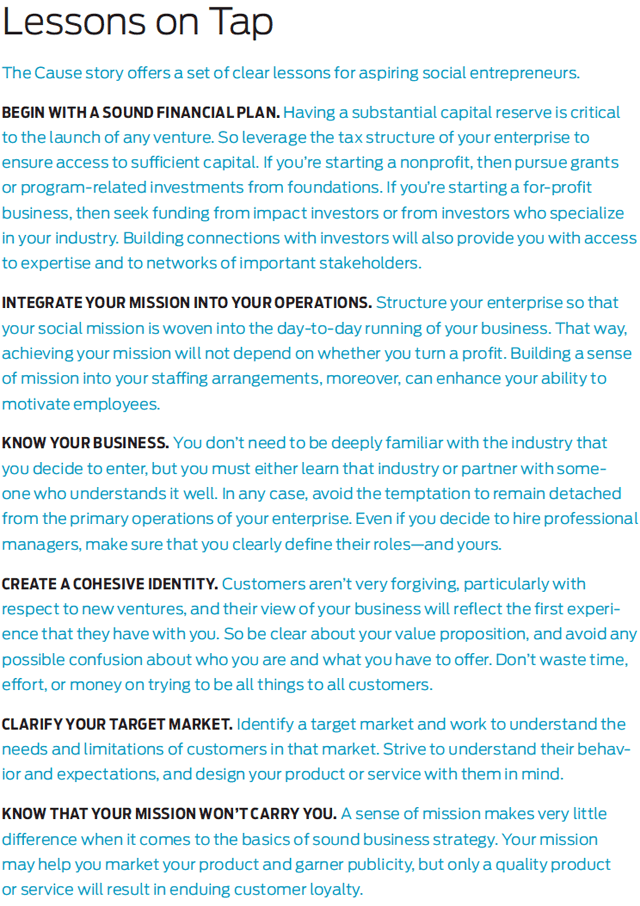
And yet, for the social enterprise field, the story of Cause and its failure leaves behind something of genuine value. It provides a compelling illustration of several principles that social entrepreneurs should keep in mind as they organize their own efforts. (See “Lessons on Tap” above.) Indeed, the next time that a group of social entrepreneurs get together to brainstorm over a few beers, they’ll be able to draw on those principles as they plot their new venture.
Read more stories by Michael Cobb, Caitlin Rosser, Andreas Vailakis & Robert Tomasko.