


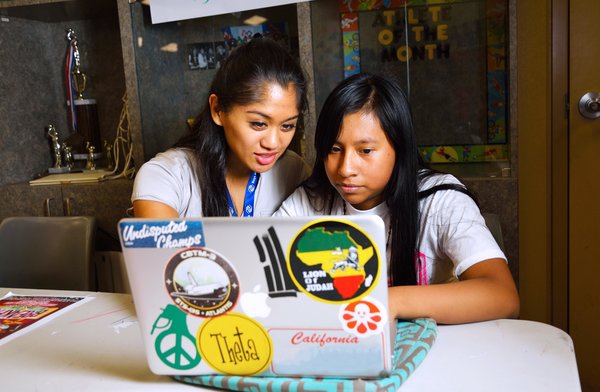
 The director of the Boys and Girls Club of Menlo Park, Calif., mentors a high school student. (Photograph by David Cruz, courtesy of The Boys and Girls Clubs of the Peninsula)
On a late winter afternoon, the sun is going down quickly on a working-class neighborhood south of San Francisco. School is out, and it’s getting chilly. But instead of cozying up to the TV, dozens of students are clustered around computers at a clubhouse of the Boys & Girls Clubs of the Peninsula. With furrowed brows, they’re fiddling with elementary code, editing video, and adjusting the sound on some R&B tracks.
It would be easy to simply assume that after-school programs such as these are beneficial—and indeed, data collected from students by the Clubs’ two-person evaluation team show an overall positive impact. But that’s not enough for Peter Fortenbaugh, the Clubs’ executive director. “I’m a huge believer in the importance of using data to inform good decision-making,” he says. “We capture a ton of data, but it’s not as good as it could be.”
So when Fortenbaugh heard about Listen for Good, a program that funds US nonprofits to ask the people they serve to weigh in on their programs, he jumped at the chance to participate. A project of the Fund for Shared Insight, Listen for Good offers nonprofits $60,000 each—$40,000 from Shared Insight and $20,000 from one of the nonprofit’s existing funders—to administer a standardized survey to a large swath of their clients.
This spring, the Boys & Girls Clubs of the Peninsula received one of the first 19 grants, along with Habitat for Humanity Greater San Francisco, artworxLA, Neighborhood Housing Services of Chicago, the Regional Food Bank of Oklahoma, and a range of others. The Fund for Shared Insight announced 13 more grantees at the end of March and plans to select about 20 more this year.
Listen for Good is “building upon interest that’s latent in the field,” says Fay Twersky, director of the William and Flora Hewlett Foundation’s effective philanthropy group. Twersky cochairs Shared Insight, a consortium of foundations that aims to improve philanthropy. “We’re trying to inspire nonprofits and funders to really listen more systematically, more consistently and curiously to the voices of the people that they help,” she says.
It’s a promising move, says Phil Buchanan, president of the Center for Effective Philanthropy. Foundations “don’t have a lot of naturally occurring feedback loops, so they tend to be surrounded by people who tell them what they want to hear,” Buchanan says. “The more thoughtful foundation leaders recognized that this was not a good thing, because it got in the way of getting the information they needed to be more effective.”
Although the Boys & Girls Clubs of the Peninsula already collect feedback from their students and staff, participating in Listen for Good will provide new perspective, Fortenbaugh says, because all the initiative’s grantees will use the same Net Promoter survey.
This survey, which asks a series of questions about client satisfaction and loyalty via the online questionnaire site SurveyMonkey, is traditionally used by for-profit businesses to measure their relationship with customers. This spring, Listen for Good will become the first to employ the tool on a large scale in the nonprofit world, says Valerie Threlfall, Listen for Good’s project leader. Using a standardized tool will allow Shared Insight to build a dataset of responses that other nonprofits then can use as benchmarks to assess their own impact in similar areas (such as after-school programs). Each organization will also be allowed to add a few customized questions of its own.
Threfall says the project has two goals. The first, of course, is to assess the quality of clients’ experience with a nonprofit’s programs. “Second, it’s the potential to ask if they’re starting to feel some of the things that will be predictive of longer-term success in the program,” she says. “There’s not a whole lot of literature across all fields that links people’s nonprofit customer perceptions to their longer-term outcomes.”
Buchanan is optimistic that Listen for Good can help draw more of those connections. “It’s an interesting and exciting experiment to see if something can be done that is more standardized and comparative than the many, kind of highly specialized, one-off efforts today,” he says.
This article has been modified since its initial publication. The text around a quotation by Phil Buchanan has been changed to clarify that it was foundations that he said “don’t have a lot of naturally occurring feedback loops.”
Read more stories by Kristine Wong.