


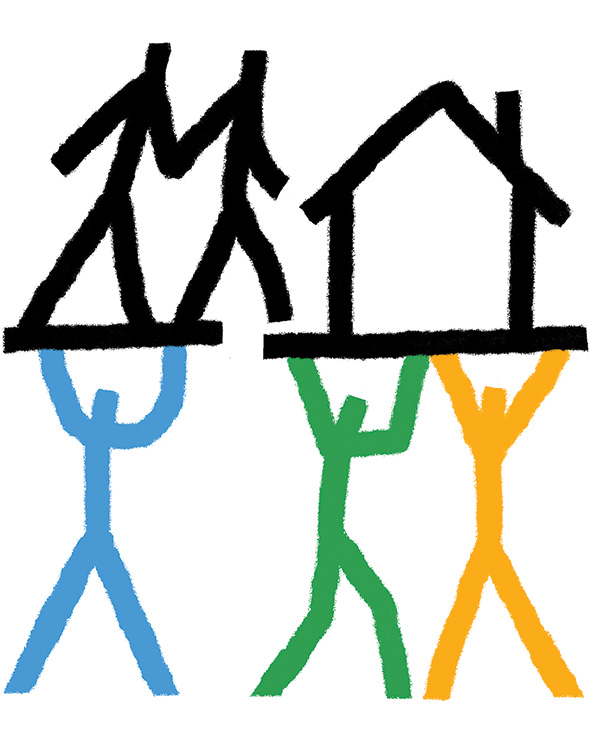
 (Illustration by Ben Hickey)
Our national homelessness crisis is the result of entrenched systemic failures that have deep impacts across our society. Yet, in most communities, no one formally owns responsibility for these failures and addressing their root causes.
For years, we saw this lack of accountability at play in Silicon Valley: Local jurisdictions worked in silos, service providers lacked funding, and the whole ecosystem lacked leadership.
But in 2008, at a blue-ribbon commission chaired by then-San Jose Mayor Chuck Reed and then-Santa Clara County Supervisor Don Gage, local leaders agreed that the best way to end homelessness was to partner together. The commission sparked the creation of Destination: Home, a new public-private partnership charged with bringing our community together. We mobilized a diverse set of stakeholders using a collective-impact model—a framework for sustained collaboration on a social challenge by which participants commit to a common set of strategies, shared data, and metrics to track impact. With Destination: Home serving as the backbone—the organization that coordinates and manages the collective effort—our model brought together for the first time the county of Santa Clara, the city of San Jose, the Santa Clara County Housing Authority, housing developers, business leaders, nonprofits, and people with lived experience of homelessness.
In 2011, the first pilot was launched, an effort to house 1,000 of our county’s most vulnerable residents. We were able to use a blend of existing and newly created public resources to launch the first collective effort of our ongoing partnership.
By 2015, more than 200 stakeholders had come together to create the first countywide five-year Community Plan to End Homelessness (since updated in 2020). This blueprint established clear goals, metrics, and accountability standards across the region and paved the way for a shared infrastructure of open, frequent communication that leveraged each party’s strengths. That same year, we released “Home Not Found,” the largest and most comprehensive study on the costs of homelessness ever conducted. The report analyzed the variety of cost drivers associated with living on the streets and the cost efficacy of a home.
With partners aligned behind a common strategy, the county of Santa Clara proposed and secured approval for a $950 million affordable housing bond (Measure A) that earmarked more than 70 percent of the funds for housing that targets homelessness—units affordable to those with 30 percent of the area median income or less—and that includes on-site supportive services. This critical first step has spawned 50 new developments with 5,000 affordable units (and counting).
We’ve also piloted new strategies to address the homeless crisis, including the launch of a Homelessness Prevention System that has grown to serve nearly 2,000 households each year and successfully helps keep 95 percent of families served from falling into homelessness with immediate cash aid, legal support, case management, and connection to other social services.
Over the years, we have also secured significant support from the private sector. Thanks to a landmark $50 million donation from Cisco in 2018—at the time, the largest corporate philanthropic contribution ever made to address homelessness in the United States—a subsequent $50 million contribution from Apple, and the support of dozens of other private sector funders, roughly $300 million in flexible, private funding has been raised and deployed to scale the housing strategies mentioned above as well as many other key strategies that fill gaps in addressing our homelessness crisis.
Altogether, our community has collectively helped well over 25,000 people exit homelessness. In recent years, we’ve seen our biannual point-in-time homelessness counts level off—and even begin to decrease. What’s more, we’ve largely done this without any significant increases in federal funding. And while every community is different, we believe that others looking to solve homelessness or similarly intractable challenges can find similar success by embracing a collective-impact model.
Elements of Our Success
Forming a solid, sustained collective-impact model is extremely hard work, and it doesn’t happen overnight. Here in Silicon Valley, our coalition came together over more than a decade. A number of elements were critical to our success, especially our style of partnership and commitment to power sharing.
Sustained partnership requires working to build common ground among diverse stakeholders, creating shared goals, as well as collective systems and infrastructure. Take, for example, our work building more permanent supportive and extremely low-income (ELI) housing. Even after the adoption of the $950 million Measure A housing bond in 2016, we needed the help of many other partners to get projects built. We started by launching a concerted strategy to engage more than a dozen jurisdictions in Santa Clara County. Through countless conversations over many years, we were able to secure buy-in from several cities that agreed to provide local funding and/or land to support new developments.
Ending and preventing homelessness is painstaking work, requiring system-wide coordination, shared funding, and trust.
The city of San Jose went one step further in allocating 45 percent of its affordable housing dollars to ELI and supportive housing development (amounting to hundreds of millions of dollars). In addition, the Santa Clara County Housing Authority not only agreed to the same 45 percent ELI policy, but also allocated thousands of its housing vouchers to supportive housing units—providing a source of ongoing revenue critical to making projects successful.
At the same time, our growing cohort of public partners convened affordable housing developers and service providers—groups that are essential to building and operating these new projects. For some, it was an easy sell; others had reservations. But by providing capacity-building support, technical assistance, and practical training to help these groups fully engage in the effort, we successfully brought dozens of developers and service providers on board.
Finally, we integrated the private sector. With the buy-in of corporate partners like Cisco and Apple, Destination: Home is able to deploy flexible private dollars to fill gaps and accelerate progress on our core pillars of housing production and homelessness prevention efforts. This flexibility includes providing early financing to help nonprofit developers secure and prepare sites (before government funding becomes available), offering grants to help our nonprofit partners increase capacity to take on more projects, and even paying for a dedicated planner in the city of San Jose to expedite project review.
These intentional efforts to align a wide array of partners behind this common goal not only was instrumental to building the housing we need to end homelessness but also set the foundation for further collaboration.
Power Sharing
Power sharing is a revolutionary act that can initially scare potential stakeholders. But with a collective-impact model, it can win their confidence and succeed over the long term.
First, it requires individual leaders to put aside their egos for the sake of the greater good. In our coalition, we’ve had leaders who recognized that we could accomplish more by working together—and as a result, we’ve built structures and processes for shared decision-making and committed to following them.
Second, it requires including those who have been historically denied access, including people with lived experience. We took our first step in 2018 when Destination: Home supported the creation of the Lived Experience Advisory Board of Silicon Valley (LEABsv) to provide input into our collective efforts to address homelessness. In the years that followed, the county’s Continuum of Care (CoC) Governance Board, the city of San Jose’s Housing Commission, and Destination: Home’s board of directors and staff have added seats specifically reserved for people with lived experience. Our efforts directly involve such individuals in major aspects of our homelessness response: designing interim housing sites, evaluating the system of care, dictating funding, and advocating for policy changes, all of which help ensure that we are meeting the needs of those we serve and maximizing our impact.
And finally, it requires traditional partners who are used to holding power to be willing to share it. In particular, donor and grantee relationships are often fraught with uneven power dynamics. The organizations that control the money too often dictate the needs and desires of these partnerships. In 2018, Cisco took a different approach. For one, they made their catalytic $50 million grant unrestricted, allowing this funding to be used in the true spirit of a public-private partnership. They also connected Destination: Home with other major donors, bringing us to corporate tables for the first time.
Put together, these forms of power sharing have truly helped catapult our ability to reshape the supportive housing system in Silicon Valley. Ending and preventing homelessness is painstaking work, requiring system-wide coordination, shared funding, and, most of all, trust. But with a commitment to build a common agenda together—focusing on partnership and power sharing—we collectively can make more progress toward ending homelessness than any one entity was achieving on its own.
Read more stories by Jennifer Loving & Ben Spero.