


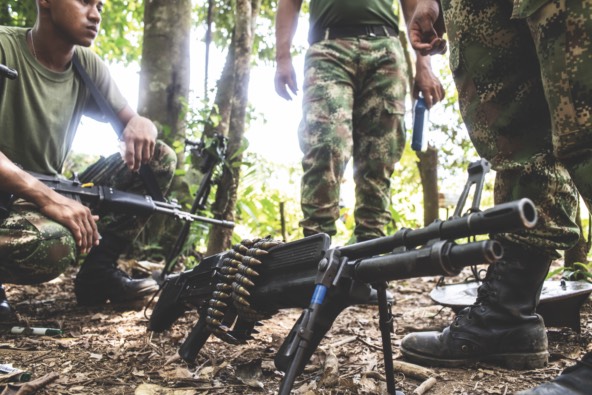
 Soldiers from the Sparta Cinco unit of the Colombian army stand guard in Puerto Guzmán to protect members of COMUCCOM. (Photo by Ugo Lucio Borga)
In Putumayo, Colombia, an unusual partnership is helping to turn former battlefields into farmland and protect one of the most complex ecosystems in the world. In this region bordering Ecuador and Peru, soldiers are stationed in the jungle not to fight guerrillas, but to help a cooperative of civilians, farmers, and former fighters of the Revolutionary Armed Forces of Colombia-People’s Army (FARC-EP). The Marxist guerrilla group formed in the 1960s and fought a civil war against the Colombian government that lasted until a peace agreement in 2016. The conflict left more than 200,000 people dead and millions displaced.
Here the Cooperativa Multiactiva Comunitaria del Común (COMUCCOM) was established in 2018, bringing together former combatants, civilians, and military personnel in a shared project of reconciliation and environmental stewardship under the motto “Peace is built collectively.” The organization, supported by off-budget funds from the UN Mission in Colombia, the United Nations Development Programme (UNDP), and the European Union, is dedicated to promoting peace, environmental justice, and sustainable development.
“After the signing of the peace agreements, our cooperative was born to involve local associations as protagonists in restoring nature for future generations and active peacebuilders,” COMUCCOM’s head Duberney López Martinéz told Mongabay in 2023. “We want to show that we can leave behind a culture of conflict and move toward solidarity and peace in our territory.” Martinéz has led the cooperative since the assassination of its founder, environmentalist Jorge Santofimio Yepes, on February 24, 2022, at a meeting of its board of directors.
Santofimio Yepes started the venture from scratch, obtaining a five-year loan for 48 hectares of land from the office of the former mayor of Puerto Guzmán, Rodrigo Rivera. Today, 27 families have moved here, and 12.7 hectares of the property have been transformed into a sustainable agricultural community, focused on fish production along with beekeeping projects and a nursery dedicated to conserving the Amazon rainforest.
Security and Prosperity
Registered with the Chamber of Commerce a few months after its foundation, COMUCCOM already had 90 members in 2018 and reached 150 in 2021. The cooperative is now part of the Network of Amazonian Community Nurseries, a group of 12 organizations chaired by signatories of the peace agreements, women, and campesinos from the regions of Caquetá, Meta, Putumayo, and Guaviare, created to preserve the biological corridor of the Amazon and promote a culture of communal peace. The project is, in the words of former Environment Minister Carlos Correa, “fundamental [for] stopping deforestation.” Gustavo Petro’s government seeks to restore the entire Colombian Amazon basin by reaching the most affected areas, including those in the deep jungle.
“This violence disproportionately affects those who defend the environment from economic interests linked to natural resources.”
The cooperative’s projects include a tilapia fish farm, made possible by funding from the Centro Experimental Amazonico (CEA). The farm produces up to 14 tons of fish annually, all destined for local markets. Currently, they are preparing for the second phase of the project, aiming to double productivity from 5 to 10 fish per cubic meter. This effort is supported by the recent inauguration of PisciMayu, a market in Mocoa designed to boost the sale of their catch.
In the forest farm, the Women and Gender Committee—composed of 18 members, including former combatants, daughters, and women from the communities of Puerto Guzmán and Santa Lucia—keeps more than 15 beehives. In this way, the committee supports the dreams of community life in harmony with nature. The cultivation and reforestation project with endemic plants, located along the property’s western perimeter, aims to protect and renew the territory.
Ensuring security in Putumayo region is extremely complicated because the region’s dense forests, rivers, and rural pathways make it naturally open and difficult for the central government to monitor. Raphael Santofimio Jepes, a signatory to the peace agreement and former FARC combatant, and his sister, Maria Carolina Santofimio, who serves as the community’s security officer, have been crucial in ensuring the community’s safety.
“If it weren’t for them, they would have already killed us all,” says Armando Aroca, Yepes’ former comrade-in-arms and now the legal representative of the cooperative. By “them,” he means the soldiers of the Sparta Cinco unit of the Colombian army, who have been deployed in the forest adjacent to COMUCCOM’s lands specifically to protect the project and those who work there.
This case stands out. Apart from rare exceptions—such as Jani Silva, a prominent rural community leader and activist in Colombia who has worked for decades to protect peasant communities, defend land rights, and promote peace, and who was nominated for the Nobel Peace Prize and granted government protection for her efforts—it is uncommon for the state to deploy its armed forces explicitly to defend rural peasant communities.
Santofimio’s murder received wide national media coverage, igniting public outrage and compelling the government to act. Jairo Agudelo Taborda, professor of international relations at the Universidad del Norte in Barranquilla, Colombia, views this initiative as part of a broader political shift: “For the first time, a progressive government is trying to implement agrarian reform and a fairer tax system.”
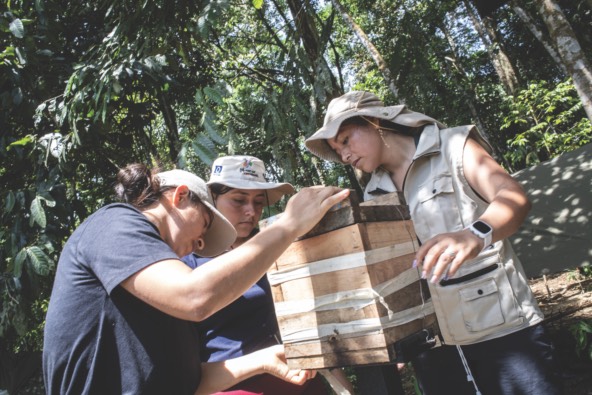 Beekeeping is one of the many forms of sustainable agriculture that members of COMUCCOM have adopted. (Photo by Ugo Lucio Borga)
Nonetheless, protection for environmental defenders remains limited and inconsistent. “The challenge now,” Taborda says, “is … to extend the model of peace signed with the FARC to other armed groups still operating in the country,” a vital step toward achieving lasting peace in Colombia.
A Fragile Balance
The establishment of COMUCCOM and the protection it receives mark a fragile balance between local initiatives and broader national challenges. After the FARC-EP’s demobilization after the 2016 peace agreement, the Colombian government failed to establish effective control in many of the rural and remote areas previously held by the guerrilla group, particularly in the Amazon rainforest. The resulting power vacuum invited various dissident armed groups to compete for territorial control and resource exploitation. In 2024 alone, 33 former FARC-EP members who had joined the peace process were assassinated, according to the UN Verification Mission in Colombia. Since the signing of the peace agreement in 2016, a total of 441 ex-combatants, including 11 women, have been killed.
“This violence disproportionately affects those who defend the environment from economic interests linked to natural resources,” Taborda says. Indigenous and Afro-descendant populations, grassroots organizations, and peasant communities fear that armed conflict may be returning or has already resumed in their communities, according to UN interviews.
The ongoing violence and instability have led to more than 252 people being killed and 51,623 people forcibly displaced last year. The Office of the United Nations High Commissioner for Human Rights (OHCHR) documented 25 killings and 119 attacks against environmental defenders—civilians protecting natural resources at the risk of their own life. At the same time, Global Witness reports that Colombia remains one of the deadliest countries for environmental defenders, who are often targeted for opposing extractive projects and demanding the right to prior consultation.
The ongoing crisis in the cocaine market, caused by the introduction of synthetic opioid fentanyl by Mexican cartels into the North American market, has further destabilized socioeconomic structures throughout South America, leading to a spike in violence. Armed groups vying for control of the land are seeking to convert their illicit sources of income.
“Today, illegal mining has become the dominant illicit economy in the Colombian Amazon,” Taborda says. Previously, these revenues came almost exclusively from cocaine production, but now armed groups are mostly turning to the exploitation of illegal mining sites.
While cocaine cultivation leads to deforestation of large swaths of land, excavations associated with mining activities more deeply compromise the environment of the affected regions. Due to pollutants, including mercury, used in the extraction and processing of metals, illegal mining presents a long-term threat to soil and water basins, with catastrophic consequences to the Colombian Amazon’s biodiversity and the local communities that depend on these forest ecosystems.
In February 2025, Colombia’s then-Environment Minister María Susana Muhamad announced that deforestation in the country had increased by 35 percent in the previous year. This data confirms the findings of a report based on an 18-year study, conducted by the Colombian Amazon Land Cover Monitoring System (SIMCOBA), warning that without adequate control policies, another 2.1 million hectares (5.2 million acres) of forest could be lost over the next two decades. “The environmental agenda on deforestation must go hand in hand with the total peace process,” Muhamad stated.
Muhamad’s statement echoes research by the Amazon Scientific Research Institute (SINCHI), detailing the FARC-EP’s territorial gains over vast areas of the Colombian Amazon during the civil war. Though rooted in armed conflict, armed groups’ presence inadvertently curbed large-scale deforestation by limiting illegal activities such as coca cultivation and land grabbing. Following the 2016 peace accords, the Colombian state struggled to reassert its control over these remote forested areas. As state presence weakened, new armed groups moved in and began vying for territorial dominance, fueling renewed violence and accelerating environmental degradation.
Such a reality is particularly vivid in Putumayo and neighboring regions like Guaviare. While the 2016 peace agreement once promised lasting stability, new armed groups have filled the vacuums left by the FARC, controlling local economies, imposing oppressive rules, and perpetuating violence. National efforts, including President Gustavo Petro’s “total peace” strategy, have struggled to keep pace with this evolving conflict, as dialogue, social investment, and security measures contend with rising criminal networks and shrinking international support.
Amid this challenging landscape, COMUCCOM offers a unique example of hope and resilience. By bringing together former combatants, local families, and environmental defenders, the cooperative has transformed a once-contested area into a space of environmental restoration, sustainable livelihoods, and collective solidarity.
Read more stories by Ugo Lucio Borga, Leonardo Delfanti & Gino Paoletti.