


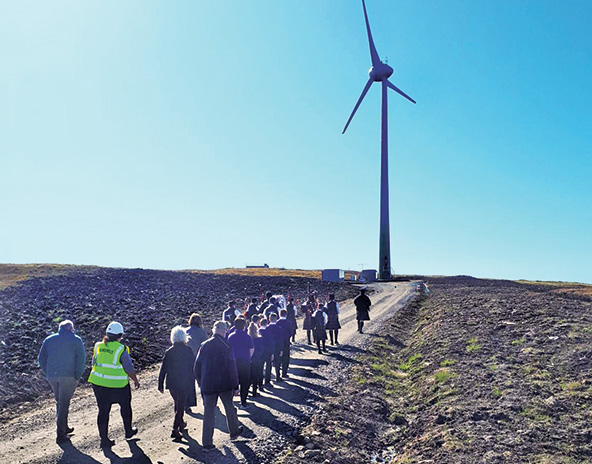
 A group of visitors walk toward a turbine at the UistWind farm on the Scottish island of North Uist. (Photo courtesy of Local Energy Scotland)
On the rocky western coast of the Scottish island of North Uist, in the Outer Hebrides archipelago, loom two 250-foot-tall onshore wind turbines that churn endlessly in the North Atlantic Ocean breeze.
This small wind farm, called UistWind, is one of 570 community-owned renewable energy projects in Scotland, ranging from solar parks and hydroelectric plants to bioenergy installations and marine-powered technology. While citizen-run clean-energy projects exist throughout Europe, Scotland’s are distinct because many are owned by charitable organizations working to assist local municipalities to fund development projects.
Scotland is a world leader in renewable energy. In 2020, renewables covered 97 percent of Scotland’s gross electricity demand—just under 10 percent of which hailed from clean-energy co-ops like UistWind and other locally owned generation facilities.
The Scottish government strongly supports local energy and circular economy schemes because they increase renewable energy production, lessen the strain on the national grid, create jobs, and generate revenue. Many of the collectives are part of the Zero Carbon Communities campaign, an initiative guiding residents to net-zero emissions. Scotland aims to be carbon neutral by 2040 and envisions community energy as a cornerstone of its renewables’ rollout and energy efficiency push—with a goal of doubling its renewables output by 2030.
This dedicated commitment began in 2011, when the Scottish government sought to increase community involvement and collaborate with the private sector in its nationwide conservation efforts. Founded in 2013, Local Energy Scotland (LES) administers the Scottish government’s Community and Renewable Energy Scheme (CARES), a £5 million ($6.5 million) funding program that awards grants and loans of around £150,000 ($200,000) to communities developing clean-energy projects. LES is composed of five climate and energy nonprofits: Energy Saving Trust, Changeworks, Scarf, the Energy Agency, and the Wise Group.
Project Facilitator
In addition to providing funding and loans, LES offers consulting services to communities, businesses, and other organizations on renewable energy. It offers free online tools, including good-practice guides and research studies, that assist communities in organizing and running local energy projects.
Renewables projects are notoriously costly, cumbersome ventures to get off the ground, especially in poorer rural or remote areas. To get a single wind turbine generating electricity, for example, a community faces a daunting range of assessments, legal agreements, and technical requirements, as well as the need for significant investment capital to cover start-up costs.
LES helps by functioning as a cross-sector bridge. “LES as a third sector organization itself communicates particularly well with other third sector groups, like the community groups involved in clean-energy projects,” rural development expert Bill Slee says. “LES is much closer to communities than public sector bodies, which can be bureaucratic and distant.”
LES Director Chris Morris emphasizes that the consortium’s success in facilitating is due in large part to the professional expertise of its employees. “Most staff are embedded within local charities, meaning they can benefit from opportunities to work collaboratively with colleagues to support community groups,” he explains. “Our structure facilitates [helping] colleagues within their host organization who focus on working with businesses, supply chains, and households. And our staff assists throughout the process—from the very beginning through energization if necessary.”
North Uist needed this very assistance. Like other islands in the Western Isles, it has grappled with depopulation as well as the decades-long decline of its fishing industry. In 2009, North Uist’s community leaders decided to leverage its most abundant natural resource—wind—to buoy its economy. But none had experience in the complex business of energy generation.
In 2010, Community Energy Scotland (CES), which administered CARES funds prior to LES, recommended that the municipality establish the North Uist Development Company (NUDC) as a charity and helped them secure a CARES preplanning loan of £150,000 ($200,000) for feasibility studies. The consultants identified Criongrabhal—a hilly, unpopulated site on the western coast—as having optimal conditions for two midsize turbines, in total costing £3.4 million ($4.6 million).
LES then helped North Uist win local planning permission and a license from Scottish & Southern Electricity to export electricity to the national grid, in 2013. But the effort quickly encountered a hurdle: The UK Ministry of Defence objected to the turbines’ proximity to radar ranges and denied the permit. For the next five years, NUDC and LES development officer Murdo Murray battled the powerful UK ministry, eventually brokering a compromise that stipulated that the turbines would be turned off when the ministry required, but not so often as to make the project financially inviable.
In 2018, NUDC finally received permission to build but then faced the task of raising investment capital. Murray’s guidance and a CARES post-consent loan of £45,000 ($60,000) facilitated the documentation required to secure loans from Scottish banks.
Yet, changes in the renewable energy support scheme—the UK government cut all funding supports—resulted in the project finding itself short of investment capital. Murray helped the community raise another £460,000 ($616,000) through a community-share offer—a type of local investment fund that communities in Scotland often rely upon to accrue capital for clean-energy projects. Construction commenced in spring 2019, and that September the rotors began spinning.
In 2019, UistWind and other locally owned clean-energy projects accounted for £20 million ($27 million) worth of community benefits. In North Uist, an energy surplus of nearly £105,000 ($140,000) will flow into the country’s coffers each year for the next two decades. These funds will support small business start-ups and affordable housing. NUDC is also investing in a wide range of sustainability projects, including low-carbon transport schemes, green spaces, assisting energy-poor households, net-zero community buildings, and energy-storage projects.
NUDC estimates that the turbines also displace the equivalent fossil fuel energy of 1,275 tons of carbon dioxide a year. While only 3 percent of Scotland’s total renewable power hails from these installations, Scotland soared past its 2020 goal of a half gigawatt of local power generation capacity and doubled that in 2021.
Other municipalities across Scotland also have profited from clean-energy generation. For example, South Uist was the first community to receive CARES funding in 2009 to build a turbine with just enough capacity to heat the local community hall. To the north, on the Isle of Lewis, the Point and Sandwick community boasts one of the most profitable community energy undertakings in Scotland. Since 2016, the three-turbine community wind farm, Beinn Ghrideag, has funded environmental philanthropy across the Western Isles with annual surpluses of nearly £1 million ($1.3 million).
Climate protection was never the main motive for Scotland’s community energy projects. “Initially we weren’t out to save the planet but to save our own communities,” says Calum Macdonald, manager of the Point and Sandwick Trust. But in terms of community development and climate protection, “it’s not an either/or proposition,” he adds. “Planting forests and laying hiking paths do both, and foster public health, too.”
Shared Ownership
While CARES funding and LES support began with community energy projects like those on the Uist islands and Lewis, they now include larger, privately owned enterprises, which communities buy into and profit from indirectly. In 2014, LES, for example, midwifed the investment of the communities of Tarbert and Tighnabruaich, on the western coast not far from Glasgow, in the Sròndoire Wind Farm, a project of three turbines proposed by a private investor, Allt Dearg Wind Farmers.
The communities didn’t have the resources, nor did they feel that they could shoulder the debt, to construct such a park themselves. LES counseled them to create legal charities, which CARES funded, and apply for loans that would make possible investment in the facility. The developer agreed to the idea because it got communities on board. The dividends began flowing in 2016 and have provided financial support to a local history and archiving project, the restoration of local footpaths, and a heritage center that encourages active tourism—a new traveling philosophy that combines adventure, ecotourism, and cultural aspects of a discovery tour.
The Scottish government, intent on keeping enthusiasm for renewables high, has set a target that half of all newly consented renewable energy projects include shared local ownership. Some shared ownership enterprises net the municipality as much as 25 percent of the project’s revenue.
This model has its benefits, not least that private developers have experience with larger projects and access to greater sums of capital. “The commercial developer may cover the whole or a major part of the pre-consent costs and thereby a significant proportion of the financial risk that would normally fall to community groups,” Slee says.
But Slee and others bemoan that fewer community-energy projects are emerging since the UK support scheme ended in 2019—a result of the Conservative Party victory that year. “Some communities get very little or even nothing at all from the owners,” says Rona MacKay, head of CES’ Operations & Governance, which works exclusively with communities.
The termination of the UK support scheme has hampered the development of new community renewable programs. Yet, renewable energy is only one factor in lowering energy costs. LES is now helping communities, businesses, and individuals help themselves with advice on and aid for energy efficiency, electricity storage, and low-carbon heating services. In terms of taking action to achieve Scotland’s net-zero targets with local-energy systems, energy conservation is no less important than clean energy generation.
Read more stories by Paul Hockenos.