


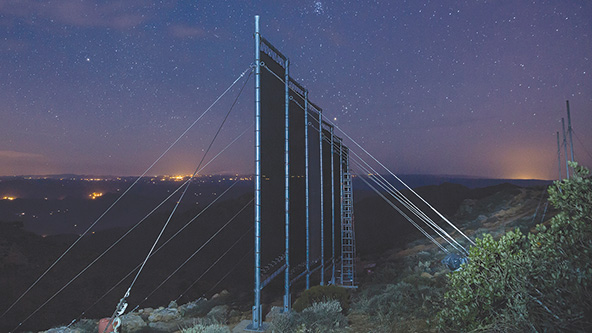
 The CloudFisher nets stand atop Mount Boutmezguida in the Sidi Ifni province of Morocco. (Photo courtesy of Dar Si Hmad)
Atop the fog-covered peaks of the Anti-Atlas Mountains in southwestern Morocco dwell the indigenous Amazigh people. The Amazigh (“free people”) are a distinct cultural and ethnic group comprising roughly three-quarters of Morocco’s population. Amazigh villages in the mountainous Sidi Ifni province are socially and geographically isolated in an extremely arid region of rising temperatures and desertification.
The greatest environmental challenge to this region has been freshwater shortages due to the decline in rainfall. The scarcity has devastated the Amazigh, whose livelihoods depend on agriculture and livestock farming. Villagers have historically relied on traveling long distances to obtain potable water from wells and family cisterns. During times of drought, they have had to purchase water at high prices from private companies or travel long distances to obtain it from rural communes. This water poverty has severely disrupted the local economy, causing working-age men to leave and weakening the Amazigh’s social structures and culture.
Aissa Derhem, an Amazigh from the village of Taloust, learned about fog harvesting while pursuing his doctorate in mathematics at Laval University in Quebec, Canada, in the 1980s. Fog harvesting is an ancient practice, tracing back to at least the Roman period, of sourcing freshwater from fog. Modern fog-collection technology involves devices called large fog collectors (LFCs) made of mesh netting that traps fog through condensation. Water sticks to the netting, runs to the bottom of the LFCs, and then is transported to a reservoir for storage and distribution.
Derhem realized that this technology could help water-poor communities like his own, especially since fog was abundant atop the Anti-Atlas Mountains. But it wasn’t until he returned home to Morocco in the early 2000s, after having taught at Laval University, that he was able to pursue the idea. In 2006, he contacted Robert Schemenauer, cofounder of the Canadian NGO FogQuest, which designs and implements fog-harvesting technology for rural communities in developing countries. Schemenauer connected him to a team of FogQuest experts and scholars from the University of La Laguna, Tenerife, Spain, to assess the fog-harvesting potential atop Mount Boutmezguida. Its summit is optimally positioned for fog exposure, as the fog travels inland from the seashore, and its height provides a natural shelter for the fog nets.
After four years of studying the mountains’ fog-harvesting potential, in 2010, Derhem and his wife, anthropologist and activist Jamila Bargach, cofounded Dar Si Hmad (DSH), a fog-harvesting and water-supply-chain nonprofit serving the Amazigh people. Bargach had taught at the École Nationale d’Architecture in Rabat, Morocco, and cofounded a women’s shelter in Casablanca. She led the formalization of DSH’s operations, including devising a fundraising strategy and conducting baseline demographic surveys.
“When I start talking about the organization, I can’t separate it from my personal life,” Bargach says. “Whenever I tell this story, it’s almost a religious or spiritual experience for me. For years, fog was present at our dinner table every day.”
Since its founding, DSH has installed 1,700 square meters of fog-harvesting netting at the summit of Mount Boutmezguida, piping water into the homes of 16 villages in the region. Today, it is the world’s largest fog-harvesting project.
The Net Effect
DSH launched its pilot in 2011 in collaboration with FogQuest to appraise the netting’s suitability and water yield in the Anti-Atlas region. Though the water yield was positive, villagers’ initial reception to the project was not. They distrusted the foreign technology. Pilot testing also revealed that villagers rejected the communal-tap system; they specifically struggled to manage multiple households’ needs through a common tap. In response, DSH redesigned its water-supply system to pipe water directly to individual households.
Between 2012 and 2015, DSH received significant financial support from the German development fund Munich Re Foundation. In 2017, Munich Re connected DSH to the Water Foundation, whose support enabled DSH to upgrade its netting to the CloudFisher fog-net technology. The CloudFisher utilizes honeycomb-style netting, which doubles the water yield and requires less maintenance than the FogQuest netting. This new high-performing and reliable netting allowed DSH to expand its service to 150 households, comprising 82 percent of households in the villages DSH operates in.
DSH’s adoption of the CloudFisher was also supported by the German Ministry for Economic Development and Cooperation, which provided funding for the new nets’ installation as well as DSH’s supporting programs, including community WASH (water, sanitation, and hygiene) workshops and education projects.
The nonprofit has maintained several relationships with funders and external stakeholders. Munich Re gave more than €400,000 ($472,440) over a five-year period, ending in 2018. The US Agency for International Development (USAID) first awarded DSH a $60,000 grant in 2013. With USAID’s support, DSH hired technical experts as liaisons between the villages and the netting site, built a monitoring meteorological station at the top of Mount Boutmezguida, and installed water systems powered by renewable energy.
In addition to fog harvesting, DSH seeks to create a culture of sustainability through its education and science initiatives in the communities of southwest Morocco. The nonprofit established a sustainability research center and an ethnographic field school through which it offers these initiatives, in addition to its WASH trainings.
Abundant Water Challenges
Despite its programmatic expansion, DSH has faced considerable hurdles in its path to sustainability. Traditional Amazigh culture affected the fog-harvesting project’s implementation more than technical setbacks. While the Amazigh who were directly involved with DSH during its experimental phase in 2006 embraced the project, others rejected it. In response, DSH organized education programs and awareness sessions, such as a children’s water school and female literacy trainings, to engage and educate villagers. This intentional public engagement conveyed DSH’s earnest investment in villagers’ lives, which helped build trust between the DSH team and the Amazigh and increased locals’ acceptance of the project.
The once-skeptical Amazigh villagers of Morocco are now the fog-harvesting project’s greatest advocates.
In 2011, once the fog-harvesting system was functional, DSH was confronted with resistance to a new way of life. The villagers had, for many centuries, lived with an extremely limited water supply. The established Amazigh culture was rooted in water scarcity, as well as the intersecting adversities of geographic isolation, social marginalization, and economic hardship. Before DSH’s arrival, water collection took nearly four hours per day, exclusively managed by women and seen as a rite of passage.
DSH’s fog-harvesting project, specifically after it upgraded to the advanced CloudFisher technology system, upended the gender roles embedded at the core of Amazigh society, diminishing women’s power and agency previously derived from their unique role as “water guardians.” As Bargach explains, “Once you get [water], you have it, own it ... it gives you some power. So, when it runs directly into your house, you lose this power.” Bargach further adds that this change has affected the intergenerational social dynamics between women: “Then there’s the walking, talking, and learning of knowledge transmission [between women]. … And now older women say, ‘I spent my whole life getting water and now [the younger women] don’t work.’”
DSH quickly recognized the risk of intergenerational cultural loss and that water management was one of the few parts of Amazigh life where women held authority. In 2014, it created “FogPhones,” mobile devices designed for monolingual and low-literate female villagers to monitor and report the water-distribution system’s conditions using images via text message. FogPhones allowed women to regain some social power by controlling the flow of information about the water system.
In addition to these social challenges, the fragile ecosystem surrounding DSH’s operations faces continual threats from extreme weather due to climate change. This year, rain patterns were completely skewed—the rainy season arrived in March despite typically happening months earlier. Regions famous for apiculture are struggling as argan trees, critical for beekeeping, are dying from drought. Mealybug infestations have reduced cactus shrubbery. Within three years, nearly 300,000 hectares (more than 740,000 acres) of land have been rendered arid.
Given the increasing dangers posed by climate change, DSH is reluctant to label its work as sustainable. “Declaring that the project is sustainable would be too rich,” Bargach says of the impossibility of trying to measure for sustainability in such an unstable environment. “Everything is changing. When I think about the fog, I think about system analysis. We can’t just speak about one element we are providing without considering [the rest].”
DSH’s fog-harvesting project is a work in progress. It has reached considerable milestones: utilizing fog water for agriculture and to revive desertified lands, reducing water-borne diseases and water-gathering time, and increasing employment opportunities and female school attendance. DSH continues to respond to ever-changing social and environmental conditions through active collaboration with external partners and especially the Amazigh, who have decision-making authority in the nonprofit’s fog-harvesting project and its related programs. In fact, the once-skeptical Amazigh villagers are now the project’s greatest advocates. Plans are underway for DSH to expand its project to 12 more villages in the Anti-Atlas Mountains.
“People used to ask what we were doing—‘digging for diamonds?’” DSH’s project manager Mounir Abbar recalls. “Those who laughed at us have realized that water is the true diamond.”
Read more stories by Atharv Agrawal, Wajed Nadine El-Halabi & Jina Yazdanpanah.