


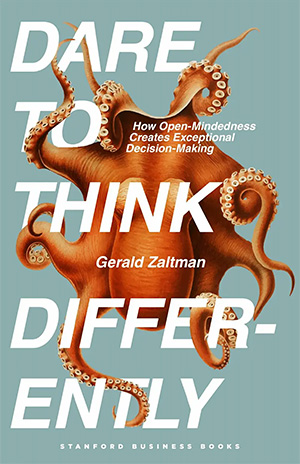
Dare to Think Differently: How Open-Mindedness Creates Exceptional Decision-Making
Gerald Zaltman
232 pages, Stanford Business Books, 2026
Have you ever wondered why some executives are consistently successful addressing difficult challenges while others are not? My team and I used a special interviewing technique (ZMET) to learn how very successful executives think, allowing us to probe nonconscious, more or less automatic thinking habits. The answer we found was that highly successful executives always ask, “How should I think about what I am doing?” instead of “What should I do?”
Thoughts about “how to think” occur below awareness but can be surfaced and enhanced, enabling executives to make intelligent sense of ambiguous situations. As I explore in my new book, Dare to Think Differently: How Open-Mindedness Creates Exceptional Decision-Making, these interviews uncovered six inner-directed “thinker toys.”
- Serious Play: Constructive mischief that has a serious purpose, such as challenging one’s own and others’ thinking.
- Befriend Ignorance, rather than treating it as a foe: Properly engaged, filling in pockets of missing knowledge can lead to novel solutions.
- Ask the Right Question, in the right way, at the right time: The right question often produces a major and welcomed surprise.
- Nurture Curiosity: One leader described this as, “The itch that demands to be scratched.” Its absence or avoidance dulls imagination.
- Panoramic Thinking: The willingness to explore seemingly unrelated fields. It requires analogical thinking.
- Embrace ambiguity rather than wish it away: The ability to create meaning in ambiguous contexts is a defining feature of intelligence. It also demands imagination.
In the following excerpt, we explore the first thinker toy, “Serious Play.”—Gerald Zaltman
* * *
The coupling of the words serious and play may induce a mental hiccup. In the popular imagination, serious is a word that is used to describe sober, sometimes boring activities. Adults are serious. So is work. Play, on the other hand, is for children, and so it is seen as inconsequential.
And yet think what a serious business children’s play is. Through play, children learn and practice all the social, emotional, and practical skills they will need as they grow up. Play demands a high level of imagination and creativity, both of which can be very effortful. It also elicits a wide range of emotions ranging from elation and joy to anger and despair. It’s not surprising, then, that managers who describe their work environments as places that discourage imagination, experimentation, brainstorming, and risk-taking—all of which are required for rewarding play experiences—rarely describe their work as enjoyable, purposeful, or productive.
In his book Growing Young, anthropologist Ashley Montagu argues that playfulness is essential to open-mindedness. He and many others who study play offer readers this important message about playfulness: don’t leave childhood without it. Or, more helpfully, don’t go to work without it. Stuart Brown, a physician, behavioral researcher, and founder of the National Institute for Play, judges play to be “largely responsible for our existence as sentient, intelligent creatures.” It is central to problem-solving, and premature dismissal of it can often prolong having to live with a problem.
For my purposes, serious playfulness is as much an attitude as an action. I define it as: engaging in waywardness or mischief with constructive intent or purpose by challenging one’s own and others’ thinking.
Serious play is an essential requirement in volatile environments, where learning needs to be speedy and flexible, and organizational strategies need to be both reactive and anticipatory as unpredictable opportunities emerge. The phrase “Let’s get serious” has always struck me as incomplete; it is missing “... and play hard.” As we’ll see in this chapter and elsewhere in this book, serious play is essential. It is the foundation for the generative thinking leading to imagination. It helps us address a crucial question: What has to happen to solve a problem or avoid a dilemma?
Serious playfulness describes the attitude we bring to puzzles (How does this work?), riddles (What else fits?), and paradox (How can that be?). Serious playfulness combined with a spirit of mischief nurtures the boldness we need to enter the “no-go zones” imposed by conventional thinking.
Note that I modify mischief with constructive intent. Serious play is not about pranks. The mischief or waywardness it engenders should never humiliate or belittle people, though it can—and should—introduce discomfort to routine thinking. Unlike humiliation, those metaphoric hiccups are actually beneficial.
Serious play is active rather than passive; it is not mindless phone-scrolling or vegetating in front of a screen. It can and often does involve watching, listening, and taking in stimuli, but doing these activities consciously and fully.
Serious Play With Mental Models
One of the most important, even essential, areas of serious play involves our “hallways.” These are the mental models that shape our understanding and responses to nearly every situation. They are sometimes called mind maps, schema, frames, and theories-in-use. My colleagues and I call them consensus maps as they summarize the shared thinking of a specific group, such as executives, a customer segment, opinion leaders, and so on. They typically operate below awareness and require serious play to surface, understand, and alter them. Recognizing them and understanding how they matter and how they can be improved through reengineering was a major theme among nearly all the executives we interviewed. Most often they were concerned with the mental models of their customers and colleagues.
Reengineering Consensus Maps
Consensus maps, then, are the core constructs—thoughts and feelings—that define in a skeletal way what most people in a group of interest think and feel about a topic. The topic might be a brand, a new product concept, employee reactions to a proposed merger, voter positions on a proposed public policy, and so on. The goal of drawing a consensus map is to describe that target audience’s behavior in a way that is intuitive, visual, and actionable. These maps have some plasticity. Thus, using various marketing tools such as advertising, package design, or even choice of distribution outlet, they can be altered to better accommodate an action plan. For many leaders unaccustomed to working with consensus maps, they appear as a madman’s version of connect the dots. This merely reflects the reality that visual representations of difficult challenges can be visually messy.
However, there is a brief, playful, and effective mental exercise or metaphor to use prior to introducing these maps. This exercise takes only a few imaginative moments:
Using your mind’s eye, imagine an ocean pool containing several octopuses, each representing an important idea involving the issue at hand. (The ideas are those of customers, distributors, employees, or some other group whose thinking is of interest.) Many octopuses in this pool communicate with one another. That is, the tip of at least one arm of one octopus connects with that of another octopus. Some octopuses have direct connections with several others. In this way, octopus arms are conduits similar to neural pathways along which messages are sent and received. Collectively, an information network is established among members of this particular pool.
Messages sent directly from one octopus to another are often passed along by the receiving octopus to yet others not within direct reach of the originating octopus. And, much like the famous telephone game you played in grade school, the message one octopus sends may be altered by the intermediaries passing it along. (On a technical note, the arms of an octopus contain about two-thirds of their total neurons, suggesting an independent brain within each arm.)
Now, imagine you are an octopus trainer. Your job is to train members of this pool to act in your preferred ways. Specifically, you may want to alter the communications patterns among them, encouraging direct hand-holding where it doesn’t exist and discouraging it in other cases. You may also want to encourage acceptance of a new octopus (a new entrant idea) to the pool and remove an existing one. Or you may want to rearrange them relative to one another to create more productive conversations.
Much like the octopuses, certain thoughts held by your target group are connected to other thoughts, behaviors, and emotions. By exploring their linkages, that is, by noting which octopuses are holding hands, you can clearly follow the pathways of thinking that are commonly held within your interest group.
Let’s set this exercise in motion with an example before describing the other ways in which you can use consensus maps.
A Paradox Involving Safety and Efficacy
A research project focused on the marketing challenges of weed killer. The core challenge was to discover what was stifling sales. The team set out to listen to consumers and understand their thoughts and feelings about weed killer to better position its marketing. The team used consensus mapmaking to draw out how the identified thoughts and feelings were connected. I can assure you that their maps were thorough, daunting, and yet very, very valuable. For the sake of simplicity and playfulness, we will be using octopuses instead.
The team discovered that the consumers’ minds were split into two “pools”—one concerned with the safety of the weed killer, and the other with its efficacy. In the safety pool dwelt octopuses like “Protect my family and pets” and “I make good decisions.” In other words, consumers wanted to know that the weed killer they were using was gentle and safe, which caused them to feel responsible, proud, and protected (other connected octopuses).
In the efficacy pool, the constructs (or octopuses) included thoughts like “Effective product kills weeds in one go” but also “I worry about toxins, health risk.” In the efficacy pool weed killers were perceived as weapons of war. The more effective they were, the more anxious the consumer felt about their negative effects.
This brings us to the major business challenge: How can a consumer who worries about toxic chemicals be a “victor” in the war against weeds if they use only the gentlest and hence least effective option? The clash between their safety and their efficacy mindsets leaves consumers feeling overwhelmed and unsure. These pools reveal a paradox—a set of conflicting thoughts that somehow coexist. Paradoxes are important, as a product or service that can resolve them is likely to be a major success. It’s like having your cake and eating it too.
At first glance, it might seem like these two pools of thought are entirely separate and therefore irreconcilable. However, it pays off to notice which octopuses peer over the edge of their pools and link up in unlikely places. It turns out that the “I am responsible, protective” and the “I feel safe and protected” octopuses link up over these pools. This connection between thoughts is the place to pinpoint how to tell a marketing story that bridges these seemingly opposite ideas and speaks more closely to the heart of what the consumer wants.
The team explored the reengineering or What of it? questions and role playing. The result? They chose to move away from the “weed killer as a weapon of war in a battle against weeds” mindset and tell a story that could bring both sides of the map together. This new marketing story came with a new hero: a doctor! The weed killer was presented as a doctor who treats the “patient” or lawn effectively yet safely against the chronic disease of weeds. Communication recommendations followed from this reframe. The new marketing strategy, which was a major success for the client (though it might have caused environmentalists no end of agita), encouraged the hand holding between “I am responsible, protective” and “I am safe, protected” octopuses.
Reflecting upon this example, when would such a consensus map work for you in your endeavors? Ask yourself:
- Am I creating space and time for flexible approaches such as building mental models, roleplaying, following “what if” trains of thought, and playing with ideas within projects or teams?
- Do I let methods evolve or do I try to stick to only what has worked before?
Consensus maps not only can tell us what key stakeholders such as customers, employees, and managers think, but why; as such, they can serve as strategic playgrounds for engaging and reshaping their thinking. My colleague Jerry Olson describes this kind of play as having two stages. The first asks, What is it? and the second, What of it?
The What is it? are the key ideas or constructs—the specific thoughts and feelings—most people in a specified group have about a topic. The constructs by themselves may have little meaning, but the consensus map or model shows their causal associations, that is, how they are linked together in a system of relationships. Again, the specified links are those made by most members of the group. The emphasis on “most” simply reflects the fact that no one group member represents in every way all other members of that group.
While consensus maps can feel overwhelming to view or create at first, you should feel empowered to pull out an electronic or literal pen and mark them up, comparing and contrasting your own thinking to that of the stakeholder group of interest. We literally “play around with” the key thoughts and feelings and their associations with one another and entertain new possibilities—first on paper through a consensus map, and then in practice with new policies or actions. To do this, you must ask several questions. For example:
- What important thoughts (constructs/octopuses) are missing on this map that we wish were present?
- How do we insert them? Which existing thoughts and feelings can be “mentors” for introducing new thoughts and feelings?
- Among existing constructs, which do we want to reinforce? Make even more salient? Less salient? Even have disappear?
- Are there associations or connections between the thoughts we’d like to create anew? Strengthen? Lessen? Eliminate?