


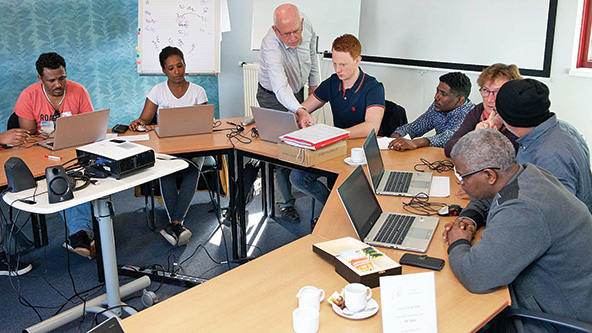
 Microsoft's Community Empowerment Fund provided laptops to Taalcafé Middenmeer to teach immigrants the Dutch language. (Photo courtesy of Taalcafé)
As technology increasingly drives the global economy and daily life, the need for remote data storage is growing. Data centers, facilities that house computing and networking equipment, aim to meet that demand.
Integral to internet-dependent data centers (“the cloud”), physical data centers require massive amounts of water, power, and space to displace the immense amount of heat produced by the thousands of continuously running routers, servers, and other technical equipment.
They take up the size of “a couple of football fields, and [don’t] employ [as] many people as other retail compan[ies],” says Microsoft Datacenter Community Development Program Manager Sonali George.
Construction on Microsoft’s North Holland data center in Middenmeer, a town within the municipality of Hollands Kroon, began in 2013 and became operational in 2015. It’s one of more than 100 Microsoft data centers throughout the world. Like many people who live near these data centers, North Holland residents initially “didn’t know what the data center was,” says Gary McLoughlin, Microsoft’s regional Datacenter Community Development project manager in Europe, the Middle East, and Africa. In 2017, Microsoft launched a program to partner with its key data center communities to improve relationships with the communities they serve.
Data centers are “something that the tech industry is having to grapple with for the first time, because they are a new-ish business model,” says Mary Fifield, a community development practitioner and consultant. When companies like Microsoft build data centers, they buy large swaths of land; the spaciousness of rural locations are ideal spots.
The consequence is that nearby communities lose natural land and resources. During construction, data centers initially boost the local economy because workers are hired to prepare the land and build the center. But, once operational, data centers don’t need to employ as many people. As a result, they “can be perceived as a negative impact on the community, especially relative to the number of direct jobs that we create,” says Mike Miles, who served as general manager for community and workforce development at Microsoft until his retirement in 2018. Between the environmental repercussions and the public relations challenges, data centers are a clear case for mitigation through corporate social responsibility (CSR) efforts.
Miles believed that pivoting CSR efforts away from a top-down approach in data center communities could improve the company’s relationship with local residents. This idea came from a lesson he learned while volunteering with an NGO: He noticed that the people his NGO was trying to help didn’t appreciate it when international volunteers arrived with preconceived notions of what would help the community. It occurred to Miles that asking communities for input about their needs would be more effective. So, in North Holland, the first step was to ask local residents and organizations for insight.
Partnership, Not Charity
Realizing this need, Miles quickly assembled a team, and Microsoft launched the Datacenter Community Development (DCCD) initiative in October 2017 in eight of its data center communities.
“This was really about creating a program that reflected the reality that communities have their own assets and the knowledge about what will work best for them, and that Microsoft could move into a different space in terms of working with communities where it’s really much more of a partnership, as opposed to charity,” explains Fifield, who assisted Microsoft with their data center community engagement strategy.
Microsoft’s DCCD provides low-cost or free broadband, works on local environmental sustainability, and collaborates with community colleges on workforce development.
The Community Empowerment Fund (CEF) is a critical component of the initiative. Established in 2017, it provides funding for existing social, environmental, and economic development programs in the community. In designing the CEF, Microsoft team members prioritized power-sharing, trust, and collaboration with its data center communities.
In CEF’s first year, Microsoft awarded $1.2 million to 32 community organizations. Grantees included a science center in Des Moines, Iowa, and a student-led job readiness program in Dublin, Ireland. Reflecting their commitment to being good community partners, six of the beneficiaries were from municipalities within North Holland, one of the CEF sites.
With the first grant cycle, Microsoft deepened community coffers with financial contributions while establishing relationships with local organizations. The team then debriefed community members who had helped pinpoint local priorities and highlight potential grant recipients.
Based on feedback from communities in North Holland, Microsoft created a board comprised of employees and community leaders from CEF’s local target municipalities, Hollands Kroon and Medemblik. Known as the Datacenter Community Advisory Board (DCAB), the group includes five voting members (three at-large community members, one Microsoft data center employee, and a local Microsoft corporate office employee), up to three nonvoting members, and one local youth representative.
The new board removed McLoughlin from the gatekeeper role as the sole liaison between Microsoft’s CEF and the community by endowing more local groups and initiatives with greater decision-making power when it came to grantmaking. It also decided in 2018 to issue an open call for grants via the Microsoft Netherlands website instead of selecting organizations themselves.
From more than 175 proposals in DCAB’s first funding cycle, Microsoft’s governance council approved seven local projects, including a group of libraries known as Stichting KopGroep Bibliotheken, to teach children how to code; a program for Dutch-language learners; and a carbon-neutral scouting clubhouse that provides coding and robotics instruction to youth.
In CEF’s first funding cycle, the North Holland nonprofit Lions Wieringermeer received €4,400 (approximately $5,000) for an event about environmentally friendly housing. Dutch bank Rabobank provided a matching grant. “[Attendees] came to the evening expecting that they had to invest 15, 20, or 30,000 euros to make their house sustainable,” explains Lions Wieringermeer’s secretary, Ben Tops. Instead, they discovered that small, inexpensive changes could shrink a home’s carbon footprint.
While organizing the event, Lions members discovered a strong interest in sustainability among area high school students, so then-DCAB member Age Miedema nudged the club to partner with local schools, which Microsoft funding enabled them to do.
The new hub linking Lions, Rabobank, local schools, and local leaders meets another DCCD goal: to promote collaboration among community groups. McLoughlin created an intentional space for this by hosting a networking meet-up for CEF grant recipients and their guests. “It’s [about] being able to bring people together and see if there’s opportunities for shared value,” he says.
McLoughlin visited grant recipient sites and held public sessions twice a year—known as Voice of the Community—to learn about the community’s needs and how Microsoft can support them. Additionally, the gatherings give stakeholders a chance to share their views on what Microsoft does well, and how they can improve their support of the community. Voice of the Community represents a crucial aspect of the DCCB approach: listening. “I can’t emphasize enough that it starts with that community listening and that interaction with the community, rather than just going in and trying to deliver projects that you feel are meaningful, but you don’t really know if they’re what’s needed in that local community,” McLoughlin says.
Tops says Microsoft’s interest in partnering with local organizations surprised residents, particularly because the company initially kept a low profile. “We have a lot of big companies in this area, but none of them set up a program like this,” he adds. He knows that self-interest is in the mix—that CEF improves public opinion—but thinks “it’s fantastic.” And he’s not alone: Surveys conducted by Microsoft since CEF and DCAB launched indicate that North Holland residents see Microsoft as a good community partner.
Community Customization
George and her colleagues chose North Holland for the DCAB pilot because, she says, “there was already existing local leadership that ... we had good relationships with.” And “they were already used to a culture where they make the decisions.”
At the same time, community involvement includes challenges. Miles observes that it’s been “very hard for us to make sure that our money or other contributions are actually being put to good use in the community.” An effective tracking system remains “embryonic,” he adds. Moreover, the DCAB model, from application review to getting to know local stakeholders and community, has not yet reached its ideal, streamlined form as a type of CSR. “It’s a more time-consuming model than simply writing a check or doing something more transactional,” Fifield says.
Nevertheless, Microsoft is scaling DCAB to other places with community endowment funds—Des Moines, Iowa, and Phoenix, Arizona, now have DCABs. The expansion has brought with it the realization that each community has its own culture, language, and ethos. “It was easy to think that they’re all going to be roughly the same, and we’re going to scale because of that similarity. But because they are all so unique, we had to rethink how we scale the program to rethink and honor their individual uniqueness,” explains Miles.
As DCAB expands to the United States, the core of its value remains clear. “The creativity from the community about the community’s needs far surpasses ours,” Miles says.
Read more stories by Heather Beasley Doyle.