


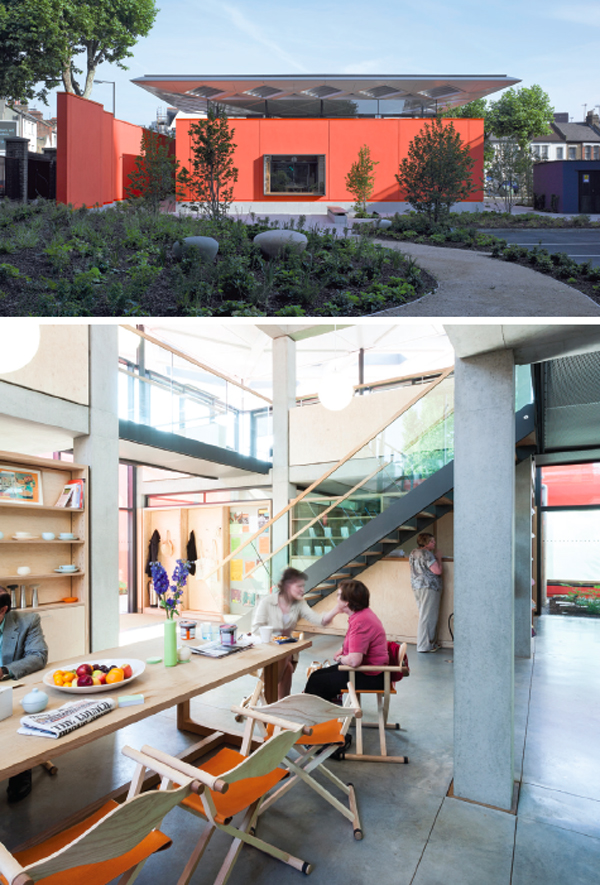
 The exterior (top) and the interior of Maggie's West London present a welcoming view to visitors. (Photos courtesy of Maggie's Centres)
On an afternoon earlier this year, a group of people share confidences and sip tea from china mugs as they sit in a coral-red pavilion that stands wedged between the Fulham Palace Road and the concrete highrise of the Charing Cross Hospital in West London. The pavilion, encircled by courtyard gardens, features a wood-burning stove, quiet nooks for private conversation, and a kitchen table where people naturally gather. It resembles a beautifully designed home, but it’s actually a drop-in center for people who have cancer. Known as Maggie’s, the center occupies hospital land and is run by the Maggie Keswick Jencks Cancer Caring Centres Trust, a UK-based charity.
Lucy, a regular visitor, has just emerged from a weekly relaxation class. She first visited Maggie’s in June 2014, shortly after learning that she had a cancer that had spread from her liver to her hips and her back. Today, after undergoing extensive chemotherapy, she is thinking mostly about her future. But she recalls how, on that first visit, she followed a woodland path that leads to the building from the road, and as the roar of London traffic receded behind her, she felt her pulse slow, her lungs fill with air, and her muscles relax. “When you’re first diagnosed with cancer, your whole body goes into stress,” she says. “Having somewhere to go that’s inviting, where you’re not on your own and not in a hospital, is a lifeline.”
Maggie’s West London is part of a network of 16 facilities, all of them built on the grounds of National Health Service (NHS) hospitals. There is also a Maggie’s Centre in Hong Kong, and the organization operates an online center as well.
The centers are named after Maggie Keswick Jencks. Diagnosed with advanced cancer in 1993, Keswick Jencks spent the following two years researching ways to live positively with cancer and sketching out her vision for a place that would provide emotional and practical support for other cancer patients. She didn’t live to see that vision come to life, but—along with her husband, Charles Jencks, a noted landscape designer and architecture critic—she developed the blueprint for what would become Maggie’s Centres. She also persuaded the chief executive of the Western General Hospital in Edinburgh, where she received treatment, to accommodate the first center on the grounds of that hospital, and she persuaded her oncology nurse, Laura Lee, to run the new facility.
Maggie’s Centres doesn’t offer medical care. It exists exclusively to help people cope with the emotional and practical stresses that follow a cancer diagnosis. The centers, which are free and open to all, offer a host of services. They employ cancer support specialists—normally former NHS oncology nurses—who help visitors to learn about new treatments and to prepare for consultations with doctors. They also employ psychologists, along with advisors who help people claim government benefits. They run workshops on how to eat healthfully, how to cope with hair loss, how to release pent-up emotions through expressive art, and in general how to live well with cancer.
At the heart of each facility is a kitchen, where a cup of tea is always available. Jonathan, another visitor to Maggie’s West London, explains the core appeal of the place: “As a cancer patient, you’re a number—a body with a cancer to be treated, passing through a r evolving door. A t Maggie’s, there are no 15-minute appointment slots, and you’re able to be a person.”
A Caring Place
The collaboration that Keswick Jencks pioneered with the Western General Hospital set an important precedent. Hospitals have long encouraged people to raise funds on their behalf, but the notion of providing services independently on grounds leased from an NHS hospital was new. “We had the backing of the chief executive and a few oncologists, but some doctors were very antagonistic to the idea of allowing in [an organization] that wasn’t within their control,” says Lee, who is now the chief executive of Maggie’s Centres.
Also new, and crucial to what would become the Maggie’s Centre experience, was an emphasis on building facilities that are visually and spatially appealing. Maggie’s leaders decided to design each center individually, using different architects, instead of adopting a single template that might have allowed them to keep costs low. In fact, says Jencks, the sites used for Maggie’s Centres vary so widely—“a car park here, [an unfilled] space there”—that standardization was never practical. The organization has tapped renowned architects for most of its projects: Frank Gehry for the Dundee center, Zaha Hadid for the center in Fife, and so on. These buildings embody a philosophy that Jencks articulates in his book The Architecture of Hope. Uplifting environments, he suggests, affect how people behave toward one another; by fostering optimism, they may even assist a patient’s recovery.
Nowadays, such ideas permeate health care thinking. The plans for a future NHS cancer center at Guy’s Hospital in London, for example, acknowledge that the “visual arts and good design contribute to the improved well-being of patients, staff and visitors.” But in the mid-1990s, design was of so little interest to medical professionals that even Lee regarded it as a side issue—that is, until she saw the effect that good design can have on users. “When we opened the doors of the first center, patients from the hospital came in and began telling me [things] that they’d never told me before,” she says. “I realized, then, there was something about the building that made people feel safe.”
An early indication that Maggie’s was gaining clinical recognition came when—after the creation of the first center in Edinburgh—NHS hospitals began to ask the organization to build centers on their sites. Even so, the potential for conflict persists at the working level, particularly when a hospital runs its own charity to fund services that go beyond regular medical care. For that reason, Maggie’s leaders work to complement those services, not to compete with them. “We spend a lot of time with hospital staff [members], getting to understand what they provide and how we can add value to what they’re already doing,” says Ann-Louise Ward, program director at Maggie’s. An NHS cancer nurse and a Maggie’s cancer support specialist might co-facilitate a support group, for example, or the two organizations might co-host a “well-being day.”
Some people have complained about the separation between Maggie’s and the NHS. Maggie’s, in fact, has to raise all of its funds from private donors. But Andrew Anderson, center head of Maggie’s Edinburgh, highlights the benefits of not relying on government support. NHS budgets, he notes, are under intense pressure: Forced to choose between making a cancer drug available and funding social services, officials will usually prioritize the drug. Maggie’s also remains free to pursue innovation as it sees fit. “Independence allows us to respond very nimbly to the suggestions of people who use our centers,” Anderson says.
Helen Ferns, general manager for integrated care at the Clatterbridge Cancer Centre NHS Foundation Trust, takes a similar view. “Because Maggie’s isn’t delivering clinical care, it’s allowed to be something different,” she says. “No one is in uniform, and [each center] is as far away from a clinical environment as you can imagine. That’s a much better place than a hospital for patients to relax in with family.”
A Plan For Growth
Today Maggie’s has a presence in more than one-quarter of the 61 NHS specialist hospitals that treat cancer. Ultimately, it aims to have centers in all of them. It is also expanding internationally: Planning or development is under way for facilities in the Netherlands, Norway, Spain, and Qatar. As its centers become better known, they are also becoming busier. Maggie’s Edinburgh, for instance, now receives more than 80 visitors each day. For a people-oriented charity, rapid expansion creates a challenge: How can it grow without losing the sense of informality that makes its facilities so appealing to visitors?
Maggie’s takes various steps to ensure that it continues to offer the right support, in the right way. In an annual survey, the organization asks visitors how well it is meeting their needs. (In 2014, 99 percent of respondents rated their experience at a Maggie’s Centre as either “excellent” or “good.”) In addition, Maggie’s submits itself to peer evaluation every three years. Expert reviewers assess its programs and work with staff members to identify areas where Maggie’s needs to shift in response to new developments in cancer care.
Although Maggie’s offers a core set of activities in all of its centers, it also encourages each center to develop other offerings. That approach allows centers to give special attention to cancers that are prevalent in their communities. (Lung cancer, for example, is far more common in Glasgow than in many other parts of the United Kingdom.) Localized programming also creates opportunities for centers to learn from one another. A case in point is a course on living with prostate cancer that Maggie’s runs nationally in collaboration with Prostate Cancer UK. That course began as a local initiative by the center in Fife.
Another element of the organization’s growth plan involves making its centers more accessible to hard-to-reach groups. More women than men use the centers, but Maggie’s has recently improved that gender balance by introducing programs that cater to men. Maggie’s also struggles to reach people with rare cancers and to connect with patients who are age 65 or older. “We’re talking to other organizations, so that we can make our programs attractive to [older] people,” says Ward.
Even as Maggie’s Centres evolves, one aspect of the Maggie’s experience won’t change. “However many people come to our centers, it’s really important that there’s someone to meet them, introduce them to the kitchen, and walk them to the [tea] kettle—because if we don’t get that part right, they won’t come again,” says Ward.
Read more stories by Alicia Clegg.