


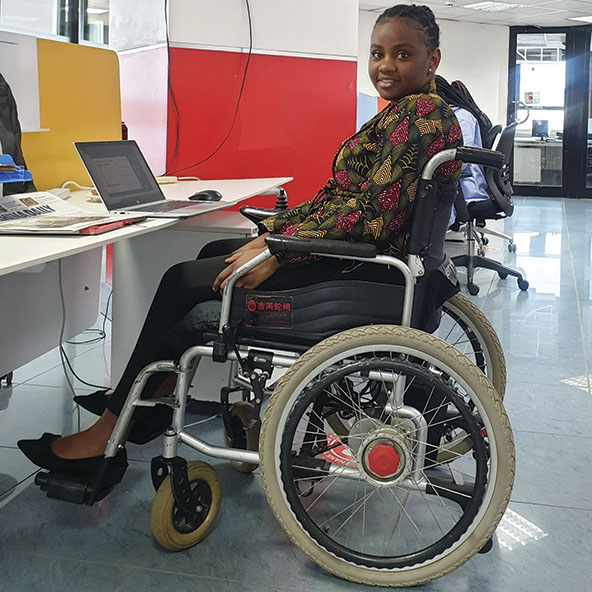
 Stella Muigai used Riziki Source’s job database to land her current position as a personal assistant to the CEO of one of Kenya’s biggest telemarketing companies. (Photo courtesy of Riziki Source)
Kenyan social entrepreneur and 2012 Ashoka Fellow Fredrick Ouko
knows what it’s like to struggle to find a job as a disabled person. He contracted polio at the age of 2, which left both of his legs permanently paralyzed. After completing his undergraduate degree at the University of Nairobi in 2012, he applied for countless jobs but received only one in-person interview with a prestigious multinational company based in Nairobi.
“As I sat in the waiting room,” he remembers, “I noticed the other candidates—all of whom were able-bodied—being called in for interviews that lasted the standard 20 minutes. But, to my dismay, I was given only five minutes.” The disparity struck him deeply. “It became clear to me that the playing field was not level.”
The employment rate in Kenya is 74 percent among the general population, but it is only 1 percent among people with disabilities. Disabled job seekers confront prejudice, cultural stigma, and other significant obstacles on the job market, from inaccessible buildings and offices to ableist attitudes that discredit the disabled job seeker’s qualifications. Such biases and impediments persist despite clear evidence, including a 2020 study by the Kenya Institute for Public Policy Research and Analysis (KIPPRA), that people with disabilities are just as productive and reliable as workers without disabilities.
Ouko’s struggle to find employment motivated him to create Riziki Source in 2015, five years after founding the Action Network for the Disabled, a nonprofit with the mission for disabled social inclusion. A Nairobi-based social enterprise, Riziki Source aims to help Kenyans with disabilities like himself access job opportunities, secure permanent employment, and flourish as entrepreneurs.
Riziki means “livelihood” in Swahili, Kenya’s national language. The word also represents Ouko’s goal of building pathways for people with disabilities to thrive both in the labor economy and in their own lives.
The enterprise’s programming concentrates on education and skill building to help disabled people. “We focus on developing essential soft-skills training, including but not limited to communication, teamwork, leadership, self-advocacy,” explains Hassan Oyugi, Riziki Source’s business development officer. “By emphasizing these valuable skills, we aim to make our job seekers more appealing to employers.”
In the first half of 2023 alone, Riziki Source trained 437 people with disabilities, facilitated gainful employment for 17 of them, and provided workplace-inclusion training to 38 employers. To date, the enterprise has helped 850 disabled people secure full-time employment and has trained hundreds more.
Professional Empowerment
The public need that Riziki Source seeks to fill is stark. One in two Kenyans with disabilities—nearly 500,000 people—live in poverty because of lack of job opportunity, job security, and employment benefits. Higher levels of poverty, in turn, correlate with worse health outcomes, as the World Bank reported last year. The Kenya National Bureau of Statistics’ 2020 Comprehensive Poverty Report found that disability is a strong indicator of multidimensional poverty—poverty along multiple dimensions from health care and housing to education and basic sanitation—across all age demographics. Youth with disabilities, for example, “have nearly a 15-percentage point higher probability of being multidimensionally poor” than peers without disabilities. With only 10 percent of the nation’s disabled children in school, the disabled community faces an uphill battle when it comes to their welfare.
Riziki Source has stepped in where businesses have ignored the problem and government efforts have fallen short.
In response to these dire statistics, Kenya has passed several laws to eliminate the social and economic barriers faced by disabled people. In the 1990s and early aughts, the government created organizations such as the National Council for Persons with Disability (NCPD) and the National Fund for the Disabled of Kenya to foster the social integration of people with disabilities. Yet these organizations have struggled to create the necessary systemic and culture changes to help Kenya’s disabled population, in part because they have been mired in accusations of embezzling funds and wasteful spending. Legislation like the 2020 Persons with Disabilities Bill promised to secure 5 percent of all private and public sector jobs for people with disabilities. Yet the goal remains unattainable because the nation lacks the infrastructure to accommodate people with disabilities in the workplace.
Riziki Source has stepped in where businesses have ignored the problem and government has fallen short. Its approach encompasses four pathways designed to empower people with disabilities at various stages of professional development.
The enterprise’s capstone project, the Riziki Source app, is a mobile platform built and launched in 2020 that connects disabled job seekers with employers through its disability employment database. People can register for free, and all registered users can access the database’s job opportunities for free, too. Job seekers can include their disability, qualifications, skill sets, and location on their profile. Riziki Source then uses this information to match job seekers with potential employers, who, if they are interested in the candidate, contact Riziki Source to manage the interview and hiring process. In addition to the database, the platform offers disability mainstreaming training for employers seeking to develop their inclusive practices and workplace cultures to accommodate disabled employees.
Riziki Source also launched in 2020 Riziki Shop, a marketplace where disabled Kenyans can sell their goods and services directly to consumers. The marketplace initially operated within the physical location of Riziki Source’s Nairobi office, but since the COVID-19 shutdowns, the marketplace has moved online.
In 2021, Riziki Source created a youth-employment accelerator program called Tuchape Kazi, Swahili for “let’s work.” Through this initiative, Riziki Source’s staff provide free mentoring and guidance to disabled youth. A year later, Riziki Source established a consultancy to advocate for disability inclusion in the workplace. Its staff trains organizations on best practices, policies, and legal frameworks related to disability rights, with the mission to create welcoming workplace cultures.
Financial Boosters to Expansion
Ouko launched Riziki Source with 215,000 Kenyan shillings ($1,500) from his personal savings. Grants and monetary prizes have financially buoyed the organization, including a $20,000 grant from the NCPD in 2018. The year prior, Riziki Source was shortlisted for the Africa Prize for Engineering Innovation, sponsored by the Royal Academy of Engineering. The accolade offered training support for its staff, who were taught how to craft fundraising proposals and business plans to help scale the enterprise.
When COVID-19 struck, Riziki Source pivoted their operations and fundraising objectives to account for a workforce required to work remotely. A 2.2 million Kenyan shillings ($15,000) grant from the NCPD, Ouko says, “helped us stay afloat during those challenging times,” including keeping its entire team of 26 employees on payroll. A part of the grant was also used to provide mental-health-support services for its employees as well as its database users. “These services were essential in a time of heightened stress and anxiety of such a period of uncertainty,” Oyugi notes.
In addition, the Mastercard Foundation awarded Riziki Source a $140,000 innovation grant, which Ouko calls “a real game-changer, because it has enabled us to expand our activities nationwide.”
Catherine Ndioo, the Mastercard Foundation’s country lead for program communications, says that the foundation was inspired by Ouko as the “living proof that one can overcome personal challenges to achieve excellence.” Its large investment, Ndioo adds, reflects Riziki Source’s success “as the driving force in transforming the employment landscape for individuals with disabilities.”
Ouko believes the enterprise can capitalize on its success to expand its reach across East Africa in the coming year. Now having expanded its team to 34 employees, Riziki Source has the capacity to grow not only across the region but also, Ouko asserts, across the continent.
“In the next five years,” he says, “our goal is to establish ourselves as the foremost authorities in the realm of employment for people with disabilities across the African continent.”
Read more stories by Charles Wachira.