


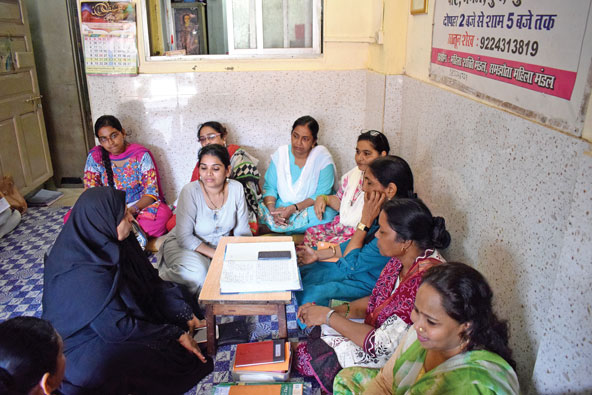
 Female qazis listen as a Muslim woman describes her ordeal at the Bharatiya Muslim Mahila Andolan office in Mumbai. (Photograph by Puja Changoiwala)
Every time her alcoholic husband beat her, 42-year-old Zeenat Shaikh silently cowered in a corner of her Mumbai apartment. Shaikh attempted suicide many times to put an end to the consistent abuse over two decades of marriage. But her darkest moment, she says, was in December 2016 when her husband sent her a WhatsApp message with the image of a handwritten document abruptly announcing their divorce. Her thoughts went to her daughters, whom she could not support on her own.
Shaikh rushed to the local qazi—a cleric in Islamic family courts—who’d officiated the breakup on paper. He told her that under Muslim Personal Law, a special statute that governs family matters such as marriage, divorce, inheritance, and custody of children for Muslims in India, a man could divorce his wife by pronouncing “talaq” (the Arabic word for “divorce”) three times before a qazi.
“I refused to accept the divorce, and walked out. But my husband left me anyway,” says Shaikh, who then filed a petition attempting to invalidate the separation.
Although India has a strong judiciary and constitution, the country’s family affairs are not governed by a single, secular law but by a system of legal pluralism. Various religious groups have their own parallel extrajudicial systems, and for India’s 172 million Muslims, marriage, divorce, domestic disputes, and justice under Sharia law are overseen by qazis, who are historically men.The Supreme Court of India recently held triple talaq unconstitutional, bringing hope to Shaikh and many other Muslim women. But the judgment has done little to hold clerics accountable for other injustices against Muslim women.
Bharatiya Muslim Mahila Andolan (BMMA), a secular women’s rights organization led by Muslim women in India, is working to change that. To counter the male-dominated clergy, BMMA is training Muslim women in tenets of the Quran, the Indian constitution, and women’s rights law. After a year of study, 15 women graduated as the country’s first female qazis in April 2017. The clerics, age 25 to 65, now work in seven states across India. They have varying levels of education, from primary school dropouts to college graduates, but are united by a common desire to achieve gender equality for Muslim women.
Noorjehan Niaz, cofounder of BMMA, says many male clerics hold “extremely patriarchal” views that justify practices such as unwarranted separations, polygamy, and nikah halala, which requires a divorcée to first marry another man and consummate the marriage if she wishes to remarry her first husband.
“We’re trying to bring a structural change, where female qazis, who understand issues plaguing Muslim women better, are leading gender justice for the community through progressive and liberal interpretations of the Quran. The motive is justice for women by women,” says Niaz.
The new qazis have achieved some success arbitrating personal issues such as domestic violence and inheritance disputes. But collectively, they’ve overseen just one divorce and have not yet officiated a marriage. They say they have yet to be approached with requests for legitimate marriages.
Unlike many of their male counterparts, the women qazis refuse to honor marriages without proper documents and decline to perform child marriages.
Before training more women, BMMA is trying to make the first cohort more consequential, Niaz says. Her group is raising funds and raising awareness about their presence through other women’s organizations and social media.
“When we announced we’d become clerics, male qazis created a furor,” says Rajasthanbased qazi Nishat Hussain. “Male clerics stated that women can’t become qazis, that it had never happened before. But we pointed out that the Quran dictates no such restriction,” she says.
Advocates cite the need to move away from religion-based personal laws and toward a uniform civil code, but Audrey D’Mello, director of the women’s rights organization Majlis, says the diverse country isn’t prepared for that yet.
“Gender justice and uniformity of rights should be embedded in personal laws, and have to come from within communities, instead of being passed as statutes from the center,” D’Mello says.
Any step aimed at helping vulnerable women, should be encouraged, she says. “Qazis are means of dispute resolution for Muslim women, and anyone who plays the role, male or female, is important.”
Karnataka-based qazi Nasreen Matai cites poetic justice each time she arbitrates favorably for a woman. In 2011, Matai lost her 23-year-old sister to hypertension after the woman’s in-laws abandoned her, leaving her unable to afford treatment. Her sister had given birth to a girl, and the family wanted a male heir.
“I don’t know how successful women qazis will be in my lifetime—if we’ll have the acceptance male clerics enjoy—but our efforts will benefit future generations of Muslim women in India,” Matai says. “Had I been a qazi seven years ago, my sister would’ve lived.”
Read more stories by Puja Changoiwala.