


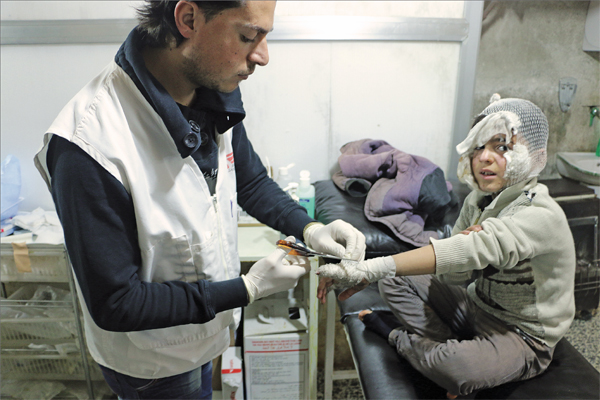
 A Nations’s Wounds: An MSF
team member tends to a boy at
a displaced persons camp during
the Syrian civil war in 2015. (Photo by Martin Zinggl, courtesy of MSF France)
A Nations’s Wounds: An MSF
team member tends to a boy at
a displaced persons camp during
the Syrian civil war in 2015. (Photo by Martin Zinggl, courtesy of MSF France)
Rony Brauman was president of MSF France from 1982 to 1994. It was a period, he notes, when he and his colleagues often engaged in vigorous debates about the use (and misuse) of corporate philanthropy. He recalls, for example, a meeting of the MSF France board of directors in 1987 that dwelled at considerable length on a coffee packet. The maker of the coffee packet, a large French corporation, proposed to make a donation to MSF France for every packet that it sold. As part of this arrangement, each packet would feature the MSF logo. Brauman and his colleagues talked over the advantages and disadvantages of the offer: Accepting it would not only bring in welcome funding but also allow MSF France to reach large numbers of potential new supporters. Yet for MSF France, the implications of associating its brand with the brand of a for-profit company were troubling.
The debate about the coffee packet went on for most of an afternoon. Then the board voted to reject the company’s offer. Brauman, in retrospect, suggests that the board might have used that time more productively. But he also notes that discussions of this kind are a vital part of the MSF France culture. The debate in 1987 touched on something that was fundamental to the organization’s identity: its need to preserve complete independence from governments, corporations, and other institutions that might try to influence its work.
“I believe that companies can make a valuable contribution. But their involvement can never be entirely neutral,” says Brauman, who now serves as director of research at CRASH, a think tank operated by MSF France. During the period of his leadership, MSF France was relatively open to receiving corporate funds. Even so, Brauman recalls, he often expressed skepticism about business involvement in the organization’s activities. “It’s important not to confuse the objectives of a company [with those of] an NGO,” he says.
Over the course of more than 40 years, MSF France has dealt in various ways with the tension between its principled commitment to independence and its pragmatic involvement with corporate benefactors. The story of how MSF France has confronted this challenge—how it has maneuvered around the traps and temptations that come with accepting corporate support—has broad implications for other organizations of its kind. Every NGO must wrestle with the question of whether and how to seek donations from for-profit companies. Such donations can provide a lifeline that enables an NGO to do good work on a meaningful scale. But they often come with strings attached. And the companies that offer them may engage in activities that contradict the NGO’s mission.
Brauman observes that corporate partners can offer more than financial support. They can also offer valuable expertise and important capabilities. They can even offer passion and commitment. “When companies give to MSF, they feel that they are beside us, at the front line, tackling humanitarian catastrophes,” he says. And yet, he notes, companies also make “decisions that may be important for them but [that] are not necessarily for the common good.”
Striking a Balance
MSF France is the founding branch (or “section”) of MSF International, a global NGO that encompasses 24 country sections. MSF stands for Médecins Sans Frontières. In the United States and Canada, the organization goes by the name Doctors Without Borders. Best known for its humanitarian work during crises such as the earthquake in Haiti in 2010 and the Ebola outbreak in West Africa in 2014-2015, MSF also works to confront persistent health problems, such as high maternal mortality rates and the spread of HIV/AIDS. MSF France has an operational presence in 35 countries, and each year about 6,000 health professionals from around the world volunteer to work on its field projects. In 2014, the organization had an annual operating budget of 254 million euros (about $300 million).
The vast majority of MSF France’s revenue comes not from corporations or public institutions, but from individual donors. Indeed, that source accounts for more than 70 percent of its funding. By engaging with a large number of individual donors who share its values and admire its work, MSF France has been able to ensure that no single donor (corporate or otherwise) can exert undue influence on its strategic and operational decisions. In other words, its drive to preserve its independence has proven to be a smart financial investment.
Today, however, after a period of neglecting corporate sources of support, MSF France is working to increase the share of its resources that comes from for-profit companies. MSF France now maintains 15 corporate partnerships, and several of them involve long-term relationships in which companies not only provide funding but also contribute technical expertise and logistical resources to MSF field projects. But these partnerships account for a small portion of the organization’s total revenue. In 2014, French companies and corporate foundations contributed 1.4 million euros (about $1.6 million) to MSF France—which is a mere 2 percent of the income that the organization raised from domestic sources. Across the MSF movement, meanwhile, sections raise an average of 8 percent of their funds from corporate donors. MSF International has set a goal of increasing the share of revenue that the movement collects from corporate sources to 10 percent. The leaders of MSF France say that they fully support that goal.
But moving in that direction is hardly a simple matter for an organization that fiercely protects its autonomy. Corporate partnerships that involve any kind of potential compromise of its integrity can inspire dissent, or at least skepticism, from staff members and other stakeholders. “There’s a tendency to think that we shouldn’t work with a corporate partner that offers anything less than a large, unconditional donation,” says Mélanie Cagniart, director of fundraising at MSF France.
Viewed from one perspective, the continuing debate within MSF France over corporate funding might seem like a sign of failure: By now, shouldn’t the organization have achieved a greater sense of clarity regarding this crucial strategic issue? Other NGOs, after all, have made a definitive choice either to embrace or to reject corporate partnerships. (See “All or Nothing,” below.) But MSF France has purposely followed a less categorical approach. Although the pendulum of its official policy has swung in one direction or another at various moments in its history, leaders of the organization have maintained a steady commitment to exploring the limits of what counts as acceptable corporate support. “As an organization, we’re forever seeking our balance,” says Brauman.
Launching a Movement
The history of MSF France and its engagement with corporate philanthropy has unfolded in a series of five stages. The first stage began in 1971, with the founding of MSF. (The organization of MSF into separate country-based sections occurred later.) That year, at the height of the Biafran war in Nigeria, a group of young French doctors were working in that country under the aegis of the International Committee of the Red Cross (ICRC). These doctors observed human rights abuses that they wanted to denounce publicly. But the ICRC, in order to secure the cooperation of the Nigerian government, had imposed a policy of silence on people who were taking part in its humanitarian aid mission. For these young doctors, that policy was unacceptable. They believed that bearing witness to human rights abuses was no less important than tending to victims. In December 1971, along with a group that included journalists and other doctors who had engaged in humanitarian aid work, they launched MSF.
From the start, then, a zealous regard for independence lay at the heart of the MSF mission. Indeed, to this day the MSF charter requires its sections to “maintain complete independence from all political, economic, or religious powers.” In its early years, however, MSF struggled to create an operating model that matched this lofty ideal. Without significant resources of its own, the organization was little more than a group of doctors who worked for other aid agencies.
During the 1970s, MSF underwent a crisis that would define how it pursues its goals. The organization divided into two camps: the “legitimists” and the “independentists.” The former camp argued that MSF should operate only with the consent of local governments and that it should rely on the infrastructure of international aid agencies to deliver services. The latter camp contended that MSF should develop its own logistical capacity, so that it could respond to emergencies without needing to gain the support of those entities. Ultimately, the independentist camp won the debate—and thereby established the principle that MSF should be accountable only to the collective conscience of its staff members and supporters.
Over time, MSF built an operational infrastructure of impressive global reach. (Today its logistics subsidiary has more than 100 staff members who, when a crisis occurs, can dispatch supplies to an affected area in less than 48 hours.) But during its first decade, the organization lacked the resources that it needed to operate on a scale that matched its ambitions. It received a limited amount of funding from the European Union, but otherwise it was dependent on the somewhat unpredictable generosity of the French public.
Building a Donor Base
The early 1980s marked the start of a second stage in the evolution of MSF France. In response to changing global conditions, the organization undertook a fast-growing array of field projects. The need to support those projects drove MSF France to professionalize its fundraising operations. That effort took place on two fronts. First, the organization moved to develop a stream of donations from committed individual supporters. Second, it began to cultivate donors from the corporate world.
With notable success, MSF France was creating a fundraising base among individual donors. In 1980, its president at the time, Claude Malhuret, led a fact-finding mission to the United States, where he and his colleagues learned about direct-mail marketing and other techniques that had become a central feature of US political campaigns. MSF France adopted those techniques at a time when few other NGOs saw the potential of this form of outreach. Its first foray into this kind of fundraising took place in 1982 and yielded a response rate that was 60 times as high as the rate that its leaders had expected.
In parallel with targeting individual donors, MSF France took steps to connect with people in the corporate sector. “It was a time when the role of private enterprise was being widely commended in France, a time when NGOs and businesses were enjoying a period of mutual discovery,” Brauman recalls. He and his colleagues tapped into the networks of existing MSF France supporters who came from the business world. By 1987, they had formalized the role of corporate donors by creating the MSF France Supporters Committee. The committee consisted entirely of CEOs, and MSF France recruited members with the expectation that they would arrange for their company to make an annual contribution to the organization. Supporters from the private sector also contributed valuable expertise and connections. MSF leaders, for example, drew on the assistance of people from a French-American law firm and from the bank BNP Paribas to launch an MSF outpost in the United States in 1990.
Also during this period, the MSF movement underwent an institutional change that had significant implications for the way that MSF France raises funds. The movement encompasses five operating sections that take responsibility for conducting field operations: MSF Belgium, MSF France, MSF Holland, MSF Spain, and MSF Switzerland. In the late 1980s, MSF began to launch “partner sections” to support the work of the operating sections. Each partner section has a mandate to raise funds and to recruit volunteers for a single operating section. (Partner sections also support MSF activities by contributing medical expertise, research capabilities, and communication assistance.) Through this structure, MSF has opened up new sources of donor support. Today three sections—MSF Australia, MSF Japan, and MSF USA—provide more than 60 percent of the income that MSF France receives from private (individual as well as corporate) donors.
As country sections grew in number and began to develop separate identities, the interactions between them became increasingly complex. So in 1991, leaders from those sections formed MSF International to serve as a body that could coordinate the activities of the entire MSF movement.
Reckoning with Conflict
The third stage in the history of MSF France and its interaction with corporate philanthropy overlaps in part with the second stage. Even as the organization explored the benefits of attracting private-sector support, the potential costs of engaging with corporate benefactors became vividly apparent.
In 1983, Brauman led an exploratory mission to Angola amid that country’s long civil war. The warring factions in the conflict were two former liberation movements, each of them known by an acronym: UNITA and the MPLA. Brauman’s team traveled to UNITA-held territory and helped negotiate the release of a group of hostages. While he was in that territory, Brauman made statements to the press about the humanitarian situation there, and those statements irritated people in the MPLA-controlled Angolan government. After he returned to France, Brauman held a meeting with several corporate sponsors. One of them, the CEO of a big French oil company, used the occasion to reprimand Brauman. This executive—whose company, as it happens, was extracting oil in Angola at the time—suggested that it was inappropriate for an MSF France official to comment publicly about the Angolan conflict. In reply, Brauman asserted that he would not tolerate any interference in MSF France policy by a corporate partner. “I have always been more than ready to accept criticism,” he says. “But to question [our] right to express [our] opinions freely was something else entirely.”
That clash foreshadowed a later conflict. In 1992, MSF France published a book titled Populations in Danger, which provided an overview of conflicts around the world that were causing humanitarian crises. The book also discussed the causes of those conflicts. Ernest-Antoine Seillière, the CEO of a prominent French company and a member of the Supporters Committee, objected to the project. He said that the book was an excursion into politics and that it did not align with his conception of MSF’s role. Brauman responded with fury: He was ready to “launch an atomic bomb” and to disband the Supporters Committee, he recalls. Seillière, alarmed by Brauman’s show of resolve, accepted that there were limits to the influence that corporate partners could have on MSF policy.
Two years later, MSF France did change how it interacts with the Supporters Committee. In light of the difficulties that had arisen from engaging with CEOs on the committee, the organization stopped requiring them to make an annual contribution to MSF France. (The committee still exists, but it mainly serves as a consulting body.)
Avoiding Engagement
Disillusionment with corporate donors led MSF France to enter into a fourth stage in the development of its orientation toward corporate philanthropy. In this stage, the organization largely refrained from entering private-sector partnerships. Two developments reinforced this shift. First, over the course of the 1990s, the income that MSF France raised from small donors through its partner sections grew steadily. Then, in 1999, MSF International won the Nobel Peace Prize. In announcing the prize, the Norwegian Nobel Committee highlighted the value of MSF’s commitment to autonomy: “National boundaries and political circumstances or sympathies must have no influence on who is to receive humanitarian help. By maintaining a high degree of independence, [MSF] has succeeded in living up to [this ideal].”
International recognition caused popular support for MSF to grow even faster, and an increase in revenue from individual donations reduced MSF France’s dependence on corporate funding. Those donations had an additional benefit: More often than not, they were unrestricted. Corporate funds, in contrast, often came with conditions that limited the freedom of MSF France to deploy them. In many cases, for example, companies wanted to direct their contributions toward use in specific humanitarian crises. MSF France no longer had to accommodate that kind of demand. “We could allow ourselves the luxury of turning down donations,” recalls Ann Avril, a member of the MSF France fundraising team from 2000 to 2007 and deputy head of fundraising from 2004 to 2007.
ALL OR NOTHING
The World Wide Fund for Nature (WWF) and Greenpeace both work globally to advance environmental causes. And both organizations have adopted clear policies about the use of corporate money—policies that stand in contrast to the nuanced and continuously evolving approach that MSF France has pursued. Yet those policies are starkly different from one another.
Working with corporations forms a core part of WWF’s strategy. Its leaders believe that engaging with well-intentioned companies can do more to advance WWF’s mission than criticizing companies that behave irresponsibly. “It’s our conviction that we need economic actors to attain our environmental goals at an international level,” says Nicolas Loz de Coëtgourhant, corporate engagement manager for WWF France. “We seek to raise companies’ and governments’ ambitions, so that today’s good practices become tomorrow’s norms.”
WWF France now maintains partnerships with 35 companies, including the large supermarket chain Carrefour and the tire manufacturer Michelin. Although WWF eagerly pursues corporate support, it also places limits on this kind of engagement. Its leaders have decided that no more than 30 percent of its income should come from corporate sources. (Today corporate giving accounts for 10 percent of its income.) And like MSF, WWF will not accept funds from companies whose revenue derives from fossil fuels, armaments, or tobacco.
At Greenpeace, leaders have adopted a policy of shunning corporate philanthropy entirely. They cherish the freedom to operate without any risk of external influence. “Our regular donors are reassured by our position,” says Susanna Dell’orto, a fundraiser at Greenpeace France who works with major donors. That policy, she adds, “extends beyond limiting firms’ influence [and involves] refusing governmental funding, too.”
Each of these organizations can trace the roots of its policy on corporate philanthropy back to its beginning. The founders of WWF were intellectuals who had connections, either personally or through think tanks, to business leaders. The founders of Greenpeace were activists who came together in the early 1970s to protest US nuclear testing in Antarctica. In neither case, moreover, has the organization’s policy generated much internal debate. “Working with corporates is a key pillar of our approach,” says Loz de Coëtgourhant.” Dell’orto makes a similar point about her organization’s approach: “Independence is in our DNA.”
At no point did MSF France adopt an official policy of refusing all corporate support. But leaders of the organization concluded that pursuing corporate donations was no longer worthwhile. Stephan Oberreit, head of fundraising from 2000 to 2006, made this point publicly during his tenure in that position. “MSF France has neither the desire nor the financial and human resources necessary to actively solicit corporate support,” he said. In practice, the organization went beyond merely opting not to court corporate donors. “When corporations approached MSF to offer money, the offer was refused if MSF France judged that the money came with too many strings attached,” Avril explains. “As a general rule, we refused all corporate support. I can count on the fingers of one hand the number of corporate partnerships we had.”
In seeking to limit its exposure to reputational risk, MSF France set a very high standard. In 2007, for example, a large French supermarket chain offered MSF France a donation of 150,000 euros (about $180,000) for relief efforts in the aftermath of an earthquake in Guatemala. But the company marketed a house brand of coffee that was produced under harsh working conditions—or so MSF France leaders suspected. For that reason, they declined the offer.
Receiving the Nobel Peace Prize made MSF France highly attractive to would-be corporate donors. For a while afterward, its leaders often had to explain why they had rejected certain donation offers. But then donors got the message about its strict policy. “Eventually, corporates stopped approaching us,” Avril says.
Reclaiming “Territory”
The evolving relationship between MSF France and for-profit companies is now in a fifth stage. In 2012, Filipe Ribeiro, the director general from 2009 to 2013, led a process in which the MSF France board explored the prospect of increasing the amount of funds that come from corporate sources. “We found that it was a false taboo—that there was no problem in principle with accepting corporate money,” says Stéphane Roques, who took part in that exploratory process and who later succeeded Ribeiro as director general. Roques recognizes the potential of corporate support to help MSF France grow both in size and in effectiveness. “We’ve invested less in corporate philanthropy over the last 10 to 20 years than we could have. Now we’ve decided to reconquer this territory,” he says. In 2014, MSF France hired a new staff member with a newly created position—Benoit Muller, director of corporate partnerships—to help lead that campaign.
This change in policy involves challenges that originate both inside and outside the organization. Although people within MSF France are open in principle to accepting corporate funds, some of them have expressed unease about specific gifts. “When we get into the details about how far we’ll to go to attract funding, then the pride of MSF emerges,” says Cagniart. “Some see large companies as having the means to give us a million euros without asking for anything in return, but that’s an unfortunate misunderstanding about how companies operate.”
Externally, MSF France is beginning to make up for years of neglect in its relationship with potential corporate donors. It needs, first of all, to show that it is open to accepting their support. Muller, since he took on his current role, has met with executives at several banks who were under the impression that MSF France would categorically refuse any offer of corporate funding. “The Red Cross and UNICEF have been active in this space for 20 years or so. When disaster strikes, corporations and their foundations naturally turn to them,” he says. “Our job today is to make MSF France and its brand accessible to these captains of industry.”
Reaching “captains of industry,” in fact, is central to the current strategy of the organization. Under Ribeiro, MSF France focused on forging small-scale partnerships with firms whose brand has a strong affinity with MSF’s humanitarian aims. Roques, however, has put an emphasis on developing significant, long-term partnerships with large, prominent French companies.
Working Within Guidelines
Even as MSF France moved ambitiously to attract corporate support, there was a countervailing effort in the MSF movement to limit the range of support that member sections could legitimately accept. Starting in 2007, the heads of fundraising from every country section, together with the coordinator of international fundraising for MSF International, took part in a consultative process that aimed to develop a coherent policy on which kinds of companies count as suitable donors. The result was a document called the Corporate Guidelines. The MSF movement adopted the guidelines in 2010, and all MSF sections now must follow them.
The guidelines include a “black list” of industries that are off limits: No MSF section can receive funds from a firm that makes more than 10 percent of its annual revenue from armaments, extractive industries, pharmaceuticals, or tobacco. The document also advises caution in the case of money that originates from “gray list” industries, which include gambling and alcoholic beverages. In addition, the guidelines suggest applying an affinity test to companies in potentially problematic industries, such as luxury goods and agribusiness.
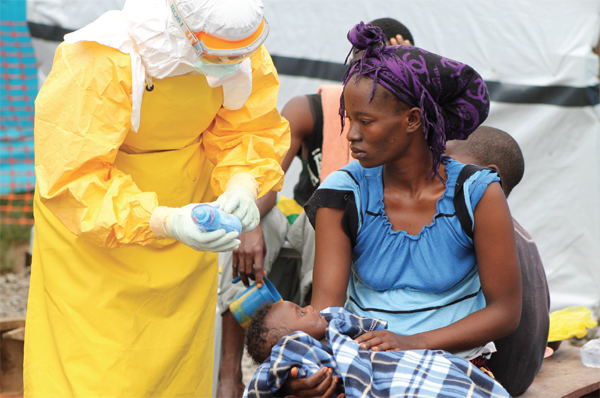 Show of Support. In 2014, during
the Ebola epidemic in West Africa, a woman and her child receive aid from an MSF team member in Foya, Liberia. (Photo courtesy of MSF France)
Show of Support. In 2014, during
the Ebola epidemic in West Africa, a woman and her child receive aid from an MSF team member in Foya, Liberia. (Photo courtesy of MSF France)
For MSF France, finding partnership opportunities that meet the requirements of the Corporate Guidelines has proved to be challenging at times. In 2013, the organization agreed to accept support from the Airbus Helicopters Foundation. The foundation proposed to cover some of the costs of helicopter flights for MSF doctors who were working in the Philippines in the wake of Typhoon Haiyan. Helicopter flights, which cost about two million euros (about $2.4 million) annually, represent a significant expense for MSF sections. Airbus Helicopters also offered to provide advice to the organization on managing the MSF helicopter fleet. Roques and Cagniart were confident that Airbus Helicopters aligned with the spirit of the Corporate Guidelines: The company fabricates military as well as civilian helicopters, but clients that buy military helicopters use that equipment for civil protection in more than 80 percent of cases.
But when Cagniart and Roques presented the deal at a meeting with its partner sections, they encountered serious resistance. Leaders of those sections argued that MSF France, by engaging with the blacklisted arms industry, was putting MSF’s reputation at risk. Ultimately, MSF France had to end the Airbus Helicopters partnership.
MSF France leaders acknowledge the need for broad principles and international norms, but they raise concerns about how the Corporate Guidelines work in practice. “There are companies that are on neither the gray list nor the black list whose image poses more of a problem than some companies that are on the black list,” says Roques. Companies that are on neither list include, for example, the large banks that arguably helped cause the 2008-2009 financial crisis. Airbus Helicopters, meanwhile, is on the black list. Other leaders point out that the guidelines give rise to inconsistencies. Cagniart and Brauman cite the case of MSF United Arab Emirates, which raises funds largely from donors who have made their money from oil: If donations from companies in extractive industries are unacceptable, why is private wealth that derives from those industries acceptable?
Roques and his team plan to broach the idea of reviewing and revising the Corporate Guidelines in the near future. “We want to move beyond a black-and-white conception of firms and toward a global assessment of their contribution,” Roques explains. The goal of MSF France, he adds, is to “work with firms whose CSR policy makes them best in class.”
Forming a Partnership
The restrictions of the MSF Corporate Guidelines have not prevented MSF France from developing and sustaining successful corporate partnerships. Consider the case of BNP Paribas, a large Paris-based bank. In 2011, the bank was looking for a way to channel the generosity of both its staff members and its customers in the wake of humanitarian crises. In consultation with MSF France, BNP Paribas created the Emergencies & Development Fund, which matches every euro that a staff member or customer donates with a euro from the bank’s own resources. Since the launch of the fund in 2012, BNP Paribas has distributed more than 1.2 million euros (about $1.3 million) in equal shares to three NGOs: CARE International, the Red Cross, and MSF France.
BNP Paribas made the first move in forging this partnership. And when the bank made that move, MSF France responded by emphasizing its independence and by insisting on the need to screen the bank for practices that might violate its Corporate Guidelines. In the end, the exacting standards of MSF France did not deter the bank.
Over the past three years, the relationship between MSF France and BNP Paribas has evolved considerably. “[MSF France has] gone from being the partner with whom we had the most tricky relationship to being the partner with whom we can be most open,” says Laurence Pessez, director of social responsibility at BNP Paribas. During this period, she notes, MSF France has undergone a change in leadership that reflects a changing attitude toward corporate philanthropy. (She cites the rise of Roques to director general and the appointment of Muller.) At the same time, Pessez suggests, BNP Paribas has earned the trust of MSF France leaders through its willingness to direct funds toward projects—refugee relief in war-torn regions, for example—that corporate donors are not always eager to support.
The image of integrity that MSF France has maintained is a big part of what attracted BNP Paribas to the organization. But how many other corporate donors fit that mold? How many companies or company foundations have the ability and the inclination to make large financial commitments to an organization that puts such a high premium on protecting its autonomy? For a potential corporate donor, that commitment to independence (and the sterling public image that comes with it) can be a strong selling point—or it can be a troubling risk factor.
Despite such concerns, MSF France leaders have reason to be optimistic about their efforts to strike a balance between engagement and independence. As it has done for more than four decades, the organization is pursuing that balance by means of debate and discussion. There are times, of course, when the prospect of entering yet another round of dialogue causes exasperation among some staff members. But in an organization founded on the right to bear witness, progress could hardly unfold in any other way.
This article has been modified since its initial publication. A quotation at the end of the sidebar “All or Nothing” was changed to correct for a translation error.
Read more stories by Sarah Sandford, Anne-Claire Pache & Arthur Gautier.