


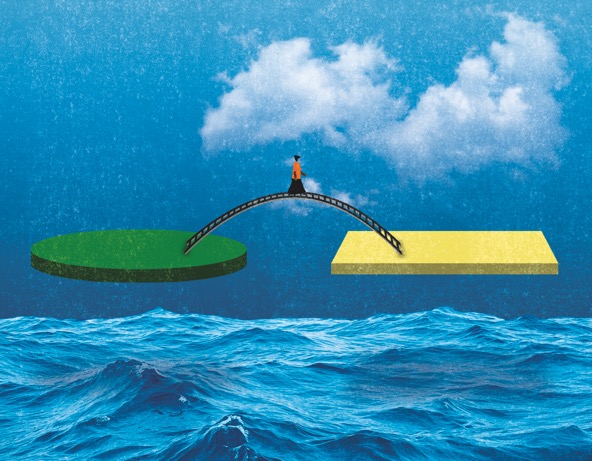
 (Illustration by Patric Sandri)
Much has been made in the popular press about the “vibecession”—the disconnect between macroeconomic data that indicate a strong economy and persistently pessimistic public sentiment, even among those who are relatively well off. Explanations vary, but most circle around the affordability of basic needs—housing, education, healthcare, childcare—and an online ecosystem that turbocharges conflict and negativity. There’s certainly validity to each of those ideas, but there may be more to it.
In this issue’s cover story, SSIR academic editor Mitchell Stevens and João M. Souto-Maior of the Stanford Center on Longevity tackle the complex challenge of bridging education and work. Go to college, get a degree, and you’ll be set for a well-paying career, or so the story went. But after decades of efforts to expand access, most Americans still don’t get degrees. Notably, the authors point to much more than college costs, although that is part of the problem. Educational attainment has itself become a major dividing line in society, and technological disruption means that even degree holders have growing doubts about whether the system is working.
In her feature, “Closing the Rental Wealth Gap,” Katie Deal recounts how homeownership and the 30-year mortgage became the dominant model for wealth-building and lifelong economic stability. Yet a third of American households aren’t homeowners, and an explosion in housing prices means the lower rungs of the wealth ladder are more and more difficult to reach. Many people are forced to move away from their work and their communities because they can’t afford homes.
Meanwhile, the authors of “Resourcing Appalachian Resilience After Helene” address a wicked combination of historic extraction, disinvestment, and environmental disaster. Their story shines much-needed light on a specific region, and it also makes clear how vulnerable the entire planet is to climate-driven devastation, especially when governments are unable or unwilling to provide a safety net.
Each of these stories responds to immediate, short-term economic challenges. Yet they are also about the longer-term loss of agency for individuals to live, work, and associate as they would like; a widespread sense that upward mobility is no longer realistic; and fear that the rug could be pulled out at any moment by forces way beyond their control. Bad vibes, indeed.
In these stories there are also points of light, however. For Stevens and Souto-Maior, what is needed is a new paradigm. Rather than “college for all” as a collective goal focused on credentials, they envision a “learning society” that recognizes, values, and supports different pathways and different kinds of learning across the life cycle. Deal shares examples of programs that are successfully shifting the wealth scales toward renters. And in Appalachia, the innovative projects, investments, and collaborations that have sprung up out of necessity may be scaled into transformative development and lasting resilience.
Commentators have warned that the vibecession may be a self-fulfilling prophecy; negative expectations can lead to further negative outcomes. Perhaps, then, this is a useful way to reframe one role of civil society and of publications like SSIR in this moment. What’s needed are the ideas, models, and civic infrastructure to make people believe that the future can once again be bright. A vibes stimulus.
Read more stories by Bryan Maygers.