


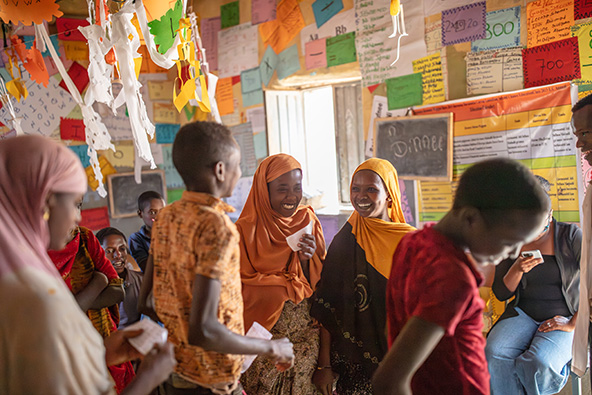
 Students Sebontu (middle left) and Hamdiya (middle right) have fun during an interactive math lesson in a Luminos classroom in Ethiopia. In contrast to rote learning—a common teaching approach across Ethiopia—Luminos classrooms prioritize interactive, activity-based learning. (Photo by Mara Chan for the Luminos Fund)
In a classroom in Uganda, a teacher writes a short paragraph on the blackboard: Nagawa ali ku ssomero ne banne. Abaana babuuka omuguwa. Omuguwa gwe babuuka gukutuka. Abaana basigala mu nnaku. Translation: “Nagawa is at school with her classmates. The children skip rope. The rope breaks. The children feel sad.” The teacher reads it aloud. The students repeat it in chorus. Again. And again. Twenty-three times. By the end, most students can recite the passage perfectly, but none can actually read and comprehend it.
This is the tragedy of educational systems focused on rote instruction. Children who learn only how to repeat familiar passages are not equipped with the skills they need to decode new words or read with understanding. Yet this approach to teaching is dominant across many low- and middle-income countries, and it’s one of the reasons why a staggering 70 percent of children in these countries can’t read by age 10. In response, many governments and development partners in countries such as Uganda, Liberia, and India have introduced “structured pedagogy” programs, which feature carefully sequenced lesson plans; a strong focus on phonics; teaching at an appropriate pace for early learners; and teacher training and coaching. However, even in programs that incorporate these “ingredients,” classroom practice often looks no different.
This points to a deep challenge for education reform: not just knowing what works, but ensuring that the necessary conditions are in place for what works to take hold in practice. The design of educational programs and the systems in which teachers operate—specifically, what systems prioritize and reward—shapes what happens in the classroom. Without engaging with these underlying incentives, even the strongest interventions will struggle to change practice.
Why Ingredients Alone Are Insufficient
Although school systems can generally provide the components of structured pedagogy programs at low cost, how they come together—the “recipe” that makes them work—ultimately determines whether or not students truly learn.
In their book Building State Capability, Harvard researchers Matt Andrews, Lant Pritchett, and Michael Woolcock categorize change processes according to the capabilities needed for implementation. They point out that some tasks, such as distributing vaccines or fertilizers, are largely logistical; they require many people, but each person performs a standardized action, and success is largely a matter of compliance. Shifting instruction through a structured pedagogy program, by contrast, falls into a category the researchers call “implementation-intensive service delivery.” These tasks also require many people, but each person acts autonomously, often in ways that go against behavioral norms and political pressure. Tasks like these also tend to be less successful than logistical tasks, and there are few examples of improvements sustained at scale.
It’s tempting to treat structured pedagogy as a logistical challenge—to assume that school systems and teachers who have the right ingredients can improve student learning across contexts. But successfully scaling up a structured pedagogy program requires that teachers fundamentally shift their behavior—their instructional practice—for many hours, every day. This often requires that they break away from approaches they experienced during their own education or have employed for many years, and adopt new ones.
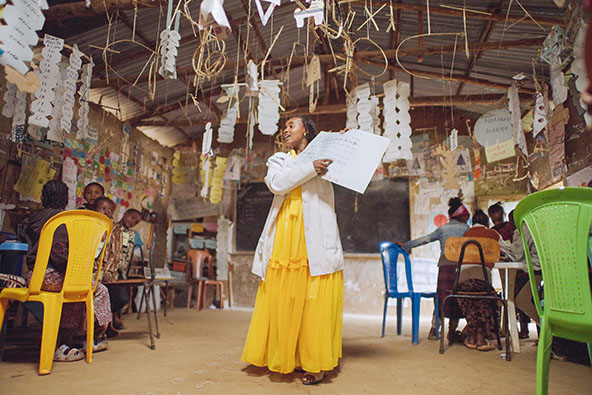 Roman, a primary school teacher in Ethiopia, explains a new lesson from her Luminos-created teachers’ guide. Roman learned how to use the teacher’s guide successfully through rigorous training and ongoing coaching, and continues to be motivated by the dramatic learning gains she sees in her students. (Photo by Mo Scarpelli for the Luminos Fund)
Research tells us that changing the behavior of any group of people is difficult and that it generally happens only with strong intrinsic motivation. Teachers are no exception. They will make dramatic changes only if they are highly motivated to do so. And, tragically, most education systems don’t incentivize practices that improve learning.
Why Systems Fail to Promote Deep Learning
Learning improvement is common rhetoric within education systems, but it’s seldom the organizing principle for decision-making, promotions, or budgets. Senior officials tend to define success according to metrics that travel easily through budget hearings, such as the number of classrooms built, teachers recruited, or textbooks delivered.
Improving foundational learning—which includes literacy, numeracy, and core socio-emotional skills—is far more challenging. Better outcomes in reading comprehension or basic math are difficult to achieve, slow to materialize, and hard to attribute. Furthermore, evidence shows that many government leaders underestimate the learning crisis. In a survey by the Center for Global Development, for example, policy makers from 86 percent of low- and middle-income countries assumed children in their country were able to read better than they actually could.
Institutions that neither encourage nor incentivize effective instruction—even if they have the right components on paper—struggle to achieve meaningful changes in instructional practice. Treating low learning outcomes as a layered challenge of politics, culture, and behavior rather than a purely logistical delivery problem fundamentally changes what the recipe for success looks like across the system.
The Top Layer: Politics
One of the reasons governments and donors often assume that learning is taking place is because education’s purpose can seem self-evident. But most education systems in low- and middle-income countries fail to prioritize learning, focusing instead on goals such as access, process compliance, and patronage. As just one example, the majority of speakers at the Transforming Education Summit in 2022, a gathering of global education leaders in the wake of COVID-19, talked about edtech, employability, and inclusion, but very few spoke about improving learning—and when learning isn’t the primary measure of system success, it’s unlikely that it will shape decisions on budgets, policy, or implementation.
Encouragingly, several countries are building momentum around prioritizing foundational learning. South Korea, Vietnam, and Brazil are historical examples of countries that have aligned their education systems with the purpose of learning and have achieved dramatic improvements in learning outcomes as a result. More recently, in 2020, India made foundational learning the central goal of its education system, and there are already signs of success in improving learning outcomes. And, across Africa, initiatives such as the Foundational Learning Exchange, a high-level African conference focusing on foundational literacy and numeracy, and the Foundational Learning Initiative for Government-led Transformation, a government-to-government collaboration aiming to improve learning, are beginning to shift attention in a similar direction, with several countries stating that foundational learning will be a major policy priority.
The Middle Layer: Culture
Commitment from government teacher trainers, classroom supervisors, and advocates who can translate policy into a culture of effective instruction is another necessary part of the mix, even though building this cadre of “culture catalysts” from scratch is no easy task. Many people in these roles have never experienced high-quality instruction themselves, and must learn both new approaches to teaching and how to cultivate those practices with teachers.
Still, it’s possible, and Luminos Fund’s work in Ethiopia helps illustrate what can happen when it’s successful. Since 2022, the fund has worked with the Ethiopian government to design and scale structured pedagogy programs that improve foundational skills while also helping shift the culture of the system around the classroom through hands-on training and coaching with government-employed classroom supervisors. Recent focus group discussions with supervisors involved in the program revealed a cultural shift in how they approach their role; rather than treating supervision as a box-checking administrative exercise, they now see themselves as enablers of effective instruction. As one supervisor in Sidama explained, “Teachers now invite supervisors to observe their classes ... We work together like a family to support student learning.” A supervisor in Tigray remarked, “Before, my approach with teachers was more controlling ... Now I focus purely on supporting teachers, and our relationship has become more horizontal.”
These shifts have led to dramatic gains in learning outcomes. Luminos research showed that learners in the classrooms with structured pedagogy read four times as fast as those in the classrooms without it. And improved learning outcomes in turn increased the intrinsic motivation of supervisors and teachers.
This kind of change often requires a deliberate “show, share, shift” approach—showing what effective instruction looks like, sharing best practices through extensive and practical training, and ultimately shifting norms and incentives across the system. It’s a resource-intensive process, particularly in the early stages, as new behaviors and expectations take hold, but up-front investment to create a culture that values and prioritizes learning is essential to the future success of programs.
The Frontline Layer: Behavior
To move from rote instruction to approaches that build solid foundational skills, teachers themselves must undergo a profound behavioral shift.
The Delhi school system’s ambitious reform to improve foundational literacy illustrates both the challenge and the possibility. Teachers initially resisted it, seeing the new initiatives as administrative drudgery in an already over-burdened system. Deeply ingrained practices, such as a rigid focus on finishing the syllabus, reinforced a business-as-usual inertia that proved difficult to break. Gradually, however, as the system moved away from top-down monitoring and introduced mentor teachers to provide peer support and bridge the gap between policy and the classroom, progress emerged. With sustained support, some teachers recognized the need to understand the learning levels of students in their classroom and teach accordingly, rather than rushing to complete the curriculum.
This kind of change is both cognitively demanding and emotionally risky. The purpose and pressures of the education system in which teachers have built their professional identity deeply influences them. Abandoning the safety of the blackboard requires practice and significant support. Instructional change is ultimately a social process; teachers are more likely to adopt new practices when they see them working in neighboring classrooms and when a new set of professional norms reinforce those practices. When these conditions are in place, teachers move from being the friction in the system to being the drivers of its success.
The work to delineate the ingredients of effective instruction is vital, but governments, donors, and implementers must focus on the recipe that allows them to work in practice. The success of reform depends on what the educational system values and incentivizes. Only where learning outcomes become a shared objective, pursued at all levels—by the education minister, the supervisor, and the teacher—can effective instruction take root and bloom.
Read more stories by Kirsty Newman & George Kronnisanyon Werner.