


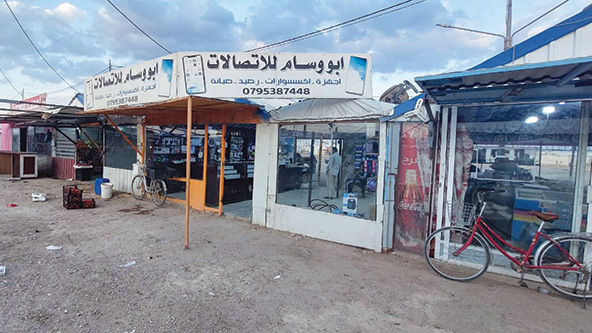
 People can make purchases with their eWallets at stores both inside (like Awad Ahmad Al-Smadi’s store, pictured) and outside Jordan’s two refugee camps. (Photo courtesy of Bahaa Mohammad)
In 2014, Omran Mansour, then 29, arrived at a Syrian refugee camp near Azraq, Jordan, with his wife and two children. Since he could not legally work, Mansour was forced to navigate the byzantine system of aid allocations from the United Nations, nonprofits, and governmental organizations to support his family. For nearly a decade, his family has used cash cards, iris-scan technology, and donation centers to access UN aid.
Since the outbreak of the Syrian war in March 2011, Syrian refugees like Mansour have been arriving in Jordan, where they live as an unbanked population. Organizations that serve refugees in Jordan have been eager to streamline the process of aid distribution. But Jordan’s banking laws, which are intended to thwart terrorist financing and money laundering, have prevented refugees from opening bank accounts because of regulations that require national identification documents to verify a customer’s identity.
Smartphone eWallets represent a new method to distribute aid that places more financial control in the hands of refugees. More than 90 percent of refugees in Jordan own a smartphone, according to Mette Karlsen, head of the cash-based interventions unit at the UN Refugee Agency (UNHCR) in Amman, Jordan.
In 2018, the agency launched a pilot project with eWallets to transfer financial assistance to 750 Syrian refugees receiving a DAFI scholarship, which offers refugee and returnee students the possibility of earning an undergraduate degree in their country of asylum or home country. COVID-19 motivated the UNHCR to expand the project, moving beyond a pilot. This spring, thousands more refugee households in Jordan began receiving their monthly aid through mobile wallets. To promote this expansion, UNHCR held a competitive bidding process in 2021 on behalf of the Common Cash Facility, a cash-assistance platform operated by a member-based consortium of cash actors in Jordan. The agency selected Umniah’s UWallet to provide aid based on its proposed cost and services, although refugees can use any of Jordan’s financial-service providers to receive aid.
Prior to using eWallets, UNHCR, the World Food Programme (WFP), and the members of the Common Cash Facility used iris technology, ATM cards, or cash in hand to provide refugees with assistance. Refugees often had limited time to access the funds before they were returned to the agency, in accordance with the agency’s financial-management regulations.
“The mobile wallet is a game changer because it’s not just about [refugees] receiving assistance anymore,” Karlsen says. “It’s about building toward a future where they can actually manage their own money and they can make their own decisions.”
The system filters refugee aid through Jordan’s existing eWallet companies, which are widely used throughout the country for bill payment, salaries, and other financial transactions. The system’s ubiquity means that refugees can use their aid allotment for purchases outside the camps without needing refugee cards that reveal their refugee status to others.
Refugees can also use their allocation toward goods and services from skilled community members like Awad Ahmad Al-Smadi who runs a mobile-phone-repair service in the Azraq camp. Al-Smadi hopes eWallets will help refugees gain more financial freedom and make purchases from his stand.
The portion of refugees using eWallets has grown to 60 percent, or 32,500 people living both inside and outside of Jordan’s Zaatari and Azraq refugee camps, since UNHCR’s eWallet expansion in 2020. Within the camps, 98 percent of refugee households now receive cash assistance for basic needs through the mobile wallets.
“This technology has made our lives—the lives of refugees—much easier,” says Mansour, who received 92 Jordanian dinars (about $65 USD) for his family’s first allocation of monthly aid in April.
WFP has begun to manage food assistance through mobile wallets. The United Nations is also working with the Central Bank of Jordan to draft a new financial-inclusion strategy to expand eWallet access and financial services to refugees. Policy makers are examining additional ways for refugees to use eWallets, including for insurance, microcredit, and credit history. Karlsen hopes that digital wallets can increase financial inclusion by helping refugees apply for and receive credit loans, obtain business licenses, and purchase cards, among other services.
“These are fantastic opportunities to invest in people’s capacity to become more self-reliant,” Karlsen says. “That’s the goal.”
Read more stories by Zoe H. Robbin & Bahaa Mohammad.