


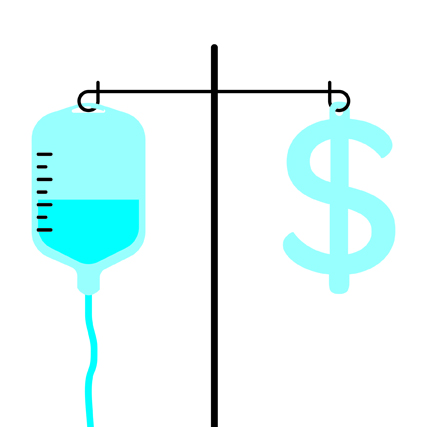
 (Illustration by Ben Wiseman)
Few things in life are as certain as death. Yet few topics are as fraught with uncertainty as the question of when to let a severely ill person die. At a time when the cost of end-of-life care continues to rise exponentially, a wide range of stakeholders—doctors and patients, politicians and advocates, policy wonks and academics—debate constantly over the morality of limiting end-of-life medical treatment.
Roi Livne, a doctoral candidate in sociology at the University of California, Berkeley, argues that there is no simple trade-off between the treatment of dying patients and the rationing of scarce resources. Instead, our approach to this issue reflects a social development that he calls “the moralization of economic scarcity.” In a recent paper, he examines that development by focusing on the history of the US hospice movement.
Beginning in the early 1970s, according to Livne, the hospice movement emerged as a force on behalf of ideas that ran counter to mainstream views on death and the role of the medical profession. Hospice advocates, for example, emphasized the value of avoiding over-treatment and the virtue of facilitating an acceptance of death. “Their motivations were fundamentally moral,” says Livne. “[They] were very concerned that dying patients were not treated appropriately—that doctors treated patients regardless of the chances that a treatment would succeed.” Until the early 1980s, the hospice movement was a small grassroots effort run primarily by volunteers. Then Congress approved legislation that allowed Medicare to cover hospice services, and a new industry began to develop around end-of-life care. That shift, Livne argues, extended the argument about minimizing end-of-life treatment from a moral plane to an economic plane. “When you treat less, you spend less,” he says. Over time, the economic and moral aspects of the issue converged, making it possible for people to view financial constraints in a morally positive way.
To study this process, Livne combined historical inquiry with ethnographic fieldwork. He conducted formal interviews, worked at a nonprofi t hospice organization, and read widely about the growth of the hospice movement from the 1960s to the 1980s. He also reviewed the congressional hearings that led to the passage of legislation that, in effect, created the for-profit hospice industry.
Today, Livne notes, for-profit organizations dominate the hospice field, and that development has had far-reaching consequences. The longer a patient stays in hospice, the more money a hospice organization earns. The average length of stay for patients in for-profit hospice facilities, moreover, is much longer than it is for those who receive care from nonprofit organizations—which suggests that some for-profit organizations cherry-pick patients in order to maximize revenue. In any event, Livne argues, the field would have evolved differently if the hospice movement hadn’t developed and promoted a moral outlook on the treatment of dying patients. Leaders of the movement “convinced enough people that it had the answers,” he says. As a result, a consensus formed around the view that limiting investment in end-of-life care could be both economically prudent and morally sound.
J. Donald Schumacher, president and CEO of the National Hospice and Palliative Care Organization, agrees that hospice care is a fundamentally moral endeavor, but he takes a somewhat different view of how economic considerations factor into end-of-life care. “If you are providing patients and their families with the most appropriate information about the true nature of their illness, and if they dis-elect the most aggressive therapy, there naturally will be a cost savings,” he says. “But saving money is not necessarily the goal.”
Roi Livne, “Economies of Dying: The Moralization of Economic Scarcity in U.S. Hospice Care,” American Sociological Review, 79, 2014.
Read more stories by Adrienne Day.