


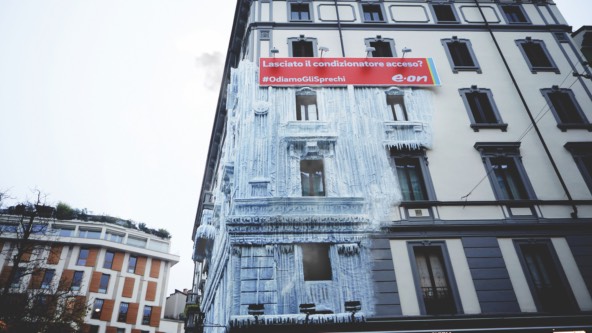
 E.ON Italia’s 2016 marketing campaign against waste included an art installation on a downtown Milan apartment building that made it appear frozen because a resident left his air-conditioning running. (Photo courtesy of E.ON Italia)
In November 2014, the E.ON Group issued a momentous announcement: The European multinational electric utility company would be divesting from its fossil fuel and nuclear generation services to prioritize renewable energy, energy distribution, and energy efficiency.
E.ON’s decision came at the end of an eventful year in the fight against climate change. In January, the European Union committed to reducing its carbon emissions by 40 percent by 2030 relative to 1990 levels. Member states swiftly adopted regulations to meet the new target, forcing E.ON and its peers to rethink their strategies.
In this context, E.ON decided to spin its fossil fuel and nuclear power divisions into a separate company. In parallel, it pivoted from a centralized energy model, in which a single entity (typically a power plant) produced energy for consumers, to a decentralized energy model, in which consumers drew on multiple, local sources of energy such as solar panels, batteries, and heat pumps.
“In that moment, I understood that the world was definitely changing,” recalls Luca Conti, current CEO of E.ON Italia, the Italian subsidiary of the E.ON Group. “The old idea of a vertical integrated energy company was over.”
These changes required each of the company’s subsidiaries to adapt to the new business model. For E.ON Italia, which has been in operation since the E.ON Group’s inception in 2000, this was no small task. At the time, Italy’s largest energy firm, Enel, provided roughly 15 times more power and seven times more gas than E.ON Italia. Despite this difference in size, E.ON Italia has emerged as a growth leader in Italy’s renewable energy sector and a market leader in the energy solutions business by becoming a vocal advocate for green transformation in the region.
In what follows, we tell the story of how E.ON Italia helped accelerate Italy’s green energy transition by creating a purpose-driven movement within and, notably, outside the company to pursue sustainability in all activities. By pursuing this approach, the company was able to unlock the creativity, passion, and energy of its employees to produce extraordinary results for the company and society. The tactics that the company deployed and the lessons they learned along the way offer a beacon to companies that also believe that businesses should do more to tackle today’s grand challenges.
A Tradition of Sustainability
E.ON Italia's sustainability initiatives originated in the environmental sensibilities that the E.ON Group fostered in the early 2000s. “When I arrived at E.ON Italia in 2008, the E.ON Group’s tagline at the time was ‘Clean and Better Energy’—that is, getting energy more efficiently and from renewable sources,” says Director of Marketing and Corporate Communication Mauro Biraghi.
The Italian team’s commitment to sustainability deepened after 2008. For example, in 2011, E.ON Italia launched an innovative gas offering that funded forestry projects throughout Italy. For every new contract signed by a customer, a tree was planted. As the trees that were planted grew, they would ultimately absorb CO2 from the atmosphere and improve local air quality.
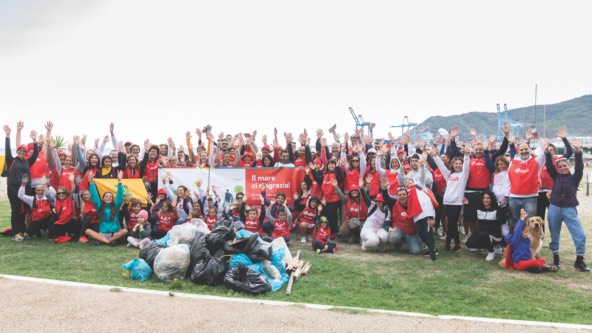 E.ON Italia employees and their families celebrate after clearing Zinola beach near Savona, Italy, of plastic waste as part of the company’s Energy4Blue program, a collaboration with UNESCO. (Photo courtesy of E.ON Italia)
E.ON Italia’s commitment to environmental sustainability only accelerated after Péter Ilyés joined the company as its CEO in 2016. Ilyés had worked at the E.ON Group since 2000, and prior to joining E.ON Italia, he had served as a board member of E.ON Hungária Zrt. Ilyés was passionate about environmental sustainability and encouraged employees to channel their personal enthusiasm for sustainability into the company’s business activities. With Ilyés’ support, the company launched a marketing campaign called “Odiamo Gli Sprechi” (“We Hate Waste”) in November 2016. The campaign featured an art installation on an apartment building in downtown Milan. E.ON Italia hired artists to make the building appear frozen, while Biraghi and his team crafted a fictional narrative to accompany the installation: An absent-minded resident had accidentally left his air-conditioning running for months. Due to his neglect, the air-conditioning froze a large portion of the building and wasted an immense amount of energy.
E.ON Italia supported the installation with a media advertising campaign that included TV, digital, social, print, and outdoor advertising. Ilyés personally promoted the campaign in press interviews at the installation. Meanwhile, the hashtag #palazzoghiacciato (“frozen palace”) became a trending topic in Italy on Twitter during the week of the installation. As a result of these efforts, the marketing campaign raised the public profile of the company’s ongoing transition to a decentralized energy model.
Employee volunteer initiatives also expanded under Ilyés’ leadership. In 2016, the company launched an educational program to introduce students to sustainability topics in school. That same year, E.ON Italia relaunched an expanded version of Boschi E.ON to reinforce the company’s green positioning and communication activities. In 2019, the company created a partnership with Legambiente, an Italian environmentalist organization, to launch Energy4Blue, which included many activities to protect the marine ecosystem. For example, employees, their family members, and E.ON customers volunteered on weekends to remove plastic from Italian beaches. Since 2022, the company started collaborating with the United Nations Educational, Scientific, and Cultural Organization (UNESCO) on the Save the Wave project, which included planting Posidonia oceanica, a marine plant, to restore the Mediterranean ecosystem.
“Our reasoning was that Italy is a sea country,” Biraghi says. “We were still supporting the forests through Boschi E.ON, but we thought, ‘How can we talk about the environment by talking about the sea?’”
While the E.ON Italia team was fostering a spirit of sustainability within their organizational culture, other initiatives were taking shape at the E.ON headquarters that would lay the groundwork for the green movement.
The Origins of the Movement
In early 2016, the E.ON Group wanted to launch a new business unit dedicated to sustainable energy solutions, which they later dubbed Future Energy Home (FEH). The division sold renewable energy products such as solar panels and heat pumps to customers and installed the products in customers’ homes, occasionally renovating their homes to be more energy efficient.
To lead the unit, the E.ON Group recruited Frank Meyer. After completing a doctorate in physics, Meyer spent a decade at management consulting and telecommunications firms. Although Meyer had never worked in the energy industry, he was intrigued by Europe’s green energy transition and was motivated by the opportunity to build and scale E.ON’s new renewable branches. The new decentralized energy model also appealed to Meyer, because of its similarity to a telecommunications network.
“The E.ON Group was seriously interested in transforming the company to a customer-centric company, and I realized that was where I could contribute,” Meyer says. “The role also had a big purpose through supporting the renewable energy transformation. That was a core motivation: With my skills, can I contribute to something really relevant for this world?”
Over the four and a half years that Meyer led the division, FEH’s revenue grew from $20 million to $800 million, and it became consistently profitable in 2019. As he built and scaled the division, he noticed that internal opinion surrounding FEH was shifting. Although many E.ON employees were initially skeptical of the decentralized energy model, an increasing number of them began expressing interest in FEH.
“We went from being a fringe part of the organization to having a critical mass of people ask if they could join us,” he says. To win support, Meyer experimented with different methods to motivate employees to embrace his ambitions for the division. One of his tactics was contracting Robert Wreschniok, CEO of the TATIN Institute for Strategy Activation, a consulting firm that specialized in aligning employees with an organization’s strategy. Meyer would later contract Wreschniok again when he moved to E.ON Italia.
“After that, we grew very quickly,” Meyer says. “Someone told me that what was happening was a movement.” Though he never set out to spark a movement, the experience taught him not only how one forms but also how powerful it can be as a motivational and leadership tool.
While E.ON Italia continued to adapt to the renewable energy transition, the company underwent management changes. After serving as CEO for five years, Ilyés was offered another senior leadership role at the E.ON Group. Based on Meyer’s success in scaling FEH, the E.ON board decided to prepare him to become a CEO. They determined that Italy was an ideal market for Meyer to thrive.
Building a Green Movement
In April 2021, Meyer formally replaced Ilyés as CEO of E.ON Italia. Meyer transitioned into the role with the goal of transforming the company into Italy’s leading provider of green energy.
In fact, he had an even more ambitious vision: to encourage all Italians to transition to renewable energy. “If we really want to find solutions for grand challenges in society, we need to engage the whole society,” Meyer says. “Ultimately, companies cannot successfully solve grand challenges alone.”
He knew that to make a meaningful impact in Italy’s renewable energy transition, he would need to harness the same forces that he had channeled while developing FEH: He would need to build a movement.
“Typically, social movements today do not include global companies; indeed, they are often built against them,” Meyer explains. “Companies, on the other hand, are often too focused on profits. Can we create a positive movement for change that combines business objectives and societal objectives? We need to; otherwise, we will not be able to solve our societal problems.”
When Meyer became E.ON Italia’s new CEO, less than 20 percent of the company’s energy sales stemmed from decentralized solutions. Since the company was still in the early stages of its renewable energy transition, Meyer made aligning the organization around the new business model a priority. To develop E.ON Italia’s strategy activation plan, Meyer once again hired the TATIN Institute for Strategy Activation.
TATIN’s strategy activation process combines top-down and bottom-up management approaches to reach employees at all levels of the organization. The rationale is that pursuing a purely top-down approach can make employees feel detached from the new strategy, while a purely bottom-up approach can be too chaotic.
“The strategy activation process starts with a vision from the leadership team, but then it involves every employee in making the vision translated into actionable steps that everyone wants to embrace,” Wreschniok says.
First, the TATIN Institute interviewed the 45 members of the company’s senior leadership about their views on the renewable energy transition. The interviews included questions about how E.ON Italia compared to its peers, their ideal future for the company, and perceived barriers to achieving Meyer’s vision. TATIN next analyzed its findings to identify big-picture themes about employees’ attitudes and perspectives. The institute then complemented its initial analysis with two 60-person workshops to collect ideas and feedback from other employees from all departments affected along the new value chain of the strategy. Through their inputs, TATIN created a strategy map that graphically represented Meyer’s ultimate vision of E.ON Italia and the challenges the company had to overcome to execute the strategy.
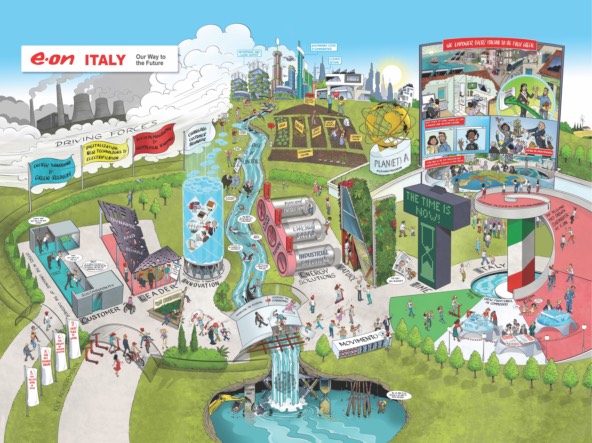 E.ON Italia CEO Frank Meyer and the TATIN Institute for Strategy Activation created a strategic map to represent Meyer’s ultimate vision for the company. Meyer then hung copies of the map throughout the office and made it his Microsoft Teams background. (Image courtesy of E.ON Italia)
Finally, Meyer held a town hall meeting and initiated a two-week challenge in which he asked employees and all leaders to present the company’s strategy based on the map. Each team discussed their perspective as to which scene from the map was the most challenging and which scene showed the greatest opportunity. As the final task, Meyer asked everyone to explain the strategy in their own words based on the map. “In this way, we ensured that more than 90 percent of the strategic content remains in the head of the leaders and employees to create a mutual understanding of the way forward,” Wreschniok says.
More than 90 percent of employees provided feedback on E.ON Italia’s new strategy, which enabled Meyer to establish a broad mutual understanding about the company’s direction. At the same time, the strategic big picture became an everyday tool: Meyer hung it in multiple places throughout the office, placed a printed and folded version in the office common space, and made it his Microsoft Teams background (the new daily meeting spot, because of the COVID-19 pandemic).
The second strategy activation phase invited each employee to suggest ways they could contribute to the strategy. During this phase, E.ON Italia used “Team Tinys,” a method the TATIN Institute developed to gamify the strategy implementation process. The Team Tinys created micro-challenges based on different pillars of E.ON Italia’s new strategy that were specific to different functional teams. Each team leader could initiate a small mission—a tiny intervention—for their own team members to complete, which took about 15 to 20 minutes to finish. Each tiny intervention was designed to focus on the team’s “Circle of Control,” creating an immediate and tangible impact that everyone on the team could experience. The exercise aimed to maximize the team’s motivation to collaborate on future goals through aligned action. The team with the most finished missions received an award at the 2023 holiday convention.
Another critical strategy-alignment tool that E.ON Italia has developed is the purpose pyramid, which highlights how the company’s purpose can affect each level of the organization. (See the pyramid below.) To create the pyramid, Meyer distilled the company purpose into three pillars: Green & Sustainable, Growth Leader, and Truly People Centric. He then translated each pillar into specific business operational goals for each department.
Strategy-Alignment Tool: The Purpose Pyramid
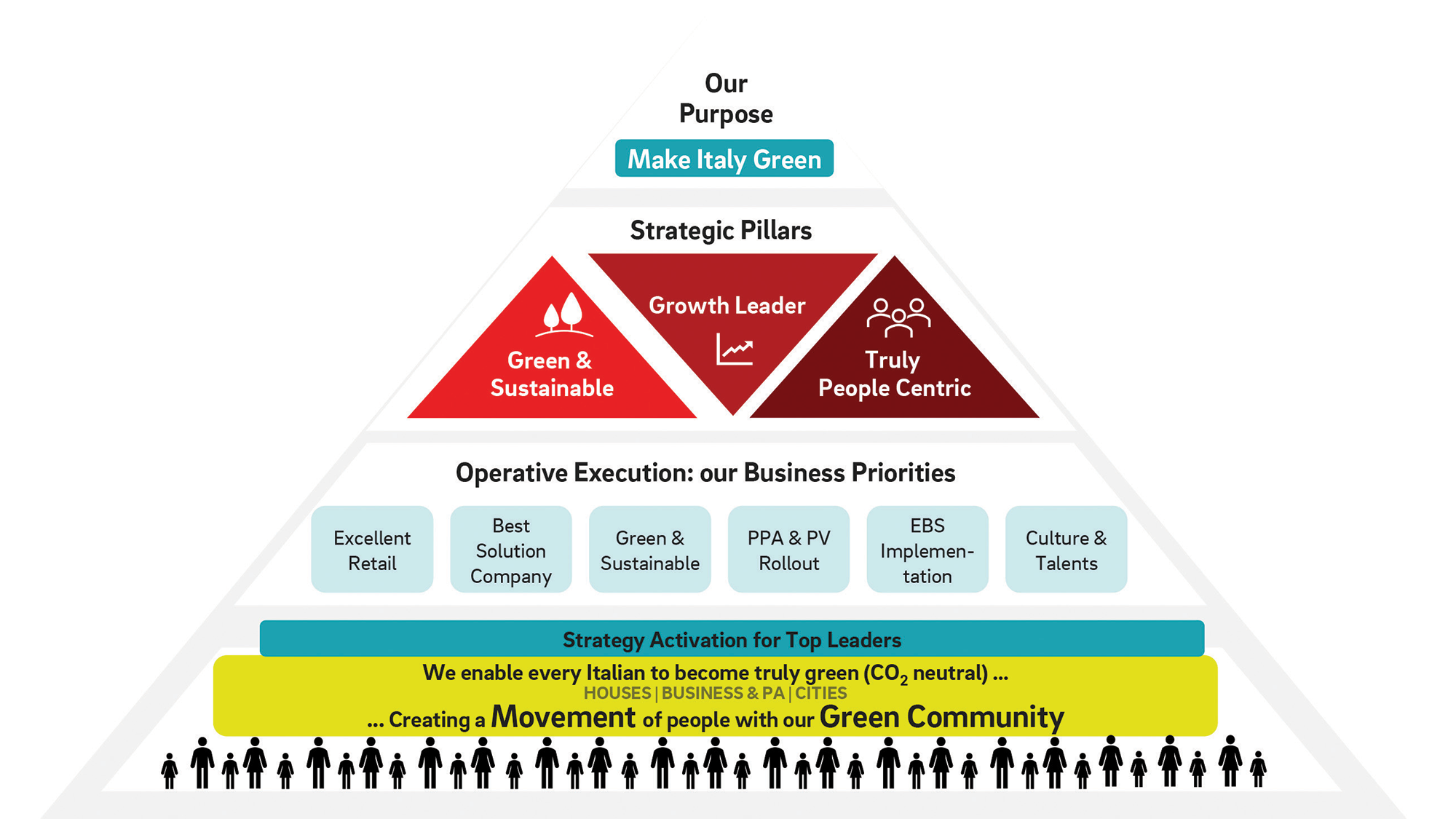 (Click to enlarge) The diagram highlights how the company’s purpose can affect each level of the organization. To create the pyramid, Meyer distilled the company purpose into three pillars: Green & Sustainable, Growth Leader, and Truly People Centric. He then translated each pillar into specific business operational goals for each department.
Creating a Movement Culture
The top-down, bottom-up approach that Meyer harnessed through the strategy activation process was critical to creating a movement culture—that is, an organizational culture that motivates employees toward an ambitious and purposeful goal. Meyer hoped that the movement culture could build a critical mass of support within E.ON Italia for making Italy green before expanding beyond the company. As he developed the movement culture, he incorporated three critical features of successful social movements that he had observed throughout his career. According to Meyer, a movement must have a tangible purpose, allow participants to see their individual impact, and foster a sense of belonging and community.
To give the movement a tangible purpose, he positioned it around the goal of making Italy green—that is, fully transitioning Italy’s energy use from fossil fuels to green energy sources. Meyer measured success through the annual number of green energy solutions that it installed in customers’ homes, the annual number of solar panels it installed (as well as the cumulative amount of green power those panels generated), and the estimated CO2 emissions prevented through its green solutions sales.
E.ON Italia’s hiring managers incorporated sustainability-related questions during the interview process. If candidates expressed ambivalence about sustainability, the company would not extend an offer.
Meyer formally announced the movement during a presentation at E.ON Italia’s 2022 Christmas convention, at the conclusion of which employees were invited to “Join the movement of Make Italy Green.” The presentation was the first time that Meyer officially used the word “movement” to refer to the company’s renewable energy goals.
Meyer also recognized the psychological importance of measuring each person’s contribution to the overall movement. During his earlier career as a strategy consultant, he had the opportunity to collaborate with Nobel Peace Prize-winner Muhammad Yunus on an assignment to address hunger in Bangladesh. Although he felt a strong purpose in the work, he ultimately became frustrated that he was unable to identify his personal impact on the project. “That taught me that I need to give to my employees a clear proof that they can move the needle, that they can have a personal impact on the outcome,” Meyer says.
To help employees visualize how their work contributed to Italy’s renewable energy transition, managers gave employees personal performance goals that were tied to the movement. For example, a salesperson could measure the number of heat pumps or solar panels they installed per year and estimate the CO2 emissions they prevented through the installations. E.ON Italia also created a list of 10 environmental, social, and governance (ESG) goals that the company and the employees committed to achieving. These goals included achieving net zero Scope 1 and Scope 2 emissions (those emitted by the company or purchased from other energy producers) by 2030 for the company’s operational activities, planting 150,000 total trees through the Boschi E.ON project by 2025, and producing data-driven ESG reports.
Finally, the E.ON Italia team cultivated belonging through creating and promoting initiatives for employees to participate in the Make Italy Green movement. Such efforts included E.ON Italia’s ongoing volunteer activities, which enabled workers to socialize and participate in the movement at the same time, and a flash mob at E.ON Italia’s 2023 summer office party in which employees brandished signs with the message “Make Italy Green.”
Meyer strengthened the movement culture through placing visual representations of the company’s push for sustainability throughout the office. The E.ON Italia team created a sustainability library in the office hallway by stocking bookshelves with books on sustainability, hung a poster of the purpose pyramid on the walls, and gave employees reusable tote bags to encourage them to eliminate plastic waste.
“Make Italy Green is present everywhere,” says Jada Piras, assistant to the CEO. “It is not just sporadic activities that show the company is sustainable because it is fashionable. It is like a life motive.”
E.ON Italia’s hiring managers sought to preserve the movement culture through incorporating sustainability-related questions during the interview process. If candidates expressed ambivalence about sustainability, the company would not extend an offer. “You can be the most skilled person in the world, but if you don’t believe in what we are doing, we don’t need you,” says Gianni Commessatti, the company’s chief operating officer.
As the movement culture gained momentum, employees changed their personal behaviors to become more environmentally friendly. “Employees are our first ambassadors for the movement,” Biraghi says. Some employees began commuting to the office via public transportation rather than driving (E.ON subsidizes public transportation for all employees) or carpooled with their colleagues to reduce their gas emissions. Other employees adopted vegetarian or vegan diets, installed solar panels in their homes, or adjusted their thermostats to reduce their energy consumption. Meyer turned off the gas supply in his home from April through September and exclusively relied on solar thermal heating, which limited his family’s access to hot water.
Nevertheless, some employees did not immediately embrace the movement culture. For example, Commessatti once overheard a conversation between longtime E.ON Italia employees. The workers, all of whom had been at the company for more than a decade, were discussing the upcoming winter season and were hoping for cold weather, which would prompt customers to boost their heat consumption. Commessatti quickly reminded them that they were transitioning to a new business model that did not rely on consumption of fossil fuels.
“The culture doesn’t change from one day to the other,” Commessatti says. “Sometimes it’s a slow process.”
But once E.ON Italia had the right internal culture in place, it was ready to expand it outward across Italy.
Expanding the Movement
In May 2022, E.ON Italia created a new promotional campaign to draw attention to climate change. The campaign featured an installation of a 23-meter-long footprint on the shore of a beach in Termoli along the Adriatic in Central Italy. The footprint was designed to estimate the hypothetical foot size of a seven-ton giant, representing the average Italian’s annual carbon footprint (seven metric tons of CO2 per year). The campaign aimed to challenge individual Italians to make their personal behavior more environmentally sustainable.
What began at an energy company with something over 700 employees had finally culminated in a social movement that aimed to involve all 59 million Italians in making the country sustainable.
In addition to the installation, E.ON Italia promoted a green quiz on its mobile app, which prompted users to answer a series of questions about their diet, commuting habits, energy use, and other lifestyle behaviors. The test then estimated the user’s annual carbon emissions and generated their “ecoStatus,” which reflected their overall level of sustainability. The app offered users tips for reducing their environmental impact, educational materials on climate change, and news about E.ON Italia’s environmental initiatives. Users could track their energy consumption through the app and see how their ecoStatus compared to the national average. They could also share their ecoStatus on social media.
E.ON Italia customers could also monitor their energy use and pay their bills through the app. It featured a rewards system called “eco-points,” which users accumulated through engaging with content on the app. Users could eventually redeem their eco-points to receive a discount on their energy bills or apply their eco-points to offset their carbon footprint. E.ON Italia employees estimated that 1,000 eco-points translated to 1 metric ton of CO2.
By mid-2023, the app had 330,000 users, up from 230,000 at the end of 2021. Approximately 20,000 app users were not E.ON Italia customers but had nevertheless downloaded the app for its sustainability-related content. E.ON Italia collectively referred to its app users—both customers and noncustomers—as members of the “green community.”
Expanding the movement beyond E.ON Italia’s immediate stakeholders in these ways represented a new phase for the Make Italy Green movement. The leadership team recognized that successfully reducing Italy’s reliance on fossil fuels would require them to persuade all Italians to embrace sustainability—even if they did not ultimately become E.ON Italia customers. Accordingly, they focused on broadening Make Italy Green from an internal, employee-based movement to one reaching out to society at large.
In May 2023, E.ON Italia publicly invited all Italians to join the Make Italy Green movement through another high-visibility marketing initiative. They launched the new campaign with an art installation of a boat on Lake Garda, the largest lake in Italy. The boat was suspended 75 centimeters above the water line to highlight the amount that the lake’s water levels had receded over the previous four years. Like the previous marketing campaigns, the installation sought to draw attention to the threat of climate change and position E.ON Italia as a leader within the green energy space.
The new campaign featured a video that profiled the floating boat and emphasized the need to adopt renewable energy to counteract climate change. The video concluded with an image of E.ON Italia employees and other members of the green community standing in the lake and holding a banner that read “Riportiamo il lago a questo livello” (“Let’s bring the lake back to this level”). The final scenes broadcast the message “Join our movement” and featured the campaign slogan #MakeItalyGreen. The video attracted 17 million views and 195 million impressions, while the campaign itself generated 460 articles and television reports, and 22,000 app downloads.
What began as a deep-rooted purpose at an energy company with something over 700 employees had finally culminated in a social movement that aimed to involve all 59 million Italians in making the country sustainable.
Early Results
E.ON Italia saw immediate and sustained success from its efforts. By 2023, E.ON Italia had generated €3.5 billion ($3.8 billion) in revenue, €2.8 billion ($3 billion) of which stemmed from renewable energy solutions. Meanwhile, the company’s adjusted earnings (EBITDA) increased almost 50 percent year over year and had tripled from 2021 through 2023. In the five years since Ilyés had initially encouraged the company to embrace sustainability, renewable energy sales had increased from 0 percent to 80 percent of overall revenue. Between 2019 and 2023, the renewable energy solutions business increased from 18 percent to roughly 60 percent of EBITDA. E.ON Italia also became the market leader for energy solutions installations in Italy, achieving its strategic target. (“Energy solutions” are alternative energy sources and infrastructure deemed by the European Commission to advance Europe’s transition to carbon neutrality.) Meanwhile, the company’s brand awareness—which they measured through a digital survey sent to a predetermined sample of Italians—had increased from about 11 percent in 2015 to roughly 40 percent in 2023.
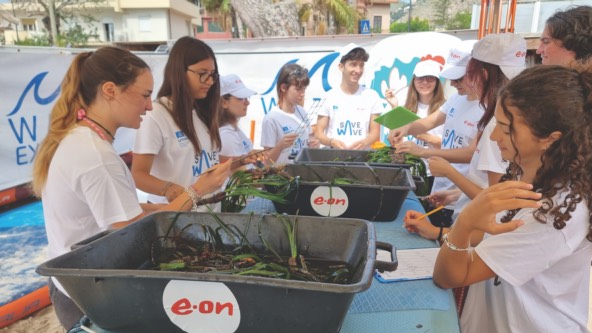 In April 2022, high school students from Palermo, Sicily, work with Posidonia oceanica marine plants as part of Save the Wave, a program to restore the health of the Mediterranean ecosystem supported by E.ON Italia and UNESCO. (Photo courtesy of E.ON Italia)
Over the course of the prior year, 2022, E.ON Italia had been busy. Its employees had installed 24,000 devices to promote the green energy transition that had collectively prevented 760,000 metric tons of CO2 from being released into the atmosphere. Meanwhile, employees had installed roughly 3,000 solar panels on customers’ homes that had produced almost 60,000 kilowatt-peak power output (kWp). Since 2011, the Boschi E.ON initiative had sponsored the planting of more than 110,000 trees that had captured approximately 76,000 metric tons of CO2. The company’s educational initiative also grew from teaching 180 classes and 4,500 students in 2020 to 700 classes and 17,000 students in 2022. Through expanding its sustainability education, E.ON Italia cultivated an understanding and appreciation of environmental stewardship within the next generation of Italians.
The movement also inspired people to apply for jobs at E.ON Italia. Stefan Padberg, the company’s chief commercial officer, recalls, “I often sit in during the final round interviews, and I ask the candidates about their expectations and why they were motivated to apply for the job. During this stage, we always talk about a job profile within the commercial management area, so I would expect their answers to be commercially focused. But almost every one of the candidates would say: ‘I like E.ON because it is creating this movement to make Italy green.’”
Yet engaging all Italians in the movement also increased public scrutiny of E.ON Italia’s decisions, which held the company more accountable for modeling environmental sustainability within its operations. For example, one customer called E.ON Italia to complain that the employee who came to install solar panels at his home arrived in a diesel car. The customer pointed out that E.ON Italia could not truly be embracing sustainability if it was using corporate cars that burned fossil fuels. However, the incident triggered E.ON Italia to review its corporate fleet and develop a plan to transition to electric cars.
Between 2021 and 2024, E.ON Italia sold 6.6 terawatt-hours (TWh) of green energy, which prevented an estimated three million metric tons of CO2 emissions. During the same time period, Italians consumed roughly 452 TWh of green energy. By 2024, overall renewable energy production increased 13 percent from 2023 and represented 41 percent of all electricity consumed in the country. Based on the country’s progress, Italy increased its National Energy and Climate Plans (NECP) energy targets: By 2030, the country aimed for renewable energy sources to make up 40 percent of its total energy consumption (up from 30 percent with the previous target) and for renewable energy to comprise 65 percent of its energy consumption (up from 55 percent). The green wave that originated within E.ON Italia’s offices is now reverberating across the nation.
Four Critical Steps for Creating a Purpose-Driven Movement
Why has E.ON Italia’s purpose-driven movement succeeded when similar efforts have failed at larger, better-resourced organizations? We have identified four critical steps the company took that made the effort impactful. We believe these steps can provide a blueprint for leaders hoping to start purpose-driven movements within their own organizations.
Step One: Define a broader collective purpose. | Under Ilyés’ leadership, E.ON Italia began integrating sustainability into its organizational culture through marketing campaigns and volunteer initiatives. When Meyer became CEO, he explicitly defined “Make Italy Green” as the company’s purpose. E.ON Italia’s purpose also included three important characteristics: It was linked to the company’s strategy (leading the renewable energy transition), extended beyond the company’s boundaries to engage with society, and was concrete and measurable.
Without these three factors, E.ON Italia’s purpose might not have translated into a corresponding movement. For example, an energy company focused on nonrenewable energy would not be able to credibly claim that it wanted to make Italy green, nor could it create enough enthusiasm among employees and outside stakeholders to create a movement.
“Our upfront analysis had shown that employees cared deeply about making a positive difference in their local communities,” Wreschniok says. “This purpose helped them see that the strategy wasn’t just about business success; it also served the well-being of the people and places they valued most.”
Step Two: Open up the strategy process by combining top-down and bottom-up approaches. | Meyer generated support for the company’s purpose-driven movement at all levels of the organization through the strategy activation process. If he had not combined top-down and bottom-up approaches, he might have encountered resistance from some employees, while others might have struggled to visualize how their work contributed to the movement. The strategy activation process also clarified how the purpose-driven movement would support E.ON Italia’s business objectives, dispelling the idea that the movement would not be in the company’s best financial interests.
Step Three: Create an internal movement culture. | Ilyés laid the groundwork for the movement culture through fostering an organizational mindset that embraced sustainability. However, the Make Italy Green movement intensified that commitment in several important ways. First, it created an umbrella concept that helped to combine different activities that previously arose independently, including the company’s marketing campaigns, its volunteer initiatives, and employees’ private behaviors. Second, it gave more purpose to those activities, directly connecting them to a goal larger than the company itself—making Italy green. And finally, the movement culture helped employees design new initiatives that supported the movement’s goals.
E.ON Italia was able to create the movement culture by taking three actions. First, it created a strong alignment between formal and informal systems of company culture, such as the language that employees used at work, the strategy map, and the sustainability library. Second, it formulated specific initiatives, such as the beach cleanup projects, tree-planting initiative, and opportunity to participate in the Lake Garda video, that enabled collective action. Third, it prompted employees to take individual action, such as changing their commute to become more environmentally sustainable and adjusting the thermostats in their homes. These three measures increased awareness of the movement, encouraging people to join—during working hours as well as on their free time.
Step Four: Transcend the company’s boundaries. | The final step of a purpose-driven movement requires leaders to expand the movement beyond the organization. One company itself cannot achieve an ambitious social goal. An energy company of 700 employees cannot make a nation of 59 million citizens green. It is therefore important to transcend the companies’ boundaries to other stakeholders. In the case of E.ON Italia, the company first involved employees, then expanded to customers, employees’ family members, and business partners before appealing to the larger public. To fulfill its purpose of #MakeItalyGreen, E.ON Italia was then considering expanding even further to involve other critical actors in Italy, such as politicians, competitors, and other industry players.
Unlike traditional campaigns that focus primarily on influencing potential customers, Make Italy Green fostered a sense of immediate identification with a broader audience: the Italian public at large.
“In other campaigns I’ve worked on, people might ask about the product or the message,” says Lucio Biondaro, CEO of Pleiadi Benefit Corporation. “But in this case, during one campaign initiative, someone stood up and asked, ‘How can I participate in this movement?’ That moment signaled to us that we had tapped into something deeper—something collective.”
The Importance of a Coherent Approach. | Individually, none of these four steps can generate massive social change on its own. E.ON Italia appears to have succeeded because the leadership team created a holistic and coherent approach that was able to build a critical mass of support within—and eventually beyond—the company.
The Movement Expands
In February 2024, Meyer accepted a new position as a member of the board of management at the Bosch Group, a global technology company. The leadership transition raised questions about how to ensure the movement’s continuation. Chief Sales and Delivery Officer Luca Conti was chosen to replace him as CEO. Conti had worked under Meyer’s leadership to develop E.ON Italia’s FEH division and joined the board after Meyer became CEO. Conti’s alignment with Meyer’s vision made him a logical successor for continuing the movement’s spirit.
“I am certain that all together, thanks to the support of highly talented and experienced colleagues and the ambitious projects that we will carry forward and those that we will undertake, we will be able to continue to be the most innovative and sustainable player in the energy market, with the customer at the center of every strategy,” Conti said in the company’s press release about the transition.
Shortly after Meyer’s departure, the E.ON Group launched a new corporate strategy to become the leader—or, in the company’s words, the “playmaker”—of Europe’s energy transition. To promote the company’s new direction, E.ON corporate launched a campaign called “It’s On Us.” The campaign featured a centerpiece video in which Austrian-German film star Christoph Waltz complained about the lack of action toward sustainable energy. After each of his criticisms, a bystander would politely point out that a given sustainability need had already been met. At the conclusion of the video, two E.ON employees cheerfully informed Waltz that they were already taking care of the full energy transition. The video concluded with the message “It’s on us to make new energy work.”
Since the campaign’s launch, E.ON has pivoted its messaging from E.ON Italia’s “Make Italy Green” to E.ON’s European-wide message “It’s On Us.” However, the underlying purpose that sparked the movement culture remains the same. Whether E.ON Italia will succeed in its quest to bring renewable energy to all Italians, let alone all of Europe, remains to be seen.
Read more stories by Marco Clemente, Fredrik Hacklin, Brayden King & Amy Klopfenstein.