


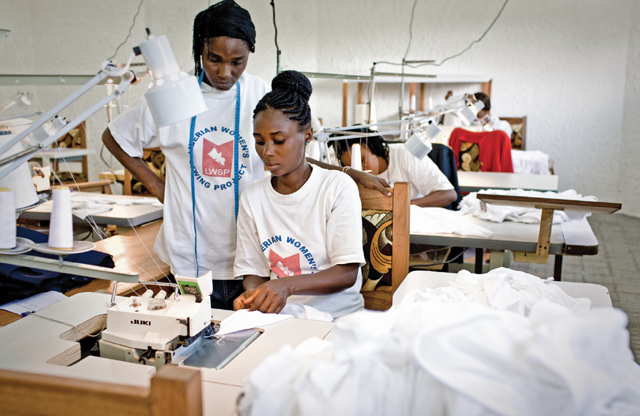
 Elizabeth Jarpah (left) and Miata Chea at Liberty & Justice’s Monrovia, Liberia, factory before Ebola struck. (Photo by Glenna Gordon, courtesy of Liberty & Justice)
Early in June 2014, Chid Liberty’s factory hummed with promise. Workers were almost done installing the sewing machines, completing a two-year-long overhaul of the facility, a multi-story building that rises above the slums of West Point in Liberia’s capital of Monrovia. Liberty & Justice, the company he founded to produce ethically sourced apparel and bring prosperity to a pocket of this war-torn nation, had just hired 200 workers.
Liberty’s mind was on logistics and possibilities, zippers and supply chains, and how best to conduct studies on the effect of employment on worker well-being. Sure, there were news reports of an Ebola outbreak in neighboring Guinea; but in Liberia, where only 16 people had died, the disease was just “a blip on our radar,” recalls Liberty. It wouldn’t stay that way for long.
Fast forward six months and more than 3,000 deaths. The factory was silent. Nobody stood at its gleaming machines. The workers were at home, an official state of emergency had been declared, much of West Point was under quarantine. Fabric lay in piles on the floor.
Fortunately, as of the end of 2014 none of the workers or their families had caught Ebola, but the company’s health is still recovering. It was difficult enough getting Liberty & Justice off the ground before the outbreak. Now Liberty must do it again, except this time under the shadow of an outbreak that not only took a terrible human toll in West Africa, but reduced much of the Western world to panic and paranoia.
“We had just under half a million dollars in open purchase orders when we took a break,” says Liberty. “Hundreds of thousands of raw materials on the ground. And we had to stop working. That was extremely painful. We are now trying to rebuild from that—which will be challenging.” One thing is certain, though: Liberty loves a challenge.
Roots in Silicon Valley
Six years ago, Liberty lived in Silicon Valley, working in finance for tech startups. His family had fled Liberia in 1981, when Liberty was just 18 months old, and he hadn’t returned since. But after the end of Liberia’s two civil wars—brutal conflicts that raged from 1989 to 2003, claiming several hundred thousand lives and leaving millions displaced—he’d wanted to go back and help his former home.
That he would start a clothing factory might at first seem fanciful, if not downright unrealistic. Liberia was not a likely source of ethically made apparel; after the war, most Liberians lacked electricity and water. The country was a literal disaster.
Nevertheless, starting a clothing business in West Africa made a certain business sense. Inhumane conditions in many developing-world apparel factories—conditions that came gruesomely to global consciousness after more than 100 Bangladeshis died in the 2012 Tazreen Fashions factory fire—had fueled growing consumer demand for apparel produced ethically, rather than by some anonymous, poorly treated person at the invisible end of a long supply chain.
Liberia also had, at least before the war, a textile industry, and West Africa enjoys a prime shipping location on the Atlantic Ocean, closer than Asia to markets in Europe and North America. With various NGOs having sponsored post-war vocational training, there were plenty of capable seamstresses looking for work. Liberty & Justice offered a chance to build a decent peace.
Liberty reached out to some of Liberia’s famed women’s groups, whose nonviolent protests were pivotal in ending the war. Despite their organization and newfound political influence, however, women were still marginalized in Liberia’s patriarchal society. Liberty envisioned his enterprise giving them work and a measure of independence, with social benefits rippling out from them.
“Most of the women here now at the factory had nothing to do. They were without jobs. Since Liberty & Justice started working with us, our lives have improved. We are able to send our children to school, to provide for our homes,” said Leona Monger, head of the factory’s worker union, in an interview before the Ebola outbreak.
Coming from someone else, those sentiments might sound hackneyed. But Monger and her colleagues had ended a war, and Liberty & Justice offered a chance to build a decent peace. They now own a 49 percent share of the factory itself (not the company), which opened in 2009. There they earn approximately $100 a month—20 percent more than their Liberian peers—and are offered savings accounts with deposits matched dollar-for-dollar for one year.
Workers have company-sponsored health insurance and can afford an education for their children. Some 98 percent of their children attend school, more than double the national rate—a profound achievement in a country where, in the words of Nobel Prize-winning President Ellen Johnson Sirleaf, “access to quality education is the social justice issue of our time.”
Theirs is an extraordinary human-interest story, but it would have important business ramifications, too. Many of the women’s group members were in their 30s and 40s. Liberty didn’t realize that standard garment-industry practice is to hire younger women, who are considered better suited to sewing long, fast-paced hours. A consultant originally called their hiring a mistake. But it turned out that the women’s age gave them a deep sense of responsibility. “I was struck by the degree of motivation of the women’s groups,” says Nate Schaffran, who oversees lending in Africa for impact investment fund Root Capital, one of Liberty & Justice’s early backers. “It was very clear that these women’s groups wanted the project to succeed, and they were making sure it would.”
The women’s story would also prove crucially compelling to buyers. From the outset, it was evident that Liberty & Justice would not compete with cheap apparel. Instead, as with ethically produced coffees, which differentiate themselves from commodity coffee as much by telling origin stories as by taste, Liberty & Justice would sell its narrative.
“If the apparel was going to commercial buyers who treated it as a commodity, then a startup factory in West Africa isn’t going to compete on cost,” says Schaffran. “But their buyers [including prAna, Haggar, and FEED Projects] were motivated in part by the opportunity to be part of the story.” The same applied to funders, says Jim Villanueva, executive director of the Eleos Foundation, another of Liberty’s investors. Funders needed to understand the story, accepting the workers’ well-being as a first priority, the inevitability of challenges, and the possibility of lower financial returns than other investments.
Challenges Ahead
The challenges of building a business in Liberia were many, some a function of post-war Liberian life but many typical of the garment industry. The logistics—“labels from New York, threads from Turkey, fabric from Thailand, zippers from Hong Kong,” says Liberty, “all needing to arrive on time, go through the Liberian port system, and get processed”—are daunting in the best of times. Within two years of opening, the factory also expanded its production nearly sixfold, which Liberty in retrospect acknowledges was probably too ambitious.
The company learned the ropes and important lessons, though. Orders kept coming in; they became Africa’s first Fair Trade Certified apparel factory. For a time Liberty & Justice shifted production to a second factory in Ghana, allowing them to renovate the factory in Monrovia. Workers there were furloughed for more than a year, a blow Liberty tried to cushion by offering training programs. In June the Monrovia factory finally re-opened, with a work force now numbering 330 people, ready for their biggest projects yet. Then came Ebola.
By mid-August, when President Sirleaf declared a state of emergency, Liberty had already told his workers to stay home. Though the official emergency lifted in mid-November, when Ebola appeared to be under control, the factory stayed shuttered. Deadlines for the previous orders were long past, and no new orders had come in.
Liberty has filled the time by negotiating deals for other manufacturers. He also plans to use the factory to package Ebola prevention kits containing disinfectant, face masks, and thermometers that will be distributed by health groups. These are, however, stop-gap measures. Eventually, Liberty & Justice needs to make clothing again. It may not be an easy sell. “After the war, a lot of people wanted to do something positive in Liberia,” says Liberty. “But Ebola has a tougher stigma. It tends to freak people out.”
Hopefully the story will prevail against fear: companies that previously saw their support of Liberty & Justice as part of a narrative of post-war Liberian rebirth will welcome their role in the recovery from Ebola. “It could almost be a source of pride to pay for pants coming from a country that’s trying to recover from something like that,” says Liz Luckett, president of The Social Entrepreneur’s Fund and member of the board of directors at Root Capital. Along with Liberty & Justice’s other investors, Root Capital says it’s ready to be patient. Tragedies like these underscore the importance of impact investment in places like Liberia.
But even if the story resonates with apparel buyers, says Liberty, problems remain. However well-intentioned they might be, companies are wary of risk; they’re reluctant to send employees to Liberia, which is necessary to work out practicalities of compliance and quality control. For now, Liberty can only wait and hope.
“Our work is probably more important today than five years ago,” says Liberty. “Obviously this is going to change how other people view Liberia. But I can tell you that from our workers’ standpoint, nothing has changed. They want to know when they’re getting back to work.”
Read more stories by Brandon Keim.