


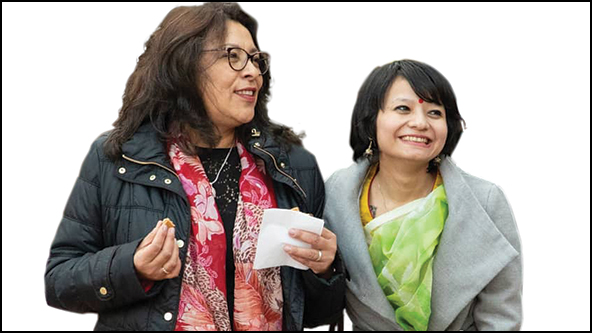
 (Photo courtesy of Angellica Aribam)
Women comprise nearly 50 percent of India’s population but only 14 percent of the seats in the parliament’s lower house—significantly below the global average of 25.5 percent. At the state level, women total 8 percent of the legislative assemblies, ranking India 142 out of 193 globally for women’s representation in government.
The few women who are elected to government face relentless misogyny from their male counterparts. “Women in political leadership are treated as second-class citizens,” says political activist Angellica Aribam. “We deal with sexism—from voters and party members.”
Aribam experienced gender discrimination the moment she entered politics while a student at Delhi University in 2012. That same year, she was elected the national general secretary of the National Students’ Union of India, the student wing of the Indian National Congress. Male legislators relentlessly criticized how she dressed and excluded her from policymaking projects because, they told her, such work was men’s domain. She also experienced unwarranted sexual advances as well as racial discrimination—a common experience of people from northeastern India, whose ethnic and racial diversity have fueled a backlash from other Indians. In 2017, her party refused to nominate her for the legislative assembly, citing her female gender and young age. At 25 years old, she quit politics.
Pushed out but not disillusioned, Aribam became determined to help women gain a foothold in government. From her personal experience, she knew that women needed mentorship and a strong support structure—both of which she lacked—to establish their political careers and to increase the overall representation of women in government. In June 2019, she founded the nonpartisan nonprofit Femme First Foundation to help women navigate the very same structural biases and practices of gender discrimination that she experienced in politics.
Aribam launched the foundation with $2,500 of her personal savings, which covered basic operational costs such as rent, accounting, and legal fees, and she relied on the generosity of volunteers for programmatic help. Since August 2020, the nonprofit’s funding model has thrived on modest fees of 4,500 rupees ($60) collected from participants in its Gendered Leadership Course (GLC) and 20,000 rupees ($270) from its She Runs Government (SRG) Fellowship program, as well as from individual donations.
The GLC consists of lectures led by Indian feminists working in politics, journalism, law, and related fields, who share their experiences of navigating sexism in their careers. The course also includes lectures on the history of feminism and gender-inclusive policymaking. “This course helped me unlearn some of my old beliefs,” says Bengaluru-based development professional Varsha Pillai, one of the 150 participants in the GLC. “We are unknowingly so entrenched in patriarchy that we forget to see things from a lens of equity.”
Armaan Mehra, an Indian doctoral student in Bad Nauheim, Germany, says that the GLC has “motivated him to acknowledge the privileges of being a man.” He has become more thoughtful about how he interacts with others. “I’ve realized that little things like asking someone where they are from might cause stress if they belong to a minority group or stigmatized community,” he says.
The SRG Fellowship, which commenced in April 2020, trains and offers mentorships to aspiring female politicians and policy makers. The six-month fellowship includes virtual seminars by politicians and academics on electioneering, policymaking, and campaign design—aspects of electoral politics not taught elsewhere in India. Each fellow is mentored by a local female politician and also receives branding guidance and training from the Harvard Kennedy School’s Public Narrative Team—a connection that Aribam made when she was an American NGO Vital Voices Engage Fellow in 2018-2019.
The inaugural SRG cohort consisted of 18 women selected from 152 applicants. Sangeeta Mittal, a New Delhi-based associate professor who has won staff association elections at her university, applied to “discover who I am as a leader and what I wish to be,” she says. She has been impressed with the training format. The one-on-one mentoring has helped her to understand the “nitty-gritties of how politics pans out on the ground.”
Because of the COVID-19 pandemic, both the GLC and the SRG Fellowship have been conducted online, which, Aribam acknowledges, has limited their ability to reach people without internet connectivity. Femme First plans to continue and expand its programming online for the foreseeable future. Aribam has devised two new programs: one that teaches schoolchildren to unlearn gender stereotypes and another that educates men on how to be better allies in politics.
“Given that more than 85 percent of the political system is made up of men,” Aribam observes, "it’s important to get them on board."
Read more stories by Priti Salian.