


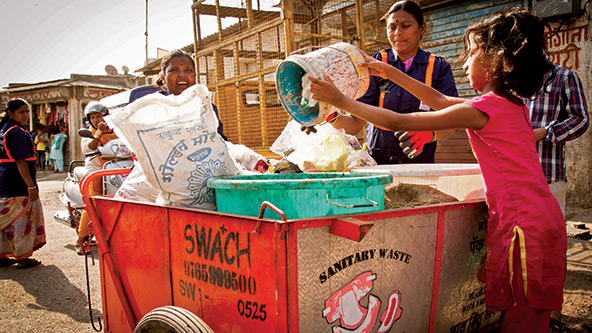
 Members of the SWaCH waste-collection cooperative put sanitary waste into a pushcart in Pune, India. (Photo courtesy of Brodie Cass Talbot/Swach
In the early 1970s, Suman More moved to Pune, in western India, from a nearby village to be married at just 12 years old. Her new husband lacked a stable job, so she was forced to work. However, with no education or training, More could only find work as an informal waste picker, rummaging through garbage bins and landfills for recyclables to sell. But that barely paid the bills.
In 2008, More joined the waste pickers’ service cooperative, Solid Waste Collection Handling Seva Sanskari Sanstha Maryadit (SWaCH), a solid-waste, door-to-door collection agency managed by the Pune Municipal Corporation (PMC). SWaCH provided her with the security she needed. “I got a fixed income every month, safe working conditions, and the identity of a city worker by the municipal corporation,” says More, who, now in her 50s, has retired from waste picking and currently chairs the cooperative.
Pune-based social activists Lakshmi Narayan and Poornima Chikarmane founded SWaCH in 2008 to integrate informal waste pickers like More into the city’s waste management system. “We wanted the waste pickers to be recognized as a critical part of the solid waste management system in the city and the first rung of the recycling chain,” says Chikarmane, a retired professor at Shreemati Nathibai Damodar Thackersey (SNDT) Women’s University, Pune.
The World Bank estimates that at least 1 percent of the populations in developing countries are waste pickers. In India, the Alliance of Indian Waste Pickers (AIW) estimates that this self-employed labor force from the lowest castes of society ranges from 1.5 to 4 million people. Many of them begin work before daybreak in search of reusable waste in garbage dumps that they can later sell to scrap dealers to put food on the table. Their precarious day-to-day existence involves navigating waste without the protection of gloves or masks, risking daily exposure to cuts and wounds by sharp objects, rodent and dog bites, and chemical burns. Roaming outside while most of the city is still asleep, some also experience sexual violence or are arrested as thieves.
More recalls her hurdles as an itinerant worker, which often included derision because of her low caste status. “I was an outsider to the city, and without contacts it wasn’t possible to get work as a domestic worker,” she says. She tried selling vegetables, but the income was inconsistent. Waste picking was the easier option without any entry barriers of caste, education, or skill.
Today, SWaCH has more than 3,500 members in its fold, and Pune, a city of 6.8 million, has been credited with pioneering the formalization and integration of waste pickers into the city’s waste management system.
Union Power
The waste pickers’ movement in Pune originated in the early 1990s, when Narayan and Chikarmane conducted adult education classes for women waste pickers at SNDT. “We realized that they spent a lot of time segregating recyclable material from mixed waste,” says Narayan, who coordinated the adult education program at the time.
Narayan and Chikarmane decided to meet with the waste pickers to discuss their labor concerns. Job security, regular earnings, and respect for their work topped their list. “Since neither the waste pickers, nor anyone else, considered their contributions as ‘work,’ the first step was to get them the status of a worker,” Chikarmane says. This could only be achieved by organizing them as a trade union.
In 1993, Chikarmane and Narayan approached Baba Adhav, a well-respected leader of the working class movement, who helped them “organize and register Kagad Kach Patra Kashtakari Panchayat (Paper, Glass, and Metal Laborers Union, or KKPKP) as the first waste-pickers’ trade union in the country,” Chikarmane recalls. All of the 800 registrants—90 percent of whom were women—received identity cards from SNDT university. In 1996, PMC gave all 3,000 KKPKP waste pickers the status of city workers.
Throughout this time, Chikarmane and Narayan documented the waste pickers’ contributions to the city. Their 2001 study for the International Labour Organization projected PMC’s savings as 120 million rupees ($162,215 USD) annually due to the waste pickers’ door-to-door collection.
With policy on their side and evidence of the impact of waste pickers’ work, KKPKP proposed their model of door-to-door collection of segregated waste with residents paying user fees to PMC. The model let waste pickers retain a right over the collected waste, which they could then sell for extra income.
In 2005, PMC tested KKPKP’s proposed model for a two-year period, in which 1,500 waste pickers covered 150,000 households daily—15 percent of the city’s population. The municipal corporation provided equipment such as pushcarts and buckets for the waste pickers and sent letters to residents to request a small user fee for the service. The model’s success resulted in the formation of SWaCH and a five-year contract with PMC, in 2008.
Ketaki Ghatge, assistant medical officer at PMC’s department of solid waste management, says that the municipal corporation invested in SWaCH because it found the model to be both “cost-effective for the municipality and uplifting to the waste pickers.” It ticked many boxes for the municipal corporation: alleviating poverty, recycling waste, and reducing emissions at a much lower price than the centralized waste-collection system.
SWaCH waste pickers usually work in pairs with another family member to collect waste from 150 to 400 households, shops, and office complexes daily. The collection is then dumped in a sorting shed provided by PMC, where waste pickers separate their recyclables and sell them twice a week to scrap dealers. The rest of the waste is picked up by a vehicle sent by PMC and taken to a landfill.
“My husband and I together are able to earn about 25,000 rupees ($338) per month,” says Asha Kamble, a longtime SWaCH member. “Recyclables on average give us about 3,000 to 4,000 rupees ($40 to $54) monthly, and more during festival time, when people clean their homes.” Kamble earns close to the minimum wage of an unskilled worker in Pune, but with the benefits of the flexibility of taking on as much work as she likes, the stability of a monthly income, and social security. Because of her employment status, she has access to eight government programs, including health and life insurance, subsidized hospitalization, and a contributory pension.
In 2012, the cooperative expanded its services—called SWaCH Plus—to include the collection of e-waste, old clothes, and other discarded items; composting; and retrieving statues from rivers and tributaries during September’s Ganesh festival, when waste pickers have a chance to make extra income.
Collective Responsibility
Prior to SWaCH, there was very little doorstep collection and no segregation of waste. Overflowing garbage bins were irregularly emptied by PMC vehicles, which then transported the waste to landfills. “With SWaCH coming in, waste is picked up every day,” says Pune resident Sanskriti Menon. Even during the COVID-19 lockdown, 95 percent of the pickers still collected waste.
Even though PMC pays for SWaCH’s staffing and the equipment, it saves an estimated 2.7 billion rupees ($36.8 million USD) annually in labor costs, reduced transportation, and waste processing, according to a 2019 report by the United Nations Economic and Social Commission for Asia and the Pacific.
Despite these advances, some of the biggest challenges for the cooperative include residents not paying the user fee and PMC not providing the slum subsidy. Chikarmane says that these problems arise because the “policy framework for solid waste management in the city is not strictly enforced.”
Some residents refuse to pay the complete monthly user fee of 70 rupees ($0.95) because they feel that PMC should serve them for free as taxpayers. This is more common among low-income slum-dwellers, who pay a lower user fee of 50 rupees ($0.68), which PMC covers by paying 10 rupees ($0.14) per household to the waste picker.
Waste pickers do not like working in slums because many residents do not separate dry and wet waste. “PMC’s monthly slum subsidy arrives only once or twice a year, so there is an overall resistance among the waste pickers to serve the slums,” SWaCH director Harshad Barde says.
Adequate sorting sheds are not available for waste pickers, so sometimes they have to store their waste in corner spaces designated by housing societies, or along smaller lanes. When a PMC vehicle doesn’t collect the leftover waste, the cooperative bears the brunt of the blame. Over the years, SWaCH has sponsored 120 small mobile sheds that accommodate one or two waste pickers’ collections, but at least 2,500 workers still don’t have storage space.
Each time SWaCH’s contract is renewed, the cooperative is forced into renegotiations because of a changeover of PMC representatives. But SWaCH waste pickers understand their value and rights, having worked in an efficient system for years and being designated official workers. “They can relate both to service users and PMC administrators, sit across the table, and bargain with them,” Chikarmane says.
Barde explains that even in case of a nonrenewal of the contract, SWaCH will be able to continue operations based on the monthly membership fee of 200 rupees ($2.70) and the services of SWaCH Plus, which is continuing to expand its services. “The cooperative would like to move to completely sustainable waste management services, including composting, plastic waste reprocessing, and opening fair-trade scrap shops for selling recyclable waste,” he says.
Because of SWaCH’s lasting success, “most urban local bodies in India now have some level of engagement for waste pickers, but SWaCH provides end-to-end integration,” explains Kabir Khan, the coordinator for both the Global Alliance of Waste Pickers and AIW. “The waste pickers take ownership of the cooperative, and work responsibly.”
Read more stories by Priti Salian.