

 (Illustration by Cristiana Couceiro)
Nonprofits worldwide have come under a sweeping movement for social responsibility. They are now engaging in all manner of prosocial activities that go well beyond their primary missions. Diversifying their boards by gender and race, paying their suppliers a fair wage, reducing their environmental footprint, and lending their voice to social causes from #MeToo to Black Lives Matter are just a few trappings of this surprising development.
As the movement has taken off, some nonprofits have formally broadened their missions to incorporate new concerns for social responsibility. In 2022, the American Hospital Association, which represents nearly 5,000 organizations in the health-care sector, revised its vision statement to insert language about justice and equity. Likewise, the Sierra Club is no longer focused narrowly on environmentalism; its “2030 Strategic Framework” also touches on antiracism, sexism, economic justice, and achieving work-life balance for its employees. Similarly, Goodwill Industries, which has a heritage statement from its founder, Rev. Dr. Edgar J. Helms, that acknowledges its history of creating employment opportunities for those who are disabled, now stresses in its core values the broader objective of being “socially, financially, and environmentally responsible.”
This development is surprising, not only because of its reach and depth but also because nonprofits are already supposed to be good actors. Advocates of corporate social responsibility typically justify it as a corrective to the social ills created by the pursuit of profit. But nonprofits’ very purpose is to contribute to the public good. In the United States, this is a legal matter: The Internal Revenue Service grants tax-exempt status only to organizations that provide public benefit. The goodness of nonprofits is also implicit to the main theory of their existence: They provide services (feeding the poor, caring for the sick) that society needs but that are undersupplied by governments and not lucrative enough for traditional investors.
In this article, we address the causes, contemporary characteristics, and consequences of this puzzling movement for nonprofit social responsibility. The phenomenon has profound implications for our understanding of nonprofit mission and for the demands that are placed on nonprofit leadership. Nonprofits that incorporate a broader view of responsibility into their work may gain legitimacy, and the expansion of purpose could spark innovation. However, leaders will also be challenged as the mission becomes less singular and will need greater skill in navigating multiple, sometimes competing goals.
The Emergence of the Movement
Starting in the 1990s, the nonprofit sector expanded rapidly in the United States and around the world. Growing resources and numbers of organizations meant greater potential for good, but also for ill, and a series of high-profile scandals rocked the sector. Academics and journalists locate the emergence of nonprofit social responsibility in the need to counterbalance the growing power of nonprofits in society.
Indeed, the number of US nonprofits has exploded from fewer than 13,000 in 1940 to more than 1.5 million last year.1 Meanwhile, many became gargantuan. The Bill & Melinda Gates Foundation, for example, was founded as recently as 2000 but now commands about $50 billion in assets—larger than the annual GDP of more than 100 countries. At the same time, the number of international nongovernmental organizations increased dramatically, from about 1,000 in 1950 to more than 76,000 in 2023.2
Nonprofits grew not only in number, size, and global reach but also in notoriety: A handful of major scandals in the 1990s fueled a backlash against their newfound status. Some of the biggest names were implicated, including the United Way, the world’s largest privately funded nonprofit. Its CEO, William Aramony, was convicted in 1992 of misusing nearly $1.2 million in donations, some on extramarital affairs. Social-work scholars Margaret Gibelman and Sheldon Gelman have identified 11 major scandals that broke from 1992 to 1998, piercing the illusion that nonprofits are somehow immune to wrongdoing.3
The series of scandals triggered a wave of third-party standards and certifications that spread throughout the sector. Well-publicized examples of nonprofit malfeasance gave rise to the founding of watchdog groups, such as CharityWatch, established in 1992, and the creation of organizations that verify nonprofits’ good standing, like the launch of GuideStar (now Candid) in 1994. Concerns about nonprofit embezzlement, tax evasion, and overall incompetence also led to initiatives such as Charity Navigator, established in 2001, to evaluate nonprofits on their resource use and efficiency.
Nonprofits have responsibilities that go beyond the direct good they do in their sphere of influence to include supporting a healthy, vibrant field of endeavor for all.
This accountability infrastructure also included organizations that promulgated best practices for nonprofit governance (e.g., BoardSource, est. 1988) and packaged ethical principles into codes of conduct that any nonprofit can adopt, irrespective of its area of work (e.g., the World Association of Non-governmental Organizations, est. 2000). A follow-on development was nonprofit accreditation, for which many providers now exist, including the Standards for Excellence Institute (est. 1998) and Nonprofits First (est. 2005). Overall, these initiatives sought not only to repair damaged faith in the sector but also to guide nonprofits toward rational, effective, and professional practices. As a result of their work, the goodness of nonprofits, previously assumed to emanate from within, increasingly came to be stamped from without through a variety of external assurances.
Dimensions of the Contemporary Movement
As the movement for nonprofit social responsibility has evolved, its character has also changed. It emerged against a backdrop of high-profile scandals and rapid growth in the number, size, and reach of nonprofits and, perhaps as a result, initially operated by a logic of social control. The initial movement was animated by the push for external oversight and standardization, in the form of certifications, accreditations, watchdogs, and codes of conduct.
By contrast, the contemporary movement is driven by nonprofits taking proactive steps to incorporate an expanding array of social issues into their core values. It goes beyond a narrow conception of the nonprofit mission and beyond the baseline responsibilities of being lawful and ethical to stress responsibility to a wide array of stakeholders, including the sector as a whole, and practicing leadership on emergent social issues.
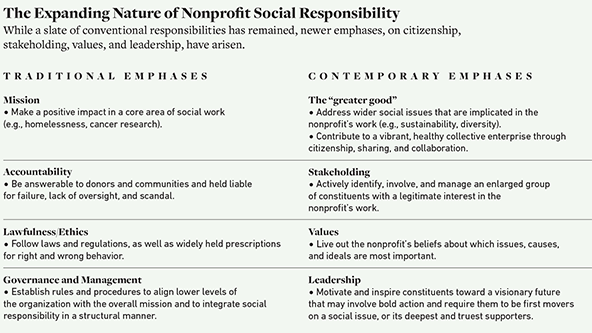
In particular, we identify the following features in the contemporary movement:
It goes beyond mission. | Whereas the goodness of nonprofits was traditionally grounded in their ability to advance a mission in an area of social work (e.g., cancer research or homelessness), nonprofits today are also addressing the connections between their missions and a larger set of social issues. One such issue is sustainability, which has been taken up by countless nonprofits whose main focus is not environmental protection. Universities such as Oxford and Harvard, for instance, have disallowed their endowments from investing in fossil fuels, while other nonprofits have supported the cause by going paperless, teleworking, and being early adopters of green technology.
Another issue that has swept the sector is diversity. Whether or not diversity is central to a nonprofit’s mission, the nonprofit is now expected to address the issue to the extent to which it can. For example, the Bill & Melinda Gates Foundation has experimented with a double-blind grantmaking process to see if it reduces gender bias in awards.4 The foundation has also created and hired a chief diversity, equity, and inclusion (DEI) officer to ensure that its own internal practices are consistent with the value of diversity.
The issue of diversity illustrates two other points about the movement. First, in some cases, nonprofits broaden their missions to allow for a wider scope of social impact. Earlier this year, for example, the American Hospital Association (AHA) augmented its mission with new language about equity (italics for the new text): “The AHA’s mission is to advance the health of all individuals and communities. AHA leads, represents, and serves hospitals, health systems, and other related organizations that are accountable to communities and committed to equitable care and health improvement for all.” Second, the issue of diversity demonstrates that the movement for social responsibility has grown more extensive over time. Indeed, as the issue of diversity has permeated the nonprofit sector, it has demanded attention on more and more fronts. An early emphasis on race and gender has broadened to include age, nationality, sexuality, educational attainment, and disability status. For example, we see nonprofits’ growing awareness of the need to create quality volunteer opportunities for the aging baby boomer population5 and for colleges to be welcoming to first-generation students and those with learning differences, such as autism.
It goes beyond lawfulness and ethics to emphasize living out the nonprofit’s values. | The 1990s initiatives for nonprofit responsibility emphasized ethics and, at a minimum, lawfulness. Today, both dimensions of nonprofit responsibility have remained important, as is apparent in the ubiquity of nonprofit codes of conduct,6 which provide guidelines for employee behavior on everything from sexual harassment to whistleblowing.7 To be sure, both dimensions are still evolving. There are now active ethical and legal discourses, for example, about what employees can say on social media, whether donor identities should be kept private, and whether to pay a ransom to hackers who hold the organization’s operating system hostage.
But in contrast with the previous era, the sector today is driven more by values. Ethics are duty-based prescriptions for behavior that impact nonprofits from without, as rules and standards that reflect widely shared beliefs about what is right and wrong. On the other hand, values are internal ideals that differ across nonprofits and reflect their individual estimations about which of the many cultural aspirations on offer are most important.
In the early 2000s, values became a more prominent topic, as experts advised nonprofits to identify a small set of priorities to formalize into core values statements that are now commonplace throughout the sector and easily located on nonprofit web pages. These documents have incorporated many of the dimensions and concerns of the social responsibility movement, such as “diversity” (e.g., The Nature Conservancy), “environmental stewardship” (Goodwill Industries), and “accountability” (Save the Children).
 It goes beyond accountability to donors and served communities to include a wider array of stakeholders. | Another early nonprofit responsibility that organizations have carried forward to the present day and further elaborated upon is accountability. A nonprofit is answerable, for example, to donors in terms of how funds are used and to served communities for any unintended harm. Accountability goes hand in hand with the duty to explain and justify, the practice of reporting, and the very activity of accounting—in the sense of recording, verifying, and analyzing the nonprofit’s resources. When nonprofits become more accountable, for example, by tracking and reporting their expenses to external audiences, they may become more disciplined to cut waste and lower unnecessary overhead. When nonprofits measure and report their social impacts, they may become more sensitive to the ways in which programs can be improved. When nonprofits disclose their donors and foundations submit their grant decisions to public scrutiny, they may avoid the perception of being controlled by “dark money” or nepotism.
Accountability also means being held responsible for failure or malfeasance. As such, accountability incentivizes nonprofits to prevent wrongdoing before it occurs. They do so by putting controls in place and adopting best practices and procedures that people with proper training and credentials oversee. Accountability—including its fellow travelers reporting, control, and professionalization—safeguards trust in nonprofits by assuring outsiders that things are being done in an upright manner.
While the emphasis on accountability has certainly not waned in recent years, understanding of whom exactly a nonprofit should be accountable to has expanded. A previous focus on groups with direct ties to nonprofits, including donors, boards, employees, and served communities, has grown to include all groups that are affected in some way by a nonprofit’s operations—in other words, stakeholders. Nowadays stakeholders include even notional entities such as unborn generations and the natural environment.
In particular, experts ask nonprofits to practice stakeholder management. This requires nonprofits to identify their stakeholders, take an inventory of their needs and interests, treat them with dignity and respect, keep them informed of organizational affairs, and create channels to include them in decision-making. With this approach, nonprofits may consider employees, for example, not just as kindred spirits with a shared belief in the mission but as stakeholders with legitimate, concrete, and addressable concerns, such as pay, job security, career advancement, and working conditions.8 Stakeholder management, as commonly presented, is not just a moral imperative but a strategic endeavor that can bring operational benefits, such as greater trust, rapport, and satisfaction among the many groups that are involved in the nonprofit’s work.
It goes beyond the individual nonprofit to stress citizenship and the collective enterprise. | The “social” in social responsibility suggests not only stakeholder relationships but also the wider society and the collective nonprofit enterprise. Nonprofits have responsibilities that go beyond the direct good they do in their sphere of influence to include supporting a healthy, vibrant field of endeavor for all. Citizenship, more specifically, refers to public-minded behaviors that are voluntary and often not formally rewarded but generally viewed positively as contributing to public goods that everyone should ideally supply.
Nonprofits today are practicing citizenship in myriad ways. The YMCA, Feeding America, and the United Way are among thousands that give their employees paid time off on Election Day. Other nonprofits have lent their voices to issues that affect the entire sector, as when Code for America, Greenpeace, and Sierra Club signed a petition to block the sale of the online “.org” registry to a for-profit investor. Yet others have consented to practices that are not necessarily optimized for them but that are good for the sector if done by all, such as accepting grant applications in a common, standardized format. In addition, some nonprofits allow peers to recruit their workers and have shared donor contact information to nonprofits in similar areas of work. Through all these actions, nonprofits have done their part to support the sector and foster a civic spirit within it.
 (Illustration by Cristiana Couceiro)
It goes beyond governance and good management to include leadership. | Social responsibility starts at the top of the nonprofit and is practiced most genuinely and concertedly when boards, executives, and senior officers are aligned and fully committed. Specifically, the movement has influenced two dimensions of the nonprofit apex: the traditional, structural focus on governance and management, and a newer, more dynamic emphasis on leadership.
Governance refers to an organization’s top-level administration through rules and procedures, including how the board and management are nominated, hired, structured, monitored, compensated, and kept independent from one another. Similarly, management refers to the stewardship and effective use of the nonprofit’s human and physical resources and to the establishment of protocols and best practices for integrating the nonprofit’s mission into lower levels of the organization. Good governance and management stitch social responsibility into the fabric of the nonprofit. For example, the model of multistakeholder governance serves to ensure, as a structural matter, that there will be board representation and therefore influence on board decision-making from the various groups that are impacted by the nonprofit, including its own workers and served communities, in addition to the usual membership of donors and industry experts. Likewise, nonprofits can promote social responsibility through their compensation schemes, for example, by linking executive pay to diversity or sustainability targets. Through such arrangements, social responsibility becomes built into the nonprofit, rather than bolted on.
More recently, academic and practitioner discourses on how nonprofits should be run have expanded to include an emphasis on leadership. These discourses portray the nonprofit not merely as a system that requires appropriate design but as an entity to be infused with life and direction. Good leaders not only put the right controls in place but also inspire and motivate organizational constituents. Increasingly, leaders are expected to be visionary—to set bold, meaningful objectives and to equip and empower subordinates to accomplish them. As a reflection of this change, mission statements, core-values statements, and codes of conduct have been joined by vision statements. These inspire stakeholders with a nearly utopian, highly aspirational state of affairs that the nonprofit can usher into being through its social work, whether it is a world “where everyone has a decent place to live” (Habitat for Humanity) or “no child goes to bed hungry” (Feed the Children).
Leadership is important to social responsibility for several reasons. First, because leaders are not just another employee of the organization but are also figureheads, they are expected to model the organization’s values in their personal and professional lives. Second, given that social responsibility often involves actions that are loosely related to the primary nonprofit mission, senior leaders need exceptional charisma, persuasion, and creativity to integrate the meaning of disparate actions into a coherent theory of action for stakeholders. Third, leaders are often needed to make difficult decisions with steep downsides, such as when college trustees risked alienating alumni by removing campus monuments to slave-owning benefactors.
Implications
From leadership to stakeholder management to citizenship, the contemporary movement for social responsibility places extraordinary demands on nonprofits. Displaying commitment to broader social issues may bring operational benefits by bolstering a nonprofit’s legitimacy and reputation. Attention to social responsibility may also instill nonprofits’ work with a larger sense of meaningfulness, which can help improve employee morale and recruitment. Lastly, as many of the associated activities enhance visibility, they may promote awareness, which can lead to more donations and volunteer engagement.
The movement for nonprofit responsibility also comes with risks. Attention to noncore social responsibilities may detract from the organizational mission.
Additionally, nonprofits that become more aware of the social issues that are inextricably involved in their work may come up with innovations. For example, the Museum of Photographic Arts in San Diego, among many other museums, has improved access to the arts by instituting a “pay what you wish” admissions policy. To address gender inequality in salary, the Hillel Foundation, the world’s largest Jewish campus-life organization, has experimented with establishing salary bands with set pay ranges for employees at different positions and making those bands known to all employees. Additionally, to promote mental health and to make workplaces more welcoming to people with disabilities, many service organizations have introduced unlimited paid time off.
The movement for nonprofit responsibility also comes with risks. Attention to noncore social responsibilities may detract from the organizational mission, especially in a sector that always seems to be operating on a tight budget. Possibilities for mission creep that used to be attributed to pressure from donors or the search for funding can now be introduced to the organization on all sides from an array of stakeholders. Over time, nonprofits that do not stick closely to their core calling and key competencies may find their identity and skills becoming less sharp as they try to become all things to all people.
Nonprofit leaders may also worry about undercutting their credibility through promotions of social responsibility that appear too corporate. Indeed, even using the language of “social responsibility” to describe the activities may be problematic, as the term is often linked in the corporate world to insincere, ineffective branding exercises. More problematically, nonprofits could themselves become subject to accusations of “greenwashing,” superficial “DEI-ization” (i.e., displaying an appearance of concern for the environment or diversity through symbolic, rather than meaningful, organizational change), or directing resources away from the mission. For organizations and a sector that are built on ideas of the public good, the consequences of such criticisms could be far more deleterious than in the business world.
Which of the multiple social responsibilities should a nonprofit focus on? Given the pressures for nonprofits to develop sharp, distinctive identities that resonate enough with specific donor segments to get them to open their wallets, nonprofits may be more successful if they target causes that are adjacent to their core work. While it is true that, on some level, all nonprofits should be accountable, ethical, and well governed, nonprofits must in practice also decide how far they want to go in each responsibility. Do they merely meet their social obligations, or do they try to exceed them and become issue-specific leaders? As they ponder the question, nonprofits may consider the many organizations that have practiced social responsibility in ways that build upon their core issues of concern. The Girl Scouts, for example, has furthered an existing commitment to women’s issues by giving a relatively long 12 weeks of paid parental leave to employees. Likewise, Every Texan, an Austin-based advocate for economic justice in public policies, has responded cooperatively and affirmatively to its own workers’ efforts to unionize.
The movement for social responsibility has had many practical effects. For one, it has led to an elaboration of roles and responsibilities within nonprofits around an expanded set of issues of concern. As a result of their efforts to balance an increasing number of stakeholders and social causes, nonprofits have become more complex operationally and structurally and have thereby placed more demands on leaders. Social enterprises, for example, take on hybrid forms so that they can better balance commercial and social goals. Nonprofits have also come to need leaders with vision and charisma who can connect with disparate stakeholders.
One of the most striking features of the contemporary nonprofit sector is the increasing rapidity with which new social causes have generated cascades of actions, policies, and statements. In recent history, these waves have followed the #MeToo movement and Black Lives Matter, as well as heightened attention to transgender rights, gender-neutral language, abortion rights, and the war in Ukraine. The greater amplitude and frequency of these issue waves no doubt reflects the nature of society today—the viral nature of social media, growing polarization in the United States and elsewhere, and advanced levels of globalization. As such, the surprising and, many would argue, welcome development of expanded nonprofit social responsibility is likely to intensify.
Read more stories by Shawn Pope & Patricia Bromley.