


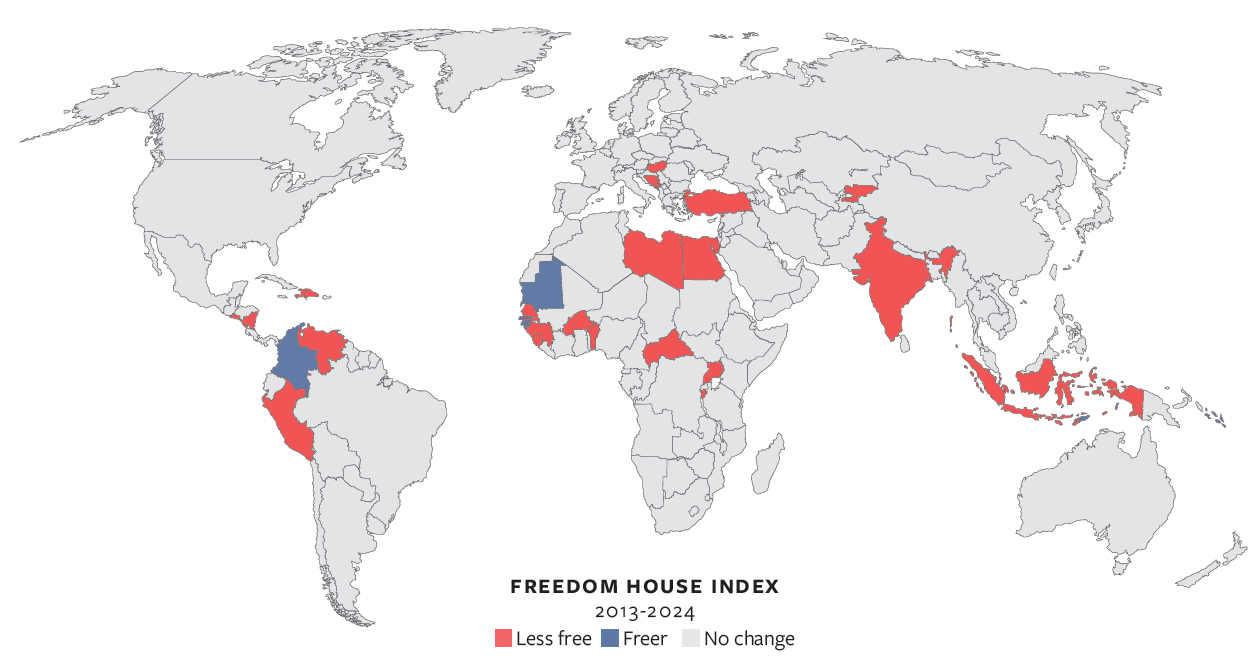
Across the world, the progress of democracy has slowed, if not reversed. According to Freedom House’s ratings, 23 countries became less free between 2013 and 2024—including India, Turkey, Hungary, and Indonesia—while only seven became more free.
What can be done to curb this trend?
Researchers link a variety of factors to democratic health, from the presence of free and fair elections and the rule of law to widespread economic opportunity, freedom of expression, and a healthy civil society. But where should those who wish to promote democracy—governments, philanthropists, or other social sector actors—focus their efforts? How can they distinguish causation from correlation? How might they find leading indicators that can serve as a warning for future backsliding (and, therefore, an opportunity to prevent it)?
Democracy promotion strategies vary significantly across different organizations and are often driven by institutional priorities and divergent instincts about what will work. But data can help. Our analysis indicates that there are distinct “early warning signals” that can be used to anticipate backsliding, and that these warning signals differ according to where a country is on the spectrum of “Free” to “Not Free.”
For example, among what Freedom House classifies as “Free” countries, the factor most correlated to future backsliding turns out to be low levels of economic opportunity, much more so than factors like challenges to elections or civil society. In “Partly Free” countries, weakened civil society is correlated with future backsliding, but—somewhat counterintuitively—lower scores on elections turned out not to be. Finally, confirming what one might expect about the importance of legal protections and political freedoms, the rule of law and the presence of open debate are important leading indicators across both “Free” and “Partly Free” countries.
This analysis relies on correlation and therefore cannot prove causation. However, if these factors do correlate with future backsliding, then they can be used as early warning signals to help leaders identify countries at risk for backsliding, as well as guide potential investments for reducing that risk. For example, boosting economic opportunity in “Free” countries with high inequality might be a strategic way to allocate scarce resources. Conversely, prioritizing countries for support based on lower scores on elections may make less sense, given that other factors are more likely to indicate backsliding (and may indicate that, when deciding what aspects of a country’s democracy to shore up, elections might not be the most important piece). Finally, one might conclude that investing in civil society is important in countries at risk of backsliding (or those that recently backslid), since that aspect of democratic society takes the largest hit after a country backslides (and can presumably help prevent further backsliding).
Building Quantitative Indicators for Democratic Health
This analysis begins by identifying five main elements that scholars agree impact democratic health:
- Elections: Free and fair elections are a bedrock of democracy, giving citizens a nonviolent way to express their preferences.
- Rule of law: Corruption and injustice can interfere with democratic processes when citizens embrace autocratic leaders who promise to restore “law and order” at the expense of democracy.
- Economic opportunity: When democracies deliver higher living standards for their citizens, it undermines populists’ arguments for autocracy.
- Open debate: Open debate, paired with tolerance for disagreement and political freedom, enables citizens to make their voices heard, organize coalitions, and challenge those in power, thereby preventing a single ruling party from becoming entrenched.
- Civil society: Citizens and movements that can effectively gather and organize can protect the exercise of their political rights.
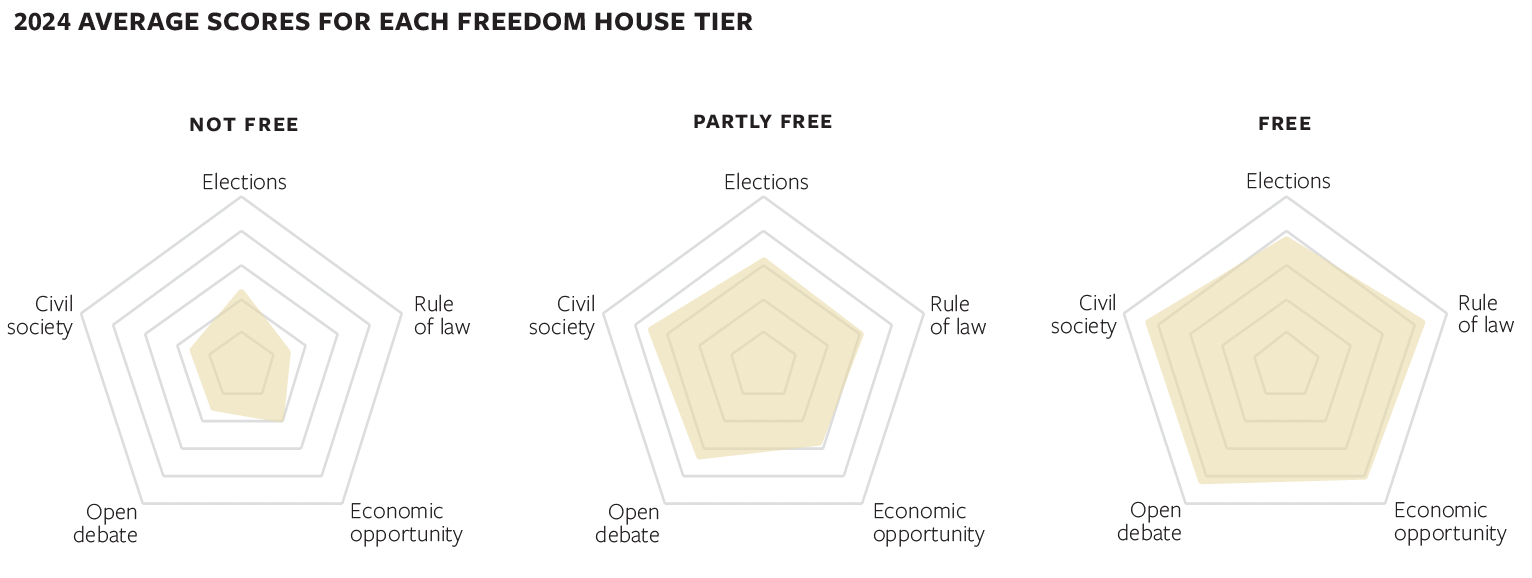
Next, we used V-Dem’s comprehensive and detailed dataset of over 400 country-level indicators related to democracy to produce a quantitative measure for each element of democratic health. Unsurprisingly, our calculations showed a strong connection between these five elements and Freedom House’s freedom classifications (“Free” countries had higher average scores on each of the five elements than “Partly Free” and “Not Free” countries).
 (Click to Enlarge)
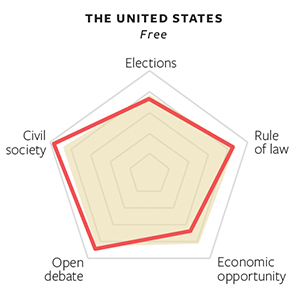
These datasets give a useful bird’s-eye view of how risks stack up across many countries, which could be useful for identifying countries at risk of backsliding (even though qualitative, contextual information from experts on the ground would be necessary to complete the picture). Our five-pointed diagrams illustrate the 2024 average scores for each tier of countries, on a scale of 0 to 1: The higher the score, the farther the point is from the center. (For example, the average Rule of Law score for “Free” countries was 0.86, but 0.61 for “Partly Free” countries.)
To discern the risk of backsliding, we compared countries that went from “Free” to “Partly Free” between 2013 and 2024 with “Free” countries that remained stable over that same period, hoping thereby to identify early warning signals. To the same end, we compared countries that went from “Partly Free” to “Not Free” between 2013 and 2024 with “Partly Free” countries that remained stable or became more democratic.
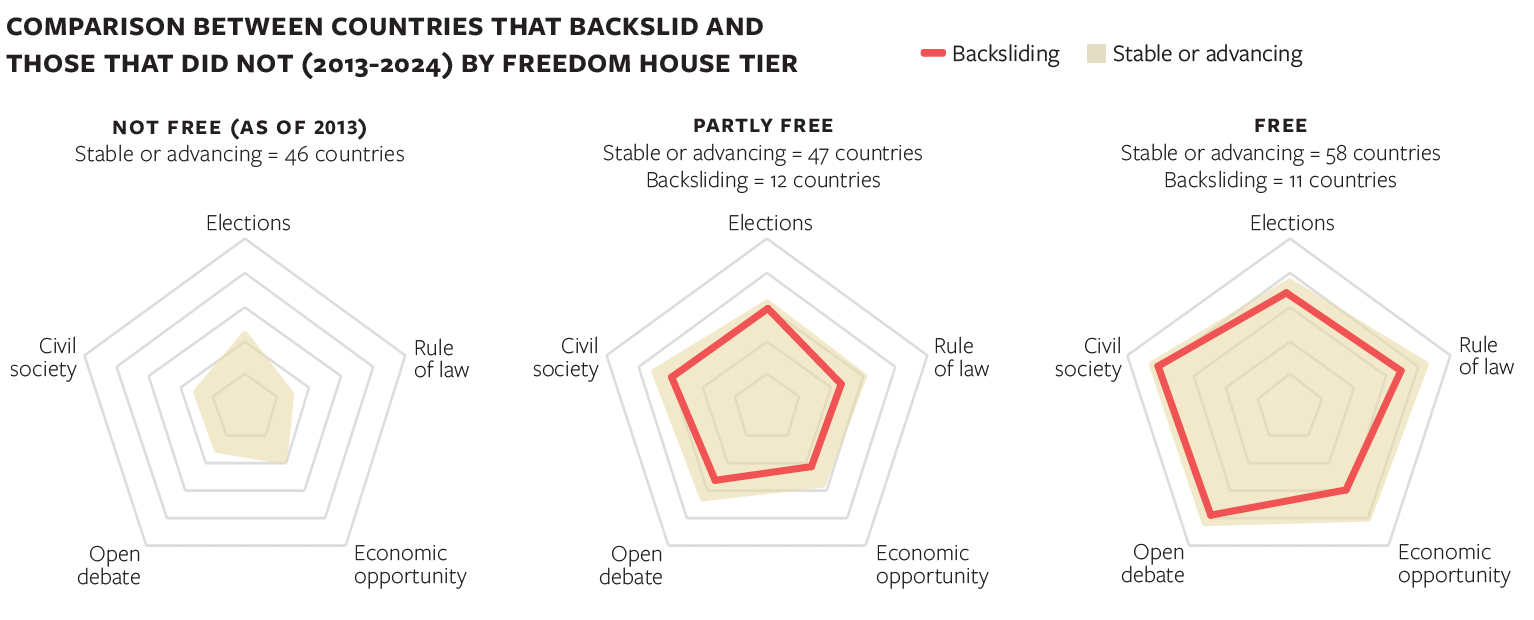
The chart below compares scores for countries that backslid with those that remained stable or advanced: The scores shown are from 2013 (since we aim to find forward-looking signals that can foreshadow future changes in classification).
 (Click to Enlarge)
In the rightmost graph, the yellow shading shows countries that started off “Free” in 2013 and remained so in 2024, while the red line shows those that backslid to being “Partly Free” by 2024.
In the middle graph, the yellow shading shows countries that started off “Partly Free” in 2024 and either remained so in 2024 or were categorized as “Free” by 2024, while the red line shows the 2013 scores of those that backslid to “Not Free” by 2024.
The leftmost graph only shows the 2013 scores of countries that either remained “Not Free” or advanced to “Partly Free” by 2024, since countries could not further backslide below “Not Free.”
Among “Free” countries, lower levels of economic opportunity appear to be the biggest predictor of backsliding. When democracies fail to deliver economic opportunities to their citizens, the data suggests, support for populist alternatives can grow. However, economic-opportunity scores change less than other indicators after countries have backslid, possibly indicating that economic opportunity is more of an early warning than a casualty of democratic backsliding.
Election scores reveal relatively little about future backsliding or its consequences. Among “Partly Free” countries, scores on elections are not tied to future backsliding and would not have predicted it (and for “Free” countries, they were only a moderate early warning signal). After a country backslid, election scores declined less than most other indicators.
Among “Partly Free” countries, lower civil-society scores are associated with backsliding. A strong civil society can help prevent backsliding by putting pressure on governments, raising international awareness of human rights abuses, and supporting nonviolent movements when they arise. Unfortunately, once “Partly Free” countries backslide, civil-society scores fall more severely than any other indicator (and once “Free” countries backslide, they experience the second-largest decrease), as autocrats seek to limit opposition. This may suggest that both before and after a country backslides, investments in civil society can be especially impactful.
Factors that remain consistently important across both “Free” and “Partly Free” countries are the rule of law and open debate, which both appear stronger in countries that did not backslide. A fair and just legal system and open debate are vital tools for constraining the power of autocrats, undermining censorship and disinformation, and protecting peaceful democratic movements and opposition from repression.
Prioritizing Investment Areas
When leaders are considering which countries to prioritize, given limited resources, these data can help identify where to invest.
For example, since low scores on rule of law and economic opportunity in “Free” countries presaged broader democratic backsliding, leaders may want to find and support other “Free” countries with low scores in those areas. Moreover, when working within a specific country, this analysis can help identify areas for intervention that may reduce the chance of future backsliding, such as boosting economic opportunity in “Free” countries with high inequality or strengthening civil society in “Partly Free” countries with constrained civil societies.
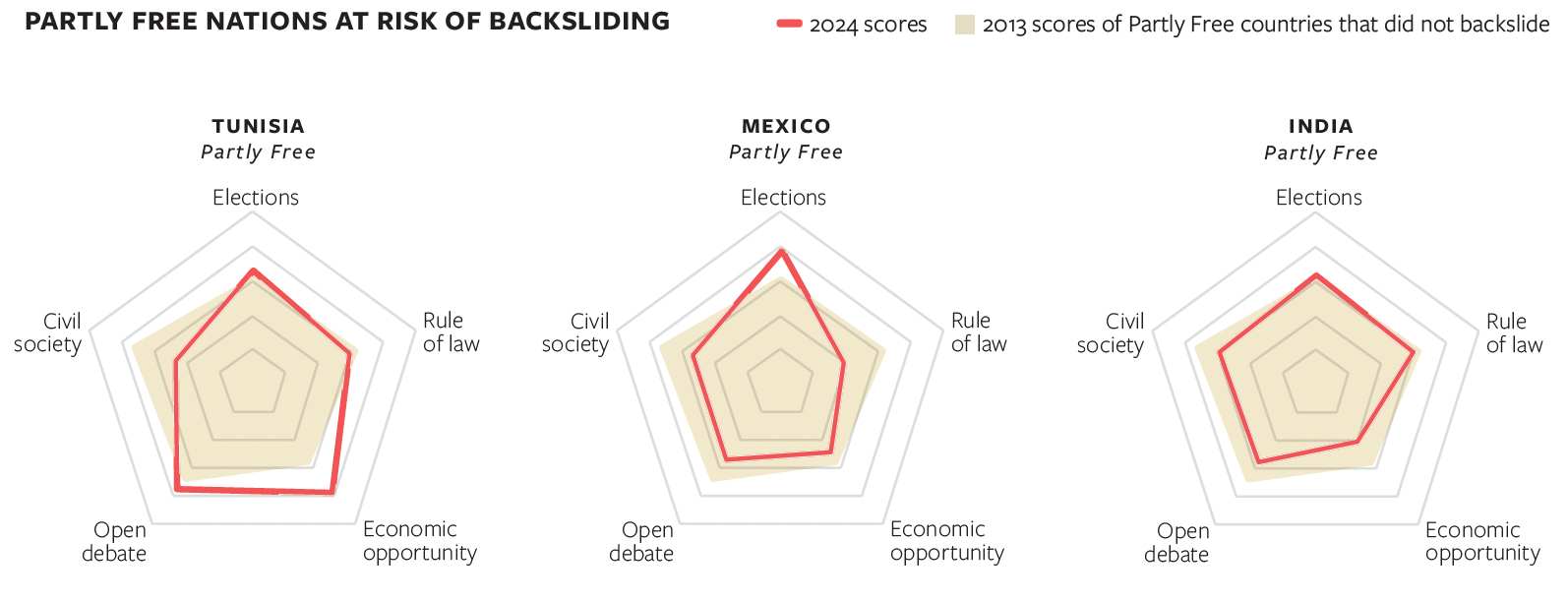
To ascertain areas to support, we can compare a country’s current scores with the prior scores of peer countries that did not backslide, as aspirational baselines. Below, we have paired data for Tunisia, Mexico, India, and the United States with some of the insights drawn from our analysis.
 (Click to Enlarge)
Tunisia (“Partly Free”) scores significantly lower on civil society than did “Partly Free” countries that did not backslide after 2013. Since weaker civil-society scores are tied to backsliding in “Partly Free” countries, pro-democracy leaders might focus on strengthening Tunisian civil society, which might include supporting leadership training, convening civil-society groups to discuss shared opportunities, and funding longer-term infrastructure and capacity building.
Mexico scores lower on rule of law, open debate, and civil society than did “Partly Free” countries that did not backslide after 2013. Since all of these are linked to backsliding in “Partly Free” countries, efforts to bolster democracy in Mexico could therefore focus on the complementary goals of reinforcing the rule of law (for example, with anti-corruption monitoring and policy research), buttressing open debate (for instance, with anti-disinformation campaigns, support for independent journalism), and strengthening civil-society organizations and movements (for example, with capacity building, organizational infrastructure building, leadership convenings).
India scores lower on economic opportunity, open debate, and civil society than did “Partly Free” countries that did not backslide after 2013. Again, since these are all linked to backsliding, it would consequently follow that initiatives to safeguard Indian democracy might prioritize expanding economic opportunity with anti-poverty and/or health-care initiatives, investments in education access, or sustainable agricultural improvements; supporting open debate with investigative journalism, civic education, or cross-cultural forums and dialogues; and, finally, strengthening civil society by supporting capacity building, facilitating leadership convenings and public-private partnerships, or helping mobilize and empower local wealthy donors.
The United States scores lower on economic opportunity than “Free” countries that did not backslide since 2013. Since that serves as an early warning signal for backsliding in “Free” countries, work to bolster American democracy could accordingly prioritize worker organizing, expanding access to high-quality education and job training, and economic policy advocacy and research, as a way to undermine populists’ zero-sum economic arguments and to shore up faith in democracy.
Other “Free” countries, such as Brazil and Chile, have similar score patterns and might also benefit from additional investments in economic opportunity and fairness.
In the United States, backsliding is a particular concern, since recent policies that risk widening economic inequality, efforts to strengthen the executive’s power at the expense of other branches of government, high-profile instances of political violence, and legal and regulatory initiatives designed to undermine civil society are all likely to negatively impact the country’s scores in the years ahead. Between 2013 and 2024, the underlying numeric score for the United States in the Freedom House ratings fell from 93 to 83 (out of 100). Assuming trends are not reversed, a similar decline could shift the United States to being a “Partly Free” country.
Looking Forward
This kind of data-informed framework—supplemented by consultations with knowledgeable local experts—can help leaders prioritize investments, weigh tradeoffs, and reassess needs as they evolve. It is vital that strategic and collaborative action be taken to defend democracy, and by analyzing data on democratic backsliding around the world, funders and other leaders can proactively identify early warning signals and design interventions that can prevent backsliding.
Further analyses could deepen these insights and help answer adjacent questions, such as trends for countries that have become more democratic (though this sample size is much smaller). Future research could also try to understand how specific elements played out in countries where backsliding did or did not occur, and to understand in more detail what strong investments in that area could look like: what types of investments to make, what types of partners are required, and what scale of time and resources are necessary for change?
Working to rebuild and strengthen democratic practices around the world is one of the largest generational challenges we face. Our hope is that this approach can provide useful data to those working on this important challenge and help prioritize resources to the areas where they can make the biggest difference.
Read more stories by Jarrett Bell & Sam Greenberg.