


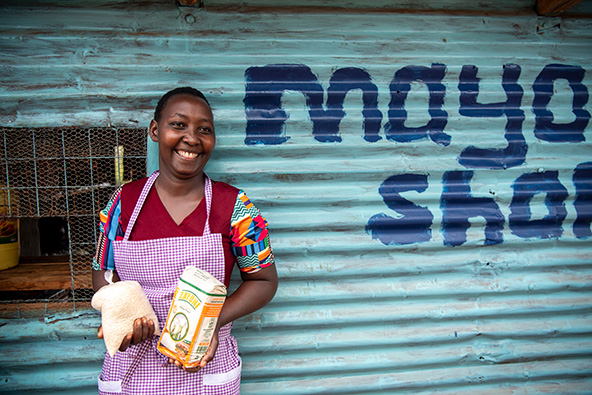
 An entrepreneur shows the products she sells in her retail business after completing a poverty graduation program in Murang'a, Kenya. (Photo by Alissa Everett Photography for Village Enterprise)
In September 2024, an article in The Economist posed a provocative question: Can evidence-based development programs, like those championed by Nobel Prize-winning economist Esther Duflo, scale effectively to combat the growing challenges of extreme poverty?
The stakes have never been higher. The US federal administration slashed 83 percent of foreign assistance programs during its first six weeks in office earlier this year, while European governments have redirected huge amounts of aid to defense spending. As a result, non-governmental organizations (NGOs) face a stark new reality, one where traditional donor-driven models are potentially no longer viable for the funding and implementation of national poverty interventions.
However, the diminishment of large-scale Western foreign aid doesn’t need to be the end of high-impact poverty alleviation efforts. NGOs can adapt by prioritizing partnerships with the governments of low-income countries. By building government capacity and ownership, fostering local trust, and using results-based funding alongside continuous innovation, NGOs can scale and sustain proven poverty alleviation strategies even in the face of shrinking aid budgets.
Building Government Capacity and Ownership
Sustainability is one of the most important elements of partnerships seeking to scale major development initiatives within government systems. Rather than creating parallel systems, NGOs need to help governments build capacity so that they can implement and scale programs independently, adapting models in ways that work within governments’ fiscal, institutional, and social realities.
Our work at Village Enterprise, a nonprofit focused on breaking intergenerational cycles of poverty through entrepreneurship, demonstrates how. Village Enterprise has been working with the Rwandan government since 2023 to equip parasocial workers (community-based volunteers who deliver social services) with the skills they need to implement a proven poverty graduation model across 8,100 households. This includes training workers to help program participants form community savings groups and develop entrepreneurial skills, and to provide ongoing support through a business mentoring program. Importantly, the effort will allow the government to reach people in a cost-effective—and thereby sustainable—way by leveraging existing human resources to deliver a wider range of services to more people.
Village Enterprise is also working with the Government of the Republic of Kenya through the Kenya Social and Economic Inclusion Project (KSEIP), an initiative funded by the World Bank. The economic inclusion component of KSEIP adopted a graduation approach to empower people living in extreme poverty with entrepreneurial skills and help them start micro-enterprises. In 2021, Village Enterprise and its partners, Global Development Incubator and Boma, began implementing the program directly while government officials learned through close collaboration. This included observing Village Enterprise team members run entrepreneurship training sessions first-hand. Starting in 2024, the government took the lead on implementation, while the other organizations took a technical assistance role.
This sequencing allowed the government to “learn by doing” before taking full ownership, and to create its own graduation model with a longer implementation period, larger seed capital grants, and a 12-month consumption stipend. KSEIP also catalyzed the development of a management information system that integrates with the national social registry to improve program targeting and tracking. Today, the government has a team of graduation experts with more than four years of experience implementing the program.
A successful transition also depends on building support and alignment across multiple levels of government. At the start of the partnership in Rwanda, for example, Village Enterprise embedded a staff member within the government’s Local Administrative Entities Development Agency to support the co-development of a training curriculum for parasocial workers and foster a shared understanding of the graduation approach. By participating in planning meetings, advising on implementation strategy, and continuously coaching government workers, the staff member embedded Village Enterprise’s expertise into the agency. This also helped overcome policy challenges and budgetary concerns related to program implementation.
The work in Rwanda also initially required a concerted effort to align three related but distinct entities: a local agency tasked with implementing poverty graduation, a ministry with policy and budgetary authority, and an agency that imposed standards on the outcomes tracking system. To help things along, Village Enterprise assigned a full-time staff member to support government coordination, funded the development of localized training materials, and provided in-kind technical resources, all of which accelerated buy-in from policy makers and paved the way for the integration of poverty graduation into Rwanda’s social services.
Fostering Local Trust
Building support and raising adequate funds for scaling at local and district levels requires a dedicated, sometimes painstaking, approach to building trust among local politicians and decision-makers. Demonstrating a program’s impact through self-funded pilots and adapting models to local priorities can help.
To demonstrate the effectiveness of its graduation model in Rwanda in 2021, for example, Village Enterprise used its own resources to implement the program in the district of Rulindo, then invited district leaders to observe parts of its nine-week entrepreneurship training course and meet with participants. Leaders who lived in the same communities also conducted informal follow-ups to assess long-term impact. These interactions built trust, gave local officials confidence that their investment would yield results, and culminated in four district governments commiting their own funding to scale up the model in their regions.
In terms of tailoring programs to win and sustain local trust, with support from the Gates Foundation, Village Enterprise began working with the Kenyan county governments of Makueni, Taita Taveta, and West Pokot in 2024 to develop policies that allow them to allocate more resources to poverty graduation programs. The counties also are receiving their own management information systems to measure and improve program impact. County governments have viewed Village Enterprise’s willingness to help tailor policies to local circumstances and provide systems for measuring impact as a commitment to ensuring that the program addresses their specific needs.
Using Results-Based Funding
Governments can’t always afford the systems and oversight they need to efficiently manage multi-step processes like targeting, grants disbursements, and training. This can lead to delays, the loss of beneficiary trust, or even the abandonment of a program. By tying program payment to verified outcomes, results-based financing creates incentives for innovation while holding the implementing organizations accountable. This helps ensure that partners allocate limited resources efficiently, achieving maximum value for both governments and the populations they serve.
As an example, the nonprofit advisory firm Instiglio has worked with the Colombian government since 2017 to bring results-based approaches into mainstream public policy, transforming how policy makers spend and measure public funds. In partnership with Colombia’s Department of Social Prosperity, the firm designed and implemented the country’s first two social impact bonds (more details here and here) to achieve job placement outcomes. The success of these projects and the proof of cost-effectiveness ultimately led to the inclusion of results-based financing in Colombia’s 2018 to 2022 and 2022 to 2026 National Development Plans.
Instiglio has since supported the government in creating Colombia’s first public outcomes fund, the LOGRA Outcomes Fund, which aims to increase employment in the formal sector and other results-based financing projects focused on outcomes such as reducing recidivism and enhancing training programs for job placements within the energy sector. One of Instiglio’s current projects in Colombia focuses on improving early childhood development outcomes using a results-based financing model to improve attendance, performance, and quality of services.
Continuous Innovation
Billions of dollars pour to development programs each year with mixed results. NGOs need to offer governments grappling with constrained resources and competing priorities initiatives that work from the start. But they also need to keep innovating.
Africa’s first development impact bond for poverty alleviation, carried out between November 2017 and December 2020, demonstrates the potential of results-based approaches to funding development. In this case, nine investors provided the working capital to fund the delivery of Village Enterprise’s poverty graduation program in Kenya and Uganda. The project used the findings of an independent evaluation to determine outcomes and whether the investors would receive a return on their investment from the outcomes payers (USAID Development Innovation Ventures and the UK Foreign, Commonwealth and Development Office). The evaluation found that the program exceeded its targets, improving the livelihoods of 95,000 East Africans. The success of the project proved that results-based funding can sustain and scale impact, even in the face of external shocks like the COVID-19 pandemic, and contributed to the Rwandan government’s decision to partner with Village Enterprise in 2023.
Village Enterprise nevertheless continues to test new innovations with the aim of making the model even more cost-effective and therefore more viable for other countries. Its first pilot of a digitally enhanced graduation approach, for example, enabled team members to equip five times as many entrepreneurs with business training within a single year, and additional tests will launch soon.
Amid the uncertainty surrounding the future of international aid, NGOs need to find ways to fund and scale evidence-based programs. Prioritizing government partnerships and laying the right groundwork can sustain progress in an era of shrinking donor support.
Read more stories by Dianne Calvi & Taddeo Muriuki.