


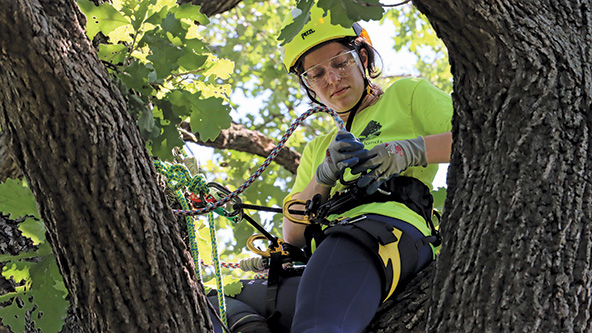
 Openlands Arborist
Apprentice Grace Ehlinger
secures her climbing line
while ascending a bur oak
tree in Lincoln Park. (Photo courtesy of Openlands)
Openlands Arborist
Apprentice Grace Ehlinger
secures her climbing line
while ascending a bur oak
tree in Lincoln Park. (Photo courtesy of Openlands)
More than 3.5 million trees exist in the city of Chicago. As climate change worsens, this urban forest will play a crucial role in mitigating its effects by reducing local temperatures, alleviating air pollution, and controlling stormwater.
The Chicago-based nonprofit Openlands has cared for the city’s urban forest since 1963. With an eye on climate change, the organization’s latest commitment to this mission is the new Arborist Registered Apprenticeship program, launched in 2021. Now entering its third year, the program is focused on creating a diverse and sustainable green workforce.
“If we want people to actively care for and manage the urban forest, one way that we can do that is introducing them to well-paying careers,” says Michael Dugan, director of forestry at Openlands.
The first arborist registered apprenticeship program in Illinois offers three years of paid training in arboriculture and urban forestry and transitional support for participants to move into steady jobs post-training.
Before Openlands introduced the program, the organization had been training individuals interested in green careers for five years. Seeking to formalize a program tailored to this training, Openlands turned to the Chicago Federation of Labor (CFL) for technical assistance and funding. CFL is a nonprofit workforce and economic development organization that supports several apprenticeship programs in fields as diverse as culinary science and advanced manufacturing.
CFL helped Openlands connect to and access federal Workforce Investment Act funding via the Chicago Cook Workforce Partnership, which administers the region’s federal employment and training funds. Openlands also receives corporate support, individual contributions, and grant funding from foundations, including the Hamill Family Foundation and the Illinois Clean Energy Community Foundation.
Eileen Vesey, program director at the CFL Workforce and Community Initiative, notes that the arborist apprenticeship program addresses workforce, community development, and climate-change-related needs while putting apprentices on promising career paths. “This is only the starting point,” Vesey says. “Depending on what your goals and interests are, you’re getting into an occupation where you’re going to have other opportunities to grow.”
The apprenticeship program is divided into two segments: one year of hands-on and classroom training with Openlands, and two years at a secondary employer for additional on-the-job training. Dugan says that during the first year, the apprentices “build a foundation of tree knowledge” through classes that are “taught by industry partners and in-house staff arborists.”
The apprenticeship program also receives grant funding via Openlands and support from secondary employer partners, including private parks and commercial tree-care companies, who employ and train apprentices in the second and third years of the program. These partners receive benefits, including tax credits, financial training support, and a job-application pool of apprentices with a year of rigorous classroom training and industry-specific credentials.
Openlands and project partners are also invested in developing a more diverse workforce that reflects Chicago-area communities. According to data from digital job platform Zippia, more than 70 percent of arborists in the United States are white, and a whopping 93 percent are men.
This commitment to diversity drew Emmanuel Gamez, a 32-year-old apprentice in the second cohort, to the Openlands program. “There aren’t a lot of training opportunities for a lot of the Latinx community working in the industry, so the career advancement isn’t where it should be,” he observes. The Openlands program is “definitely giving underrepresented and marginalized people in the industry a leg up,” he adds.
To keep barriers to participation as low as possible, CFL pays for transportation assistance to and from classes and other program-related commitments. Apprentices are offered competitive employment packages, including a structured pay increase every six months. Apprentices are also given access to career fairs and significant networking opportunities, like the Illinois Arborist Association annual meeting.
These opportunities are vital for apprentices without connections or knowledge of industry norms. “People who aren’t in that space aren’t aware of the opportunities or what the career pathways are,” Vesey says.
Openlands and its partners want to ensure the longevity of the arborist apprenticeship program, and so it is planning to include more secondary employment partners. Vesey says she is confident that the program has the potential to grow because it is “a win for everyone,” benefiting the climate, communities, apprentices, and employers alike.
Read more stories by Marianne Dhenin.