


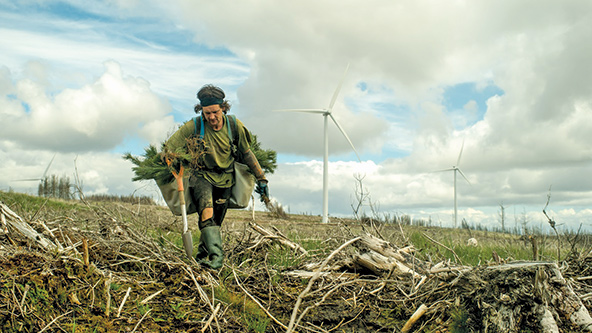
 Veteran tree planters—like Jakub Sutorý in Galway, Ireland—can plant more than 5,000 trees in one day. (Photo courtesy of Cameron Starr)
Young people between the ages of 15 and 25 are disproportionately affected by unemployment. According to a 2020 report by the UN agency International Labour Organization, youth are unemployed at more than three times the rate that adults are. Nearly 68 million youths were unemployed globally in 2019, a number that has only worsened with the economic devastation from the COVID-19 pandemic. Data from the US Bureau of Labor Statistics revealed that compared with the same period in 2019, approximately 88 percent more American youths between the ages of 15 and 25 were out of work in July 2020. In the United Kingdom, 1 in 10 young people lost their job during the pandemic.
Amid the devastation, Collin O’Mara, president and CEO of the National Wildlife Federation, proposed that one way to put millions of American youths immediately to work is to resurrect Roosevelt’s Tree Army, a federal program that, from 1933 to 1942, hired 3.4 million unemployed American youths to plant three billion trees.
While O’Mara’s vision for a modern-day Tree Army has yet to materialize in the United States, across the Atlantic, Gone West, a community-owned tree-planting company based in the United Kingdom, has been building an army of planters since 2015.
Gone West specializes in creating native forests and woodlands by partnering with local communities and businesses around the globe. Instead of asking people to volunteer their time and expertise, it employs young people in need of work and educates them about professional tree planting.
Gone West has planted more than five million trees while employing more than 200 unemployed youths and formerly incarcerated people since its founding. But planting trees is only one aspect of its mission. Gone West pushes for better working conditions for their planters and also provides additional maintenance services such as fertilizing, brush cutting, and grass cleaning.
A Community-Owned Business
In 2012, James Hughes worked for large timber companies in the United Kingdom. When he started, his job was to plant trees for a daily wage of around £100 ($140). He was mostly planting Sitka spruce, an evergreen timber species that makes up about 50 percent of UK commercial plantations.
In 2013, he started his own tree-planting enterprise, incorporated as Gone West—a British idiom meaning “gone crazy,” because people mocked him when they heard he wanted to make money from planting trees.
But Hughes was tapping into a growing sector. In the last three decades alone, predatory logging and industrial agriculture have contributed to the destruction of an estimated 420 million hectares—more than 1 billion acres—of forests around the world. This destruction increases the amount of atmospheric carbon dioxide, a significant contributor to global warming and climate change. Deforestation also damages local ecosystems, leading to the loss of biodiversity and rendering large areas vulnerable to flooding, landslides, and other natural disasters.
The demand for tree planters was also skyrocketing because businesses and timber companies began sustainability efforts in the last decade. But logging companies were also replanting trees in cleared areas to continue feeding the growing demand for timber-based products like paper and furniture.
Yet, Hughes struggled to get Gone West off the ground because he was new to the field, and he found it hard to find new contracts. He reluctantly continued working for large timber companies, which provided him with trees to be planted and paid him a daily wage for his labor. Whenever he did get a contract, he called on his friends in need of a daily wage to work with him. But the daily wages for his intermittent labor left little room to expand Gone West. “I was sleeping in my van, and I was really on edge,” Hughes says of Gone West’s early days. He regards those who hosted him while he was homeless, facilitated new contracts, or contributed on-the-ground expertise, as his early investors.
In the winter of 2015, Hughes made a discovery that transformed his business model. He had just completed a planting project for a timber company under harsh winter conditions and had about 20 trees left over. On a whim, Hughes loaded the trees into his car and drove to the historic Barras market in Glasgow, where he tried to sell them. Surprisingly, he sold each tree for whatever price the customers thought was fair, earning between £0.05 and £20 ($0.07 and $27) per tree. Hughes realized that he could turn a profit if he could source and sell the trees that he planted directly to businesses looking to offset their carbon footprint.
Hughes began reaching out to local businesses that wanted to plant trees to achieve their sustainability goals. These exclusive partnerships allowed Hughes and the team to truly engage in conservation work. Today, he sources saplings from local nurseries and sells each tree that Gone West plants for businesses for £5 ($7)—100 times what he was paid to plant that same tree for a forestry company for a daily wage.
When Gone West gained some stability, beginning in 2016, Hughes hired Jakub Sutorý, who had worked as a planter. Sutorý was wary of commercial forestry because the timber trees he was planting were heavily treated with pesticides that were harmful to the environment and to the people handling the trees. “Hughes listened to my concerns about pesticides and put his foot down,” says Sutorý, who is now Gone West’s operational manager of forestry services. He persuaded Hughes to demand that companies let him plant without pesticides—and decided to walk away if they didn’t.
“We’re not just cleaning carbon or whatever you want to say [to] look good in front of customers. We’re helping young people that don’t have a job,” Hughes says of his desire to create a community of conscious planters staffed by youth. “I believe that everybody should be given an opportunity.”
In 2017, Gone West held its first crowdfunding campaign, where more than 200 people donated more than £16,000 (about $23,000) to plant trees on their behalf. In 2019, Hughes and the team held the Seedrs Campaign, the company’s first crowd equity fundraiser where supporters had a chance to buy shares in the company. When the round closed, Gone West had grown by 359 investors and raised more than £156,000 ($216,000) to plant trees. This effort established Gone West firmly as a community-
owned, purpose-driven planting business.
Planting Hope
When the pandemic hit in 2020, the United Kingdom went into lockdown. Hughes and his team had to shut down operations for about two weeks in March. Uncertainty loomed over operations, as they lost some commissions as well as one of their vans, which they had driven into Portugal for a project but could not return because of the closed borders. According to Hughes, things improved when UK forestry workers were classified as essential workers due in part to the global toilet paper crisis, when the pandemic drove panicked buyers to drain toilet paper supplies.
Thanks in part to the essential worker designation, new opportunities have come along, with the help of Gone West’s network of investors. One investor, for example, is a member of the Prince’s Trust, a charity founded by Charles, Prince of Wales, to help unemployed struggling youths. “The Trust got in contact with us and proposed to join forces in the pandemic, considering the increase in youth unemployment rates in the United Kingdom,” Hughes recalls. Gone West and the Trust created a campaign called Acorns to Oaks, which employs youth to plant an oak tree for every £10 ($14) donated to the campaign.
While Hughes struggled to find clients a few years ago, now he faces a surplus of businesses eager to partner with Gone West. For example, while the pandemic was raging in May 2020, Benjamin Hall, the managing director of the interior design company Loft, pledged to plant a tree for every property furnished by his company through 2021. “I believe the pandemic has been created by a lack of biodiversity on Earth; we all must do more to save our planet,” Hall says. In 2020, he paid £25,000 ($34,500) to Gone West to plant 4,000 trees.
Just before the pandemic hit last year, Fausto Brigati, founder of Italy’s Hammer brewery, also decided to invest in Gone West by creating a line of beer called For the Planet. For every bottle sold, Brigati donates £0.70 ($0.90) to Gone West. By March 2020, Gone West had planted 100 trees for the company. “They gave me a good impression. They were transparent about their operations and inspired trust in me,” Brigati says, referring to why he has honored his commitment to Gone West even through the pandemic.
Hughes’ team reaches out to other communities with high youth unemployment, like his hometown, Liverpool, to meet this new demand for planters. Gone West looks for partners who are best equipped to work with conservation of native, multilayered forests and establishes long-term partnerships to create a patchwork of wildlife habitats all over the planet. “We partner up with conscious local communities around the globe who implement sustainable landscape design,” Gone West’s Chief Administrative Officer Marika Luiati says.
Today, Gone West is valued at $5.7 million and is in the process of receiving a B Corp Certification, which will legally hold Hughes accountable for the social and environmental impact of Gone West operations. Hughes currently owns about 89 percent of the company’s shares but says that he wants to eventually become just another community member—although he did not indicate how much of his shares he will relinquish, despite saying that he envisions “giving it all away.” So, for every future Seedrs Round, he will give up his own shares to welcome new investors. He hopes that the company will soon be owned by a community of people around the world, including in the future planting project destinations of Kenya, Palestine, and Spain.
“I hope to be planting five million trees every year very soon,” Hughes says about Gone West’s goals. “Plant more trees, employ more people, and give people the chance to achieve their dreams.”
Read more stories by Agostino Petroni & Sandali Handagama.