


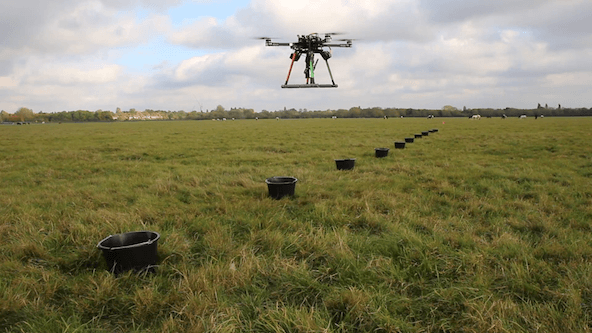
 BioCarbon Engineering conducts a UK trial of its drones’ precision planting techniques. (Photograph courtesy of BioCarbon Engineering)
The world’s forests lose an area equivalent to 48 football fields every minute, according to the World Wildlife Fund. And in the last two years, the rate of deforestation in the Amazon has increased by more than 20 percent—the highest rate in a decade. That means our planet’s ability to sequester carbon and mitigate climate change is constantly decreasing, and so are resources for people and animals who live in or near forests.
Meanwhile, reforestation has lagged, partly because it is difficult to deploy human labor and technology in the steep and remote locations where new trees are needed most. But a new technology that uses drones to plant trees may help solve this problem. The UK-based startup BioCarbon Engineering has developed an unmanned aerial vehicle that can plant 60 seeds per minute—60 times faster than it takes to plant seeds by hand. Each drone is equipped with a pressurized air canister that fires a seed pod of biodegradable plastic into the ground from a height of 10 feet. Working in conjunction with local communities, the drones also can perform post-planting maintenance, such as weeding and adding nutrients and pesticides.
“Cut-down forests are easy to put in the back space of your mind because they’re so far away,” says Lauren Fletcher, a Stanford University-educated civil and environmental engineer who founded the company. “It’s easy to say, ‘That’s someone else’s problem.’ When I saw that the state of the art for planting was a guy with a bag of seeds on his shoulder, I thought there was no reason we couldn’t develop a scaled-up global solution.” Fletcher says that using BioCarbon Engineering’s technology, a “swarm” of 6 to 10 drones can plant 100,000 trees in one day, based on trials in the United Kingdom. That means that 50 drone swarms can plant 1 billion trees in a year—enough to sequester two billion tons of carbon over 20 years. (Because of mechanical and environmental limitations, the drones can operate for a limited number of hours per day, 200 days per year.)
If the company reaches its target, it will directly address the UN Sustainable Development Goal of halting deforestation and restoring degraded forests worldwide, says Jay Corless, a UN Foundation senior advisor who coordinates the Solutions Summit at the UN General Assembly each year. “An innovation that can accelerate restoration with a limited workforce and using novel technologies is an exciting development,” Corless says. “Discovering Bio- Carbon Engineering’s ambitions and road map during the 2015 Solutions Summit gave attendees a jolt of much-needed enthusiasm. It was one of the most talked-about solutions.”
Using existing satellite and drone data sets, BioCarbon Engineering can determine which parts of a landscape need to be reforested. The company’s drones then can fly over the landscape to map it at a higher resolution. Combining this information with other data sets about soil conditions, topography, and local species in the area, the company’s planners can determine which tree species to plant where, says Fletcher. The company hopes that these capabilities will help it attract contracts from a range of government agencies, commodity pulp and paper companies, private landholders, and nongovernmental organizations.
Some groups are already showing interest. “The drone technology and the landscape planning technology can help to build [a] productive reforested landscape,” says Carlos Souza Jr., a senior researcher at Imazon, a nonprofit that works to promote sustainable development in the Brazilian Amazon. Over the next six months, Imazon is partnering with BioCarbon Engineering to test the drones in smallholder farms and mining areas as a method to replant native trees and support landscape rehabilitation. “If we succeed in the pilot phase, we expect to strengthen the collaboration with BioCarbon Engineering to build a seed production unit in the Amazon region,” Souza says.
It’s not yet clear how the drone-planted seedlings will fare in the long term, nor how local communities will respond to the technology. But Fletcher says short-term results indicate that growth is on par with that of hand-planted saplings that do not receive post-planting maintenance.
The UN Foundation’s Corless is hopeful. “Communities are at the center of their [Bio- Carbon Engineering’s] work. They promote healthy ecosystems that lead to healthier people and employment with higher skills,” he says. “BioCarbon Engineering will lead to innovation in workforce development in the restoration space and increase the sustainability practices of communities living in and around forests.”
Read more stories by Kristine Wong.