


 (Photo by iStock/sadikgulec)
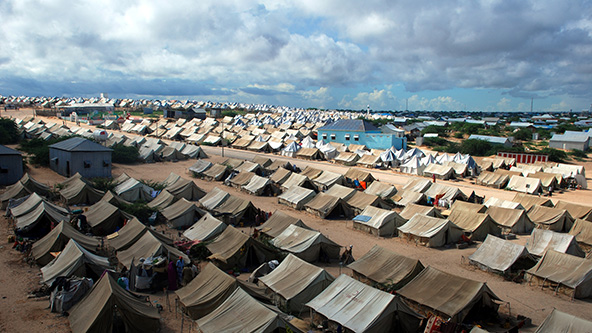
As a doctoral student at the University of Cambridge Judge Business School, Corinna Frey-Heger was interested in improving responses to the global refugee crisis. Her research took her to Rwanda, where an acute displacement crisis had turned into a quagmire: Refugees from the Democratic Republic of the Congo had been living in camps since 1996, with a new generation born into structures built to weather a short-term emergency. During Frey-Heger’s 2015 visit, Congolese refugees there were still receiving blankets and first-aid kits intended for new arrivals, even though the camps had persisted for two decades.
Frey-Heger, now a professor in business-society management at Erasmus University’s Rotterdam School of Management, joined forces with Marian Gatzweiler, a professor of organization and management at the University of Edinburgh Business School, whose research interests mirror her own, to analyze what was standing in the way of an effective response to Rwanda’s protracted displacement crisis. A new paper by Frey-Heger, Gatzweiler, and Bob Hinings, an emeritus professor of organizational studies at the Alberta School of Business, University of Alberta, and a research fellow at the Judge Business School, illuminates how organizational responses can worsen the very problems they seek to ameliorate.
Drawing on Frey-Heger’s fieldwork at five refugee camps in Rwanda and at the Geneva headquarters of an unnamed international organization for refugee aid, the researchers conducted interviews and engaged in participant observations with the multiple actors that together form the transnational regime for refugee protection. The researchers also scoured archival documents from donors, United Nations-based organizations, international and local NGOs, and the Rwandan government.
“We found mismatched priorities,” Gatzweiler says. “Donors, NGOs, and UN organizations found the minimal level of collaboration they could between them, and while this worked for the system, it didn’t necessarily work for the problem they sought to address.”
Rwanda has demonstrated openness to different approaches, the researchers explain, and yet the institutionalized framework for refugee protection—with its annual budgeting cycles, diverging interests, and conflicting political priorities—forms barriers that have constrained how organizations respond to the crisis. “Although they share broad goals of solving displacement and alleviating suffering, every actor within the regime is too often working within its own context,” says Julie Battilana, a professor of organizational behavior at Harvard Business School. “Regime barriers narrow the types of solutions that the regime considers viable.”
The researchers identify four system-level barriers to tackling the crisis, beginning with the decision to pursue encampment in remote areas. For officials in Rwanda’s capital, Kigali, centralized camps are easier to police, while humanitarian organizations prefer distributing food and aid to one location. The problem, according to the researchers, is for refugees who find themselves stuck in isolated areas without infrastructure. Nearby communities are poor, making the camps a source of tension, necessitating greater protection and prolonged isolation for individuals there.
Second, the paper shows how focusing on refugee protection creates a sense of urgency and immediacy that favors short-term thinking. “One-year planning and budgeting cycles block the organization’s capacity to imagine that the crisis could become long-term,” Frey-Heger says. “If you only plan for the next year, it’s always a one-year crisis, even if it’s 15 successive years of a one-year crisis.”
The staffing cycle that the organizations rely on—the third barrier uncovered by the researchers—means that staff members are often rotated out of one crisis and relocated to another within a year. As personnel cycle in and out, the organization loses the capacity to perceive its own role in aggravating the problem it seeks to address.
The fourth barrier the researchers identify is the streamlined, standardized approach that organizations employ, regardless of the needs of the host community, the host government, or local conditions. A global camp handbook has codified a system that works for various stakeholders but not for the refugees. “These four barriers come together,” Hinings says, “and what we see are refugee camps that are essentially their own towns, except they’re not allowed to develop a formal local economy.”
These four “regime barriers” are closely intertwined, making it difficult for actors to respond to an escalating problem. “This circularity can eventually cause the regime’s policies to exacerbate the problem they intended to solve,” Battilana says. “This work is timely and essential; humanity is facing increasingly complex global challenges that will require international cooperation to solve.”
Corinna Frey-Heger, Marian Konstantin Gatzweiler, and C.R. (Bob) Hinings, “No End in Sight: How Regimes Form Barriers to Addressing the Wicked Problem of Displacement,” Organization Studies, forthcoming.
Read more stories by Daniela Blei.