


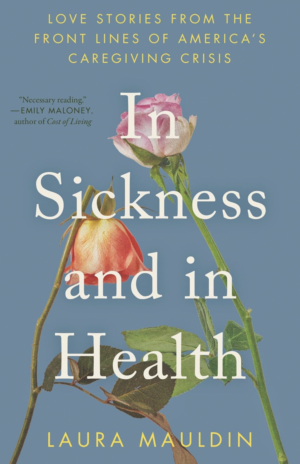
In Sickness and in Health: Love Stories from the Front Lines of America’s Caregiving Crisis
Laura Maldin
272 pages, Ecco, 2026
When I first began telling people I was reporting about family caregiving, five years ago, I got a lot of blank looks. People assumed I was reporting on parenting or about workers in nursing homes and hospitals, even though something like 63 million Americans care for a friend or family member with a chronic illness or disability. There was still precious little public conversation about it.
That is beginning to change. Laura Mauldin’s compelling In Sickness and in Health is a timely contribution to making family caregiving a topic of social concern and public policy. She provides an empathetic, thoughtful exploration of the role of the husband or wife who is expected to step in and step up when a partner becomes sick and when our system offers no other alternative.
As Mauldin puts it, the spouse becomes The One: the person who tackles the endless paperwork, manages the prescriptions, changes the bandages, and sits for hours by the hospital bed hoping to catch a moment with a busy doctor. Because the system requires a backstop, The One must always be on call, ready to go to the mat to ensure that their partner gets the care they need. Spouses must assume every aspect of care that our inadequate medical- and social-support services cannot manage. Her thesis in a nutshell: Instead of functional systems, we have The One.
A sociologist and disability-studies scholar, Mauldin takes an ethnographic approach in telling the story of American caregiving, embedding herself with a variety of caregiving couples. We first meet them during their life and love, in easier times, and then follow the bumpy road through the illness or accident that transformed their lives. Mauldin pairs these narratives with considerations of the public-policy failures that makes caregiving so difficult, whether that’s the patchwork nature of health insurance or the inadequacy of programs like Medicaid and Social Security Disability Insurance (SSDI). She also refracts each story through the lens of disability scholarship, to inform the emerging public discourse about adult caregiving with concepts and insights from disability studies and disability justice. She argues that care is systematically devalued and its infrastructure underdeveloped because of the disregard for and disdain of people with disabilities, and that tendencies toward ableism are entwined with eugenics, structural racism, and sexism, all of which undermine efforts to build a more robust social safety net.
While the five sections of the book lead us through this argument, its engine is its human chronicles, filled with both the minutiae of everyday life and the emotional consequences of these transformed relationships. By echoing these stories with details from her own caregiving years, she brings into focus the insuperable amount of caregiving labor our social systems leave to the loving spouse.
The World of the Well Spouse
Mauldin begins with her own story, a wild romance shattered by illness. Soon after she and her soulmate meet, her partner’s leukemia returns, and their romantic fantasy collapses under the strain of bleak hospital corridors and Access-A-Ride forms, as well as a torrent of unmanageable feelings: guilt, love, hopelessness, loneliness, resentment. She cares for her lover for three years in private before she finds the Well Spouse Association, a support group, and realizes how common her situation actually is. This book is her effort to foster an open conversation about this private suffering and grief.
We treat the marriage commitment as a substitute for the kind of social infrastructure that is actually needed.
The stories of the five spousal caregivers she focuses on—though she interviews many more along the way—each illustrate a distinctive aspect of the challenges of care. For example, we meet Kim and Angel, a Florida contractor who had a stroke and a heart attack that left him partly paralyzed. Because the couple could not afford health insurance, they lacked easy access to the preventive care that could have managed his high blood pressure before the catastrophe. Mauldin leads us through the saga of his care and his release home to adjust to a new life in a wheelchair, along the way bringing to light the well-documented failures of the United States health-care system, which she attributes in part to institutional ableism. Our “flawed and narrow view” of people with disabilities also injures Angel, who struggles to adapt to his new situation: “What Angel needed most at this point was some practical advice on how to be a disabled person in the world [and] to hear that a disabled life can be a good life.”
Another couple goes through a role reversal: Seth is a natural caregiver and once volunteered to care for dying AIDS patients, while Marty is an analytical genius horrified by bodily functions. But when Seth has a heart attack followed by other devastating illnesses—including a rare complication of diabetes that causes frequent open wounds—Marty is suddenly thrust into the role of caregiver. Marty does almost everything else—the finances, the paperwork, the coordination—but he blames himself for every lapse, every oversight. “He is forever trying to forgive himself for all the things he can’t do,” Mauldin writes. But his distress is the result of a medical system that leaves spousal caregivers to act as nurse, patient advocate, and other jobs they never signed up for (or are unable to fill).
For all their descriptive detail, these narratives never lose track of the book’s central theme: that the state not only abandons disabled and ill people, but coerces family members to supply the care that it will not. Throughout, she shows how the cost of trying to meet these impossible obligations—out of loyalty and love—leaves caregivers heartbroken and miserable when they cannot provide the kind of care that is necessary.
The Limits of Love
Some of the most powerful sections of In Sickness and in Health consider sexuality and trauma, both wellsprings of shame for many caregivers. Mauldin does a great service by bringing them to light. She herself struggled with both. While she firmly rejects the prejudice that disabled people can’t have sex lives, she relates how, as her partner became sicker and the caregiving more demanding, the spark between them died. The recognition that physical intimacy was no longer possible was devastating, grief on top of grief.
For example, Mauldin introduces us to Jade, a nurse who sacrificed career and financial security to care first for her husband’s father and then for him, as he coped with advanced Parkinson’s disease. She still loved her husband and still cared for him every day. But she also began having an affair, and this liaison helped give her the motivation and hope to continue with the care her husband needed. This is not uncommon, Mauldin writes: When the demands of care eclipse romantic and sexual connection, spousal caregivers sometimes look outside their partnership, finding solace in the arms of other spousal caregivers in the same situation.
Mauldin brings the persistence of trauma and post-traumatic stress into sharp focus. Caregivers endure nightmarish emergencies, moments of terrifying medical crisis in which they hold life-or-death responsibility for their beloved, and situations like these can play out again and again. The combination of proximity to death, helplessness, gore, and repetition is a recipe for traumatic reactions. Mauldin describes going through episodes like these and the imprint they left. In one heartbreaking scene, she describes leafing through the notes and photos she kept during the years of her partner’s illness, and how many of those events she cannot remember now, her memory dimmed by chronic traumatic stress.
Throughout the book, Mauldin searches for her own story in those of her subjects, awakening memories that were lost, looking for some kind of relief from the sense of shame that still lingers years after her partner’s death.
Caregiving relationships are intensely personal, all the more so when their dimensions are circumscribed by policy oversights and failures whose costs are paid by loved ones and those who love them. On this point, Mauldin is clear, bracing, and angry: We treat the marriage commitment as a substitute for the kind of social infrastructure that is actually needed, which could be sufficient to the monumental task. Spouses are inevitably expected to provide as much care as their partner needs, for as long as they need it, without financial or logistical support, an open-ended commitment that few, if any, can live up to. Not only are they condemned when they falter, but they are doomed to do so: The kind of care that people need is beyond the ability of even the most loving and self-sacrificing individual to provide.
At the policy level, this situation seems unlikely to change. A coalition of labor interests, disability-rights advocates, caregivers, and others is pressing for policies such as a national paid-leave law or expanding Medicare to cover long-term care, but the momentum is in the other direction: In 2025, nearly $1 trillion was cut from the budget for Medicaid over the next decade. However, policy details are not Mauldin’s focus when describing what must be done. She discusses collective-care arrangements, mutual-aid relationships developed at a grassroots level by people with disabilities, in which care work is distributed across a group, so that no single person is forced to take on all the responsibility. Instead of The One, there is the group. These collectives often develop organically, as one overburdened caregiver draws other people in to help, and she briefly describes them as an outgrowth of disability justice, a broader and more inclusive movement advancing the goals of disability rights.
To muster support for the public infrastructure that would bolster caregiving, she argues that we must first challenge ableism in our own lives. This pernicious bias against dependency and need not only poisons our relationships, but closes off opportunities for community. Sharing and communicating these needs openly will enable us to come together collectively to better support one another and free us from the belief that love alone can address all the needs of care.