


 (Illustration by Anna Gusella)
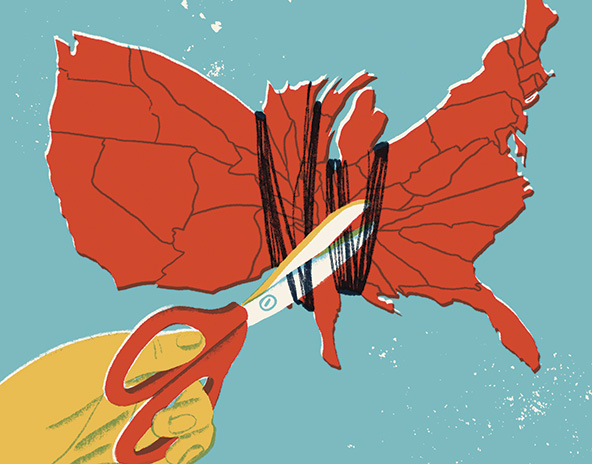
The US economy is badly unbalanced. Most of the country’s growth attaches to a handful of large coastal metro areas, almost entirely ignoring the country’s vast heartland and its small- and midsize markets. This divide has created pockets of prosperity and dynamism that are also becoming too expensive for young people to live in, depressing opportunity in the rest of the country and sowing bitterness far and wide.
Recognizing that geographic inequity is a major US problem and that the jobs of the future are rooted in a thriving innovation economy, the George Kaiser Family Foundation launched Tulsa Innovation Labs (TIL) in 2020 to help build a tech hub in Tulsa, Oklahoma, that would leverage local strengths and expand tech opportunities for all residents. Toward that end, our team sought to identify new economic indicators to measure and track our progress and to ensure that Tulsa was growing in the right way.
But this exercise challenged us more than we expected. We struggled to identify an existing framework that reflected our aspiration for inclusive growth. We concluded that traditional metrics, such as jobs created or average wage, often fail to capture the real drivers of growth and can exclude more nuanced analyses that address the inclusiveness, diversity, and resilience of jobs. The knowledge economy is quickly disrupting legacy industries and labor markets, and growth metrics of the past are losing their relevance. Given the complex shifts underway, we sought new tools to gauge readiness, track progress, and ensure that the knowledge economy growth would reduce inequality rather than exacerbate it.
We realized that the scarcity of metrics and the systemic problems were bigger than Tulsa and that solutions we and others might devise could be applicable more widely.Expanding beyond the scope of Tulsa, TIL partnered with Heartland Forward and the Aspen Institute to establish the Economy Forward Framework—a set of nine inclusive growth metrics that, when applied together, give a sense of how a city is growing and what areas need to be addressed to make the local economy more vibrant and equitable.
Inclusive Metrics
Our original research and analysis focused on 38 midsize cities with metropolitan-area populations between 750,000 and 1.5 million. We identified these cities as the focal point of the demographic movement we are witnessing from coastal tech hubs to emerging heartland cities that might create a more equitable America. We examined them over a 10-year period (2010-2020).
Three of the metrics related to industry and the particular segments of the knowledge economy that a city is looking to grow. The first is the share of jobs in the knowledge economy, which are better-paying and scarcer in many Midwest cities. The second, the share of employment at innovative firms less than six years old, measures a region’s ability to produce and retain potential high-growth companies. The third counts academic R&D expenditures, which can serve, through local universities and colleges, to anchor innovation economies.
The second set of metrics looked at accessibility, the degree to which education and career opportunities are available to underserved populations. One is labor force participation rate by race and sex, which can indicate whether vulnerable workers are being adequately prepared for the economic transition. The second is diversity of enrollment in science, technology, engineering, and math (STEM) programs, which is a nationwide challenge, especially among Black or African American, American Indian or Alaskan Native, and Hispanic students. The last counts the share of minority- and women-owned firms in knowledge-based industries. A high score here indicates success in enabling entrepreneurs from underserved populations to succeed in innovative industries, helping to close the country’s corrosive wealth gap.
The last bucket of measures related to what we called vibrancy, a community’s overall vitality. One was public investments in quality of life, which relates to the cultural and recreational amenities that are increasingly important determinants of where knowledge economy workers and the firms that employ them choose to locate. Another was the percentage of residents with a bachelor’s degree or higher, which is useful in growing start-ups and commercializing innovations. The third measured retention of graduates from local educational institutions, which is critical for preventing brain drain that can impede efforts to cultivate the highly educated workforces needed to build and sustain an innovation economy.
Based on our nine indicators, we were able to create what we called “Economy Forward” scores that segmented the 38 cities into four groups revealing where a city currently is on its journey toward a truly inclusive innovation economy.
The first tier, forward-ready cities, generally have stable and consistently growing knowledge economies and are moving in the right direction. An example of such a metro is Omaha-Council Bluffs, on the Nebraska-Iowa border. Once known primarily for its meatpacking plants and positioning as a transportation hub, Omaha-Council Bluffs has evolved to be an essential business center that houses four Fortune 500 companies across a wide swath of industries: Berkshire Hathaway (holding company), Kiewit Corporation (construction), Mutual of Omaha (banking), and Union Pacific Corporation (railroads and transportation). With a high proportion of bachelor’s degree holders (34.7 percent) and the second-highest overall labor force participation rate (71.07 percent) among the locations we studied, it is unsurprising that the city also holds the third-highest growth in share of knowledge economy jobs (+4.70 percent from 2010 to 2020). Omaha-Council Bluffs is a rare combination of an educated and working populace, a strong business core, and a vibrant young business future.
The second tier, nearly ready cities, are on positive trajectories with a number of strong indicators but still need maturing. Boise, Idaho, for example, enjoys a strong, agile economy that is producing start-ups but needs to spur its young firms into the knowledge economy. It has had a high young firm employment ratio (13.49 percent), and its population is relatively well educated, with many residents having a bachelor’s degree or higher (30.44 percent). Yet, its negative growth in young firm knowledge intensity (-1.56 percent) and share of knowledge economy jobs (-0.77 percent) are in the bottom 10 of midsize cities. The key to Boise’s continued success lies in connecting its already strong entrepreneurial and educated workforces, translating them into new knowledge-intensive young firms.
The bottom tier, at-risk cities, are municipalities that have experienced contracting economies and face serious equity issues, making them likely to struggle in the new economy. El Paso, Texas, for instance, has among the worst positioning for midsize cities: It has the worst young firm knowledge intensity (12.75 percent) and a very slow growth in share of knowledge economy jobs (-0.2 percent), and the percentage of residents with a bachelor’s degree or higher (+3.66 percent) shows that it is lacking in an educated workforce. At the same time, it is the very top city for growth in overall labor force participation rates (+3.4 percent) and the fourth-best city for improving female labor force participation rates (+3.8 percent relative to males). It also has the eighth-highest young firm employment ratio (13.93 percent), indicating a massive spurt of new people entering the workforce, employed in young businesses. No single city in our study has a larger disparity between its status today and its potential for the future. If El Paso can shift toward the knowledge economy, its rapid economic growth may make it a highly competitive city. Based on its above-average growth in young firm knowledge intensity (+0.46 percent), this trend may have already begun.
And what about Tulsa itself? It did not fare especially well in the survey but does display enough forward movement to be classified as an opportunity city, the third tier. Such cities have local assets or strengths to leverage but need sustained investment to grow inclusive and recognized tech economies.
Once known as the “Oil Capital of the World,” Tulsa has struggled to adjust to the 21st century. It performs well on average labor force participation rates (64.2 percent) but has a low percentage of residents with a bachelor’s degree or higher (26.78 percent) and a low young firm knowledge intensity (21.82 percent). So the core challenge that Tulsa faces is not increasing employment participation but rather upskilling, attracting educated workers, and fostering resilient knowledge-economy industries.
Applying the Framework
This methodology for gauging a city’s situation and prospects, applied consistently across the country and beyond, could boost inclusive economic development. We recommended the following steps for applying the framework in your city:
- Identify a leader: Identify a local organization to lead the city’s data collection and analysis, ensuring capacity and access to data sources.
- Align on goals: Share data with your local partners, and encourage your city’s economic development coalition to adopt a common set of goals, with quantifiable metrics.
- Develop a dashboard: After refining the inclusive growth metrics for your city, translate them into an easy-to-use dashboard to monitor and track your city’s progress.
- Analyze the data: Periodically review and analyze the data, surfacing insights on any required refinements to the local economic development strategy.
- Engage the public: Hold public forums and issue status updates on recommendations for the region.
- Act with intention: Integrate the inclusive growth metrics into your economic development investments so that you create interventions with a keen eye toward metrics that matter most to inclusive growth.
If the United States becomes more inclusive and equitable, and if the development is distributed across the country and not concentrated in already prosperous pockets, the result will be more growth, and better growth, for all.
Read more stories by Nicholas Lalla.