


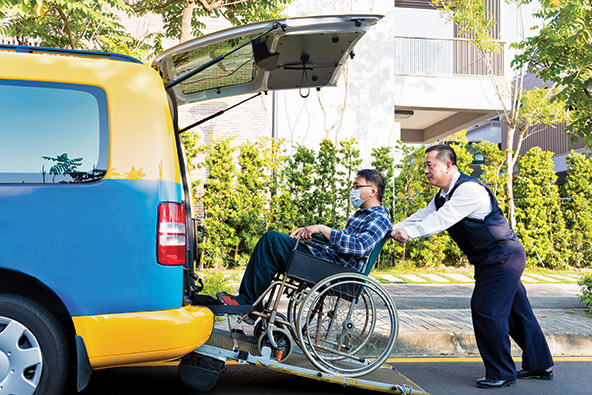
 Creating solutions to mobility access is central to the mission of FutureLab, a collaboration between Babson College and the Toyota Mobility Foundation. (Photo by iStock)
Lack of mobility has ripple effects on people’s access to education, transportation, and health services. For some people, immobility may be a temporary state, such as when they break a bone and require a cast and crutches. But for others, such as those who lose their sight and can no longer drive, immobility is a more chronic issue in their lives. Undetected gaps in mobility access can hamper people’s ability to navigate everyday activities that people without mobility challenges take for granted.
Identifying these gaps and finding solutions to mobility challenges lie at the heart of FutureLab, founded in 2019 by Sinan Erzurumlu, a professor of innovation and operations management at Babson College, and Cheryl Kiser, executive director of Babson College’s Lewis Institute for Social Innovation.
“Our goal is to combine what we learned at the lab and codesign the solutions with our partners,” Erzurumlu says. FutureLab’s partners include entrepreneurs, government officials, corporations, and universities, who collaborate with Babson College students to investigate mobility-related issues, interview people challenged by them, and develop plans to address these problems over the course of a semester.
The Toyota Mobility Foundation (TMF), which is the automobile manufacturer’s arm dedicated to creating and supporting solutions to mobility challenges, kickstarted FutureLab with a onetime grant of $1-million-plus in-kind support. “It created a collaborative experience between Babson College and the Toyota Mobility Foundation by combining Toyota’s expertise with Babson’s entrepreneurial thought and action mindset,” says Ryan Klem, TMF’s director of programs, referring to the college’s leadership model.
This model manifests itself through collaborative relationships between FutureLab’s students and community partners, like hospitals, government agencies, and senior support centers, which allow ideas incubated in Babson College’s undergraduate business school setting to be developed into real-world models and practices. “The combined coursework and applied real-life experience with local community mobility partners created a unique experience for the students to combine a human-centered design approach with Toyota’s problem-solving methods,” Klem explains.
At the beginning of a semester, students meet with community partners to learn about their challenges. With this information, students spend the semester conducting extensive interviews and observing the challenges in action in different settings (e.g., a parking lot or inside a supermarket) and different contexts (e.g., different times of the day). Students follow up with the community partners periodically to share observations and receive feedback before presenting findings and suggesting solutions. Once ideas are developed and tested, community partners are encouraged to take ownership of projects and scale them as appropriate.
Some community partners, such as the Massachusetts Executive Office of Elder Affairs, Newton-Wellesley Hospital, and the Massachusetts Bay Transportation Authority’s ADA paratransit program (The RIDE), are generally aware of mobility challenges prior to collaborating with FutureLab’s students. But through this partnership, led by students’ insights and innovations, they are able to uncover underlying issues and develop effective solutions.
For example, people don’t actively plan for limited mobility when they lose their vision or can’t drive anymore due to advanced age, but they continue to desire the ability to go where they want and when they want. The Massachusetts Executive Office of Elder Affairs, which promotes the independence and well-being of older adults and their caregivers, decided to work with FutureLab to research potential solutions to ease adoption of mobility alternatives once independence is restricted during the fall 2019 and summer 2020 semesters. “The team started with significant observational work and reported many detailed observations that we had not previously thought of that directly impact walkability and mobility,” says Elder Affairs’ deputy secretary, Robin Lipson.
COVID-19 has also exposed social and technological inequities, which directly affect accessibility, especially for older people. “When I think about the future of FutureLab, I’m really thinking about how urban living is changing,” Erzurumlu says. “I’d really like us to think about the mobility, connectivity, and social qualities of health.”
Although student research focuses on problems within the Boston metro area, Erzurumlu sees a future where FutureLab-developed solutions could be applied on a wider scale. “I don’t think there’s one silver bullet that solves a problem,” he says. “When we propose the questions ... we hope that other departments, other municipalities, or other senior centers could take what we’ve learned and see if it works for them.”
Read more stories by Joanna Haugen.