


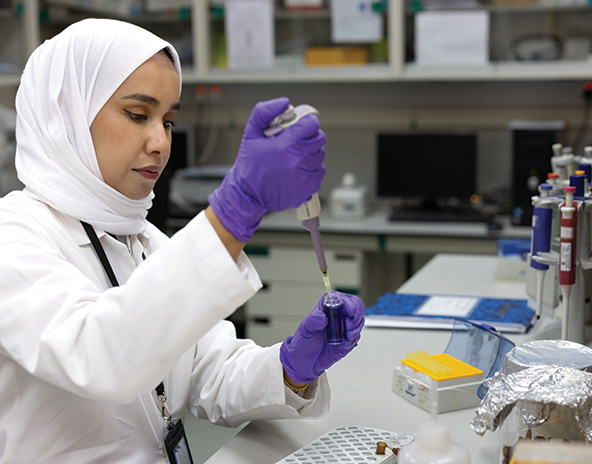
 Dr. Sherain al-Subiai works in a lab at the Kuwait Institute for Scientific Research. (Photo courtesy of the Kuwait Foundation for the Advancement of Sciences)
Because most of its land is nonarable, Kuwait imports more than 90 percent of its food to sustain its 4.2 million people. Its reliance on imports challenges its food security.
“In a world facing inflation, trade wars, international conflicts, viral pandemics, and extreme weather conditions, it is clear that Kuwait [is] at the mercy of global disruptions to food production and supply,” says Dalal AlGhawas, founder of SWAPAC, a consulting group specializing in agribusiness and food security in Southwest Asia and the Gulf Cooperation Council nations (GCC).
Kuwait has little rainfall and long, hot summers, but its climate and location in the Persian Gulf are well-suited to farming marine life. “Aquaculture requires plenty of water, making it ideal for the GCC coastlines and warm and favorable weather conditions,” AlGhawas explains.
Scientists at the Kuwait Institute for Scientific Research (KISR), a public institute organized under the nation’s Council of Ministers, believe that increasing fish and shrimp farming in Kuwait could improve the nation’s food security. AlGhawas and experts at the United Nations’ Food and Agriculture Organization (UNFAO) suggest that recent experiments with inland shrimp-farming on a semicommercial scale offer even more promise for industry growth.
The potential extent of aquaculture’s contribution to Kuwait’s economy remains an open question, however, as climate change is already afflicting the nation’s coastal fish populations and its agricultural workforce.
“The government of Kuwait has recognized that many sectors are vulnerable to the impact of climate change, including coastal zones [and] the marine ecosystem,” Deen Sharp, an expert on Kuwait’s changing climate, wrote in a 2021 investigation into the climate crisis in the nation. Yet, Sharp added, the government has not mandated reductions in fossil-fuel consumption. The nation’s oil sector is responsible for about 90 percent of the nation’s export revenue and thus has considerable influence on national politics.
He further cautioned that any expansion in aquaculture should be accompanied by meaningful worker protections. As global temperatures continue to rise, Kuwait’s labor force has become increasingly more vulnerable to deadly heat exposure. Kuwait now regularly sees summer temperatures climb above 120 degrees Fahrenheit. Many agricultural workers in Kuwait are migrants who have few labor protections, and advocacy groups are not legally allowed to monitor labor conditions on private farms.
KISR scientists are attuned to these challenges and are pursuing aquaculture research that would improve food security, diversify the economy, and support local farmers. The institute’s aquaculture program, housed within its Environment and Life Sciences Center, develops technologies for hatcheries and protocols for controlling nutrition and treating disease among its aquaculture populations. KISR’s researchers have studied aquaculture and adapted methods to the local environment and market demands since the 1970s, shortly after the Arabian Oil Company (AOC) established KISR in 1967 as part of the company’s obligations under an oil concession granted to it by Britain, prior to Kuwait’s independence in 1961.
Kuwait took control of the institute in 1973, as AOC’s interests in the region shifted amid that year’s oil crisis. The institute’s mission broadened from an early focus on petroleum to encompass applied scientific research on industry, energy, agriculture, and the national economy for the government and private-sector clients. Today, the institute employs nearly 600 researchers and engineers across 100 laboratories and frequently collaborates with international institutions, including regional climate and environment ministries, universities, and research institutes.
Swimming Upstream
Among KISR’s first big aquaculture successes were farming grouper and silver pomfret in the 1980s and ’90s—two fish species that fetch high prices on the market. The silver pomfret is especially prized in Kuwait, selling for upwards of 10 Kuwaiti dinar (KWD) per kilogram ($15 per pound).
As aquaculture continues to develop in Kuwait, KISR scientists are committed to helping build a sustainable industry.
“The silver pomfret is the most expensive [fish], but it is fragile and difficult to culture,” KISR scientist Khaled M. Al-Abdul-Elah explains. While scientists struggle to breed the fish in captivity, its population levels in the Persian Gulf have suffered from overfishing, pollution, habitat degradation, and climate change. Consequently, silver-pomfret catches have declined for decades and are now down to only 10 to 15 percent of their peak volume of about 1,000 tons in the 1990s. According to the UNFAO, the total harvest of all naturally occurring marine life in Kuwait declined from 8,616 tons in 1995 to 3,525 tons in 2021.
As the fish became scarcer, its price rose, which has incentivized even more fishing. Beginning in 2017, the Kuwaiti government implemented periodic fishing bans and market controls to reduce silver-pomfret fishing so that the species could breed and repopulate. But international groups like the International Union for Conservation of Nature and Natural Resources claim that such measures have not been sufficiently enforced to make a significant difference in silver-pomfret population levels.
In 1997, Al-Abdul-Elah’s team, in collaboration with scientists at Kuwait’s Mariculture and Fisheries Department, were among the first in the world to successfully breed silver pomfrets in captivity. “We brought fertilized eggs from the sea and grew those to be juveniles and then adults, and those adults spawned in captivity,” Al-Abdul-Elah explains.
KISR has continued its work with the species to improve its survival rates in captivity and make farming the fish more viable. Today, it breeds and raises the fish in commercial hatcheries until they weigh about 2 grams, at which point they are sold to private companies that continue to grow them to their salable size. Al-Abdul-Elah says that KISR’s hatcheries produce between 200,000 and 400,000 fish hatchlings annually.
The share of aquaculture in the country’s total fishery production has increased from 1 percent in 1995 to more than 11 percent in 2021. According to AlGhawas, the recent growth of aquaculture in Kuwait aligns with trends in the GCC. “Governments have allocated millions of dollars of funding over the last five years to boost domestic seafood production,” she explains.
No Small Shrimp
In 2015, scientists at KISR expanded their research to inland shrimp-farming. Earlier KISR research and development of shrimp cultivation was conducted on coastal farms, where the crustaceans are raised in their natural saltwater habitat. The institute began experimenting with inland shrimp-farming to support struggling farmers operating small and midsized farms. When raised on inland farms, marine life is less vulnerable to temperature changes, and disease outbreaks can be better contained without risk to larger marine ecosystems. KISR scientists are also doing the research and development needed to launch local industries related to the production process, like a feed mill and processing plants, to package and/or freeze the shrimp for sale.
Sherain Al-Subiai, a KISR scientist working on the inland-shrimp-farming project, is currently studying ways to reduce the need for imported supplies to make inland shrimp-farming profitable for local farmers. “The next step to making this project applicable to the private sector is developing our own feed formula so we can establish a feed mill that can produce feed locally,” she explains. By 2030, KISR plans to establish a hatchery and feed mill to kickstart the nation’s inland-shrimp-farming industry.
Several challenges inhibit inland shrimp-farming. The most significant is that groundwater lacks certain nutrients found in seawater that shrimp need to survive. Al-Subiai’s team received a grant from the Kuwait Foundation for the Advancement of Sciences (KFAS) in 2019 to establish a research site outside Kuwait City, about 20 miles from the nearest coastline, to address this problem. The indoor facility, completed in 2020, has two circular tanks where shrimp live after hatching until they grow large enough to be transferred into a pair of 16,000-square-foot earthen ponds located outdoors. Over two years, the team adjusted the groundwater’s magnesium, potassium, sodium, and other elements to create a suitable habitat for shrimp. When the team began its work, the shrimp’s survival rate on their research farm was below 20 percent. By the end of the project in 2022, the rate had increased to 72 percent—much closer to the usual target survival rate of 80 percent on coastal farms.
Being able to test technologies and protocols on a semicommercial scale rather than in the smaller lab has allowed KISR researchers to collect data applicable to the commercial sector. The researchers also tested both Biofloc Technology—which aggregates algae, bacteria, and other organic matter—and a new water-recirculation system on-site to reduce waste and water consumption and to treat used water, making the aquaculture more sustainable and reducing its environmental harm.
To help local farmers apply the institute’s research findings, KISR partnered with Kuwait’s labor department, called the Public Authority of Manpower, in 2019 to launch an annual training program at the KFAS-funded site to help farmers learn about inland shrimp-farming and establish farms on their properties. The training program is part of KISR’s aim to help small- and medium-sized farms in inland Kuwait pivot to aquaculture and benefit from opportunities in the sector.
“There are many possibilities for small farmers,” Al-Subiai says of the nation’s nascent shrimp-farming sector. “They can go directly to the local market and sell live shrimp to consumers or to larger companies to process there.”
As aquaculture continues to develop in Kuwait, KISR scientists are committed to helping build a sustainable industry that serves these local farmers. “We are transferring our know-how to the farmers so they can make [the sector] successful,” Al-Subiai says. Harnessing the sector’s potential, she adds, “is an important opportunity for Kuwait” and an effort that KISR researchers are proud to be leading.
Read more stories by Marianne Dhenin.