


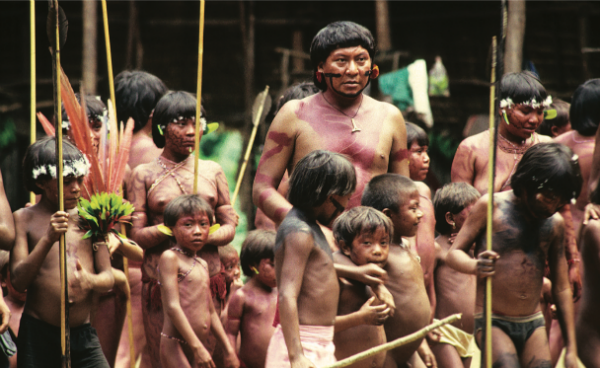
 The activist
Davi Kopenawa gathers with
young Yanomami from the
Watoriki community in Brazil. (Photograph by Fiona Watson, courtesy of Survival International)
The activist
Davi Kopenawa gathers with
young Yanomami from the
Watoriki community in Brazil. (Photograph by Fiona Watson, courtesy of Survival International)
In the garden of her shabono, a palm-thatched communal dwelling slung with hammocks, Mariazinha, a Yanomami community leader in Brazil, is speaking to a video camera. Soberly, she recalls the invasion by gold miners of the rainforest where her people live, and she describes the disease and violence that the intruders brought with them. But today, Mariazinha says, she is happy—and that camera is one reason why. “If we see illegal gold miners on our land, or if outsiders try to kill us, I will be able to let everybody know, [even though] they are very far away,” she explains.
A world away in London, a ping alerts Sarah Shenker to the arrival of a video clip. Shenker is a campaign officer of Survival International, a UK-based NGO. Within minutes, she has subtitled Mariazinha’s words translated into English, posted the clip to Survival’s Tribal Voice website, and dispatched a link to the clip to the in-boxes of Survival supporters.
In 1969, a group of volunteers created Survival International to defend the land rights of tribal peoples. One of the group’s first campaigns centered on the Yanomami. In the early 1970s, the Brazilian government bulldozed a road through the Yanomami’s ancestral lands, exposing tribespeople to diseases to which they had no immunity (such as flu, malaria, and measles) and paving the way for an invasion of ranchers and miners. The Brazilian Committee for the Creation of the Yanomami Park (CCPY) and a Yanomami activist named Davi Kopenawa pursued the campaign locally, and Survival led an international effort. The campaign ran for two decades. In 1992 it bore fruit. The Brazilian government recognized the autonomy of the Yanomami People, expelled the miners, and preserved 9.6 million hectares (about 37,000 square miles) of territory for the Yanomami’s use.
Survival International rejects the assumption that industrial societies are “advanced” and that tribal societies are “backward.” It starts from the premise that tribal societies have simply taken a different path and that they have a right to decide their own futures. Stephen Corry, director of Survival, argues that tribal peoples—if left alone—are selfsufficient, require no foreign aid, and often enjoy extremely good health. “But deprive tribal peoples of their land,” he says, “and you deprive them of all their rights, because without the land, they cannot survive.”
There are an estimated 150 million tribal people worldwide; Survival focuses its attention on 36 tribes and groups of tribes that are at a high risk of cultural or physical extinction. In addition, Survival works to protect the rights of about 100 tribes that have entirely rejected contact with outsiders. Tribes in one or both categories are spread across Africa, the Americas, Asia, and Australasia.
Based in London, Survival has offices in Berlin, Madrid, Milan, Paris, and San Francisco, and its staff consists of about 40 researchers, campaigners, and interns. It has no offices in countries where tribal peoples live and instead forges local connection through field trips and by collaborating with indigenous organizations. That policy allows Survival’s people to speak out freely, without concern for how their words might affect local employees.
As a Western-based organization, Survival does not claim to “represent” tribal peoples. Rather, its goal is to keep governments and companies from riding roughshod over land rights and human rights that are guaranteed to tribal peoples in international standards such as the International Labour Organization Convention 169 and the UN Declaration on the Rights of Indigenous Peoples. “What Survival tries to do isn’t to stop progress, but to stop [industrialized nations from] breaking international laws that [they] have written,” says Corry.
How to Fight for a Tribe
Unlike many NGOs, Survival neither seeks nor accepts government funding, a policy that prevents governments from influencing its priorities. Consequently, the organization depends largely on private donors. It has a modest budget: In 2014, its income came to slightly more than £1 million (about $1.4 million). Given its limited resources, Survival has turned its attention toward mobilizing public opinion through ambitious media offensives.
One example of how Survival fosters public activism is its 2012 campaign to save the Awá, an Amazonian hunter-gatherer tribe that has about 450 members. The Awá had seen their lands overrun by loggers and ranchers, and they faced extinction as a people. The campaign enlisted celebrities (including the actors Gillian Anderson and Colin Firth) to support the cause. It featured videos in which tribespeople describe how invaders were destroying their forest and driving away the animals that they hunted. It mobilized more than 57,000 people worldwide to send emails to the Brazilian minister of justice, and it distributed “Save the Awá” stickers that supporters then affixed to famous landmarks. All of that work on behalf of the Awá paid off: In 2014, the Brazilian government sent in army and police forces to evict the intruders and to destroy their camps. “Because most people had never heard of the Awá, the first priority was to put them on the map,” says Shenker. Then, she adds, Survival could “turn [that awareness] into action.”
In developing its campaigns, Survival has been both an emulator and an innovator. It borrowed the idea of orchestrating letterwriting campaigns from Amnesty International. Tribal Voice, meanwhile, is its own invention. For that project, Survival staff members brought solar-powered video equipment to the Yanomami and Guaraní peoples of Brazil and explained to them what the technology could do. Staff members then taught tribal volunteers how to make video clips so that tribespeople could—in their own words—tell the world about their plight.
Although Survival relies primarily on public, media-based campaigns to pursue its mission, it sometimes engages in causes more directly. In the early 2000s, it raised money and other resources to enable a group of Bushmen whom the Botswanan government had evicted from the Central Kalahari Game Reserve to fight a landmark court case. In 2006, a Botswanan court ruled that the government had acted unlawfully both in evicting the Bushmen and in denying them hunting permits. “There are now hundreds of Bushmen back in the reserve who, without Survival, wouldn’t be there,” says Gordon Bennett, a London-based lawyer who represented the Bushmen. But the fight goes on: Despite the court’s ruling, Survival leaders say, wildlife officers have continued to arrest and intimidate Bushmen.
Survival may not set out to antagonize other institutions, but its aggressive campaigning often has that effect. The governments of Botswana and India have banned some of its staff members from entering those countries, and although it works closely with some local NGOs, it has crossed swords with others. A Botswanan human rights organization called Ditshwanelo, for instance, has criticized Survival’s public denunciations of the Botswanan government. Ditshwanelo argues that Survival’s confrontational tactics are culturally inappropriate and that quiet diplomacy can do more to promote the Bushmen’s cause. But Jumanda Gakelebone, a Bushmen activist and a councilor for the Bushman resettlement community of New Xade, disagrees with that view. “Without Survival International, nobody would have known we were oppressed,” he says. “The reason the government hates Survival isn’t because what they are saying is a lie. It’s because they are putting [the truth] before the eyes of the world.”
How Much Contact?
In championing the rights of tribespeople to decide what is right for them, Survival implicitly challenges the assumption that economic development is inherently beneficial. But it would be wrong, Survival leaders say, to portray the organization as anti-development. “Survival is about listening to tribal people, and what most tribal people want is development that’s appropriate—[development] that they have chosen and can control,” says Fiona Watson, research director for Survival. In practice, such development might involve encouraging tribespeople to acquire literacy so that they can become advocates for their communities, or it might involve blending Western health care with traditional healing. In the 1980s and 1990s, for example, Survival supported a program run by CCPY that taught Yanomami tribespeople to diagnose malaria from blood-smear slides and to dispense medication for that condition.
Even as it collaborates with tribal peoples, Survival also defends the right of so-called uncontacted tribes that shun all interaction with outsiders. Survival leaders maintain that those tribes’ cultures are as viable as any other. But Kim Hill, professor of anthropology at Arizona State University, calls that view “romanticized and naïve.” In reality, he argues, isolated tribespeople are vulnerable to accidental encounters with outsiders and are at the mercy of diseases that outsiders bring. For that reason, Hill (along with Robert Walker, associate professor of anthropology at the University of Missouri) has called on the Brazilian and Peruvian governments to initiate managed contact with isolated tribes and to provide those tribes with field medical care.
Corry insists that imposing contact on isolated tribespeople serves the interest of those who want to steal indigenous lands. He also argues that when governments have pursued this policy—as the Brazilian government did before the late 1980s—it led to suffering and death. Nor does Corry concede that exposure to Western culture would improve the lives of people from uncontacted tribes. To make his point, he cites the high rates of alcoholism, suicide, and illness among many assimilated tribal peoples.
Overall, Corry says, respect for tribal rights is now stronger than it was in the past. Recent gains, to be sure, are hard-won and precarious. In Brazil, for instance, rural lobbyists have proposed legislation that would open up tribal territories to mining, ranching, and settlement. Yet Corry offers reason for optimism: “A couple of hundred years ago, slavery was widely accepted, and the abolitionists did a pretty good of job of persuading the world that slavery was unacceptable. Our job is to bring about a groundswell of public opinion such that the theft of tribal peoples’ lands will be viewed as a crime, not a historical inevitability.”
Read more stories by Alicia Clegg.