


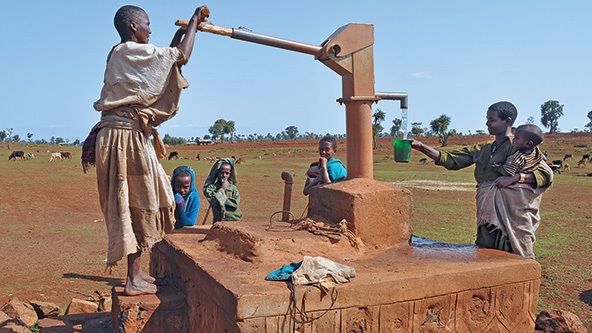
 A4ID works with global partners around the world, including Water.org, which provides potable water services. (Photo courtesy of A4ID)
Ugandan charity Caring for Orphans, Widows, and the Elderly (COWE) collapsed in early 2007. Rather than helping Uganda’s poorest citizens, COWE had been perpetrating a cruel economic crime on them. Through a pyramid scheme, the organization posed as a microfinance institution and sold coupons with the promise of lucrative returns. After its collapse, many of its investors lost their homes and life savings. Worse, in a country that imprisons people unable to pay their debts, some of the victims who had taken out loans to invest in the scheme fled the country or committed suicide.
The Global Alliance for Legal Aid (GALA), a US-based nonprofit founded in 2012 that promotes justice in developing countries, offered legal support to the victims but found the scale of the fraud too great to handle alone. It needed help. But where would a small and relatively new nonprofit turn to secure the support they needed?
GALA contacted the global nonprofit of UK-based Advocates for International Development (A4ID), which connected them to Simmons & Simmons, a London-based law firm with 22 offices worldwide. GALA was able to secure the expertise of that firm’s highly skilled lawyers—and at no cost. With their help, GALA documented COWE’s history of fraud and provided victims with advice on legal actions they could take against the charity.
A4ID forms a connective tissue linking law firms with development organizations around the world. Organizations send their requests—whether, for example, for support on employment contracts or fighting human rights cases—to A4ID, which then finds the appropriate legal experts who offer their services on a pro bono basis.
In addition to being a legal matchmaker, A4ID has an ambitious agenda based on the UN’s 17 Sustainable Development Goals (SDGs)—the SDG Legal Initiative. Through events, legal guides, and training programs, the initiative aims to use the skills and experience of lawyers to help meet the UN’s SDGs, the first goal of which is to “end poverty in all its forms everywhere” by 2030.
“The clock is ticking very loudly now,” says Yasmin Batliwala, who joined A4ID as its chief executive in 2010. “This is a call to action to get the entire legal profession to focus their minds on the SDGs.”
Pro Bono Partnerships
Before A4ID was established in 2006, law firms’ pro bono services were largely limited to their local communities. Little was being done by corporate lawyers on an international basis, in significant part due to the dearth of information, opportunities, and connections to NGOs. “It was something people were interested in, but it was not easy to make those connections,” explains Suzanne Turner, a partner at London-based law firm Dechert and chair of its pro bono practice.
A4ID grew out of a response prompted by the devastation from the 2004 Indian Ocean earthquake and tsunami, in which 1,000 London financial district lawyers offered their services for free to development organizations fighting poverty. “They developed a vehicle that would be the intersection between the development sector and the legal community,”
Batliwala explains.
Initially, A4ID secured in-kind support in the form of free office space from two law firms, New York-based Reed Smith and London-based Clifford Chance. In addition, it has funding from the UK’s Department for International Development (now the Foreign, Commonwealth & Development Office), the Legal Education Foundation, and the charitable foundations of law firms Clifford Chance and London-based Baker McKenzie.
By partnering with large global law firms, A4ID connects NGOs to legal services in their area, either to branches of the global firms or to local firms that work with those global firms. The engagements that A4ID’s partner law firms undertake are wide-ranging and often involve several organizations. While some projects, such as the Ugandan fraud case, tackle crime and injustice, others address environmental crises.
In some cases, A4ID has brought together law firm partners and international agencies to develop legal frameworks that support sustainable global development. This was the case for the International Federation of Red Cross and Red Crescent Societies (IFRC), which in 2007 adopted a set of recommendations on the preparation of regulatory systems for international disaster response. To help the IFRC turn these recommendations into a model law that could be enacted by multiple independent legislatures, A4ID brought together three of its global legal partners—Frankfurt-based CMS Cameron McKenna, London-based Allen & Overy, and Chicago-based Baker McKenzie—as well as lawyers from US technology company Microsoft. The model law, a pilot of which launched in 2011, provides a template for governments to integrate the IFRC’s disaster response recommendations into their national laws.
Of course, matching charitable organizations with free services is not a new practice. Powered by technology platforms, nonprofits can secure volunteers with the right skills at the click of a button. Nor is A4ID alone in making legal-sector matches. The American Bar Association brings together low-income clients with lawyers who either take on cases for free or provide online answers to legal questions. And, with offices in the United Kingdom and India, iProbono allows nonprofits to post projects on its platform, assists them in developing a clearly defined scope of work, and sends alerts to the most appropriate lawyers in its network.
Similarly, A4ID brings teams of lawyers on to projects as well as provides access to the right local experience and knowledge. “That’s one of the benefits for us of working with them,” says Jacqui Hunt, who leads the Ending Sexual Violence campaign for Equality Now, a global human rights NGO for women and girls. “They can tap into their offices in different places and into the ability of their lawyers to speak the local language,” she adds.
However, what distinguishes A4ID from other legal-aid matchmakers is an agenda that goes beyond just providing free legal services to forming lasting partnerships focused on global development. For example, A4ID is one of Clifford Chance’s strategic pro bono partners, which means the firm can also support A4ID projects with funding from the Clifford Chance Foundation. This type of relationship helps A4ID to deepen its global networks.
“The grant we’ve received from the Clifford Chance Foundation has enabled us to have a base in Nairobi,” says Batliwala, who adds that a base in Delhi means it can expand its services throughout India. “We can introduce pro bono culture in the places where we’re located.”
For development organizations, help with complex legal challenges relating to their missions is only part of the support they receive through A4ID. Lawyers can also help with administrative and operational work—things for which it can be difficult to secure philanthropic funding.
“Anybody giving us funds wants to give it to the dedicated purpose for which we exist … and not necessarily paying law firms,” says Patrick Beggan, who leads international growth and development at Plant-for-the-Planet, a tree-planting youth initiative that raises awareness of climate change.
Yet, he adds, organizations such as his rely on lawyers to help them protect intellectual property and ensure that partnership agreements, memorandums of understanding, and letters of intent are drawn up appropriately.
Moreover, since legal work involves devising complex and compelling arguments, there is another way the sector can help development organizations further their missions. “Lawyers can operate as great advocates,” says Virginia Fuentes, associate director of global human resources at the NGO Human Rights Watch. “They have great communications skills, can synthesize things rapidly, and can put complex situations into words.”
Supporting the SDGs
The demand for legal services in the developing world is not the only gap A4ID fills. “Within corporate law firms there is real appetite among a lot of lawyers to do impactful pro bono work,” says Tom Dunn, Clifford Chance’s pro bono director.
Such work can also enable firms to help their younger lawyers to rapidly develop skills like building relationships with clients. “You’re less likely to get that in the fee-paying
work because a more senior member of a team is going to have responsibility for direct interface with the client,” Dunn explains. “In pro bono work, you get that opportunity at an earlier stage in your career.”
Engagement with nonprofits also immerses lawyers in the kind of work that might not otherwise land on their desks. “Through their interaction with us, they learn a bit about our approach,” Hunt says. “So they are increasing their skills and their knowledge of the world.”
For Batliwala, this awareness raising is critical to accelerate progress toward the SDGs. She believes that the social sector needs to learn how to harness lawyers’ expertise in working to meet the goals. Since 2007, A4ID has offered this learning through its Law and Development Training Programme, which is available to professionals from both law firms and development organizations (whose participants can enroll for a discounted fee). With a range of modules that can be taken together or individually, the program covers such topics as responsible project financing, environmental law, and tax justice. Currently run virtually because of the COVID-19 pandemic, the program is designed to help legal sector professionals improve their understanding of development issues so that they can provide more effective pro bono services tailored to the SDGs.
As A4ID looks ahead, its Legal Guide to the Sustainable Development Goals, published online in 2021, is critical to its SDG agenda. By June 2022, A4ID will publish guides on each of the 17 goals that explain the laws that apply to them and how the legal sector can help advance them.
Also on the horizon is an annual conference series that will explore how pro bono legal services can advance the UN’s SDG agenda. With its inaugural event held online in June 2021, future conferences will bring together legal practitioners, corporate leaders, and academics.
“If there’s a single profession in the world that can have an impact, it’s lawyers,” Batliwala says. “They understand the law and how to make it work. If we can get them working on this together, we could really achieve something.”
Read more stories by Sarah Murray.