


 Illustration by Jakob Hinrichs
It was June 2005. Eight women arrived at the meeting hall in Antananarivo, Madagascar, dressed in their Sunday best. The Ministry of Health & Family Planning had asked these community volunteers to participate in a full-day family planning workshop.
Over the course of the day, these eight women, all of them trained through a program funded by the US Agency for International Development (USAID), listened to dignitaries and met the event organizers, watched a video, and participated in team-building exercises. But most of the time was spent with their teams. At the end of the day, each team emerged with a goal and a plan to increase usage of family planning services in the communes surrounding their community health centers, within the next 100 days! Shortly thereafter, the leader of one team broke into tears. “When everyone left the room, I started sobbing,” the woman said. “I had just committed to my colleagues and to ministry officials that we would increase the regular users of family planning services by 30 percent in the next 100 days. We had never been able to do anything like this before.”
One hundred days later, in September 2005, Jean Louis Robinson, the minister of health, celebrated the extraordinary results achieved by these teams, with special praise for the community volunteers. The eight teams had far exceeded their original goals. Instead of the targeted 30 percent increase, the number of regular users of family planning services had increased by a factor of five—from an average of 50 visits per week in each center to 250 visits per week.
EXTRAORDINARY RESULTS THROUGH ORDINARY KNOWLEDGE
These teams did not use any innovations or new technology. At the workshop no one introduced a global “best practice” on family planning, or spoke about social marketing and social media. Instead, the community volunteers, along with their other team members, had walked door-to-door, talking with people in their neighborhoods about family planning. This might be viewed as low-tech work, hard on the feet and tedious. Yet those who participated were engaged and enthusiastic. They had produced the tangible, groundbreaking outcomes that had eluded others for several years.
These teams achieved breakthrough results by using a process that we call Rapid Results. The practices built into these initiatives have evolved organically from work pioneered by Robert Schaffer and his colleagues in private sector consulting engagements stretching back 50 years.1 After introducing this work in developing countries2 with support and sponsorship from the World Bank, Schaffer Consulting spawned the Rapid Results Institute as an independent NGO focused on building capacity to provide coaching support for this work to local organizations in low-income countries.3
During the 10 years we have used this process, we have witnessed how resourceful and persistent people can be in using their available knowledge and techniques to achieve goals that are meaningful to them. We have also observed that when the existing knowledge falls short, they are motivated to fill these gaps and have a greater readiness to use an infusion of external input.
No doubt there are many situations where one can stumble on the right mix of people and circumstances that make this resourcefulness and persistence a naturally occurring phenomenon. Unfortunately, this is not the norm. And it is particularly lacking in public sector agencies engaged in development work in low-income countries. Our experience is that there is plenty of untapped capacity for performance in these agencies, but several systemic barriers prevent this potential from translating into actual performance.
First, the grand design of most development projects, typically hatched by outside development professionals, makes local ownership of this work difficult. Second, the hierarchical structure of most public sector agencies in low-income countries, coupled with the implicit rules for allocating credit and blame, make it unappealing for middle managers and frontline staff to commit themselves to performance goals. Third, in many low-income countries, the public views public sector workers as incompetent or corrupt. And public sector workers often view themselves as victims of a dysfunctional system that encourages corruption and rewards inefficiency. Consequently, public sector workers on the whole assume an identity that does not promote accountability and professionalism.
Rapid Results stimulates high performance in spite of these systemic barriers, by helping leaders create a protected work environment where these barriers are temporarily neutralized, and where ownership, commitment, and a professional identity are possible. This does not change the system. Nevertheless, the initial progress and experience of success that are enabled by this temporary process create the energy, momentum, and confidence people need to tackle systemic barriers to performance.
The thinking behind our work aligns with views advanced by nontraditional development thinkers stretching back to economist Albert Hirschman in the 1950s, up to the current scholarship of economist William Easterly, author of The White Man’s Burden: that long-range comprehensive “planners” can have a limited impact on development, and that the real breakthroughs will come from “searchers” who are attuned to small solutions that work in the local context.
The approach is a natural fit for what Harvard University professor Ronald Heifetz refers to as “adaptive problems”—ones that can be solved only if people in the community or organization change their values, attitudes, or behaviors.4 An example of an adaptive problem is promulgating safe sex behavior as a way to fight the spread of HIV/AIDS. The approach is not a good fit for purely technical problems that can be solved by an expert working by himself or by decree from someone in authority, for example, figuring out the optimal location for a health center designed to serve a cluster of villages. Furthermore, Rapid Results should not be used as a way to organize the implementation of predetermined solutions in carefully scripted ways, because its transaction costs would be too high to warrant the additional value it can provide in these situations.
This approach is not a silver bullet. Development effectiveness has many unsolved riddles. Our aim in this article is to shed light on one of these: how to overcome the implementation gap—the gulf between knowing what is important and actually making it happen.
FROM RICE FARMING TO FAMILY PLANNING
In 2005, Madagascar was one of the poorest countries in the world, measured by GDP per capita.5 The Malagasy culture favors large families. For newly married couples, the common blessing is “May you have 14 children—seven girls and seven boys.” Starting in 1990, the Ministry of Health & Family Planning had been pursuing a national policy around modern family planning services. Many programs had been implemented to reduce the fertility rate: training health agents, inaugurating celebrations for National Family Planning Day, and distributing contraceptives through community programs. Despite these investments and the continued focus of the ministry, progress had been disappointing. Over a period of 15 years, the usage of family planning services by Malagasy women of childbearing age in the central region of Analamanga had increased by a mere two percentage points, from 10 percent in 1990 to 12 percent in 2005.
The Rapid Results approach had been brought to the attention of Robinson at a government workshop sponsored by the World Bank. This approach had been earlier introduced in Madagascar to help avoid the shortage of rice that had provoked street riots that year. After the workshop, Robinson convened a few of his senior aides for a planning session with the Rapid Results coaching team, who suggested that the ministry start by focusing on one theme and one region. After some discussion, the group selected family planning, and Robinson instructed his director of health services to contact Norolaolao Rakotondrafara (also known as Lalao), a medical doctor serving as director of health in the Analamanga region.
THE CHOREOGRAPHY OF ENGAGEMENT
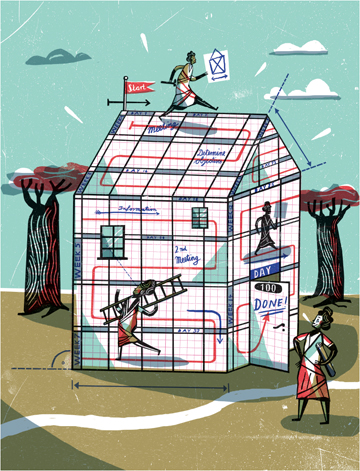
Each Rapid Results initiative6 focuses on achieving an ambitious goal in 60 to 120 days. The structure of the initiative is simple, although highly choreographed in three acts—pre-launch, launch, and implementation—each designed to neutralize one of the systemic barriers to performance.
Pre-Launch: Creating the Space for Engagement and Ownership
Most development work is based on the implicit assumption that the country participants are “willing but unable” to make progress because of gaps in their functional knowledge or techniques. In many instances, however, it is just the opposite. People’s “willingness” to act is far more problematic than their “ability” to act. That’s because donor analysts often dominate the design phase and frequently produce plans that are too complex to be implemented. Judging the risks and potential benefits, public sector staff see that more work is involved for which they will receive no additional pay, and that senior managers will claim the credit. Too little time is spent on the crucial issue of encouraging ownership and of creating a protected space within which vulnerable middle-level staff can try new things.
Act I—the pre-launch—reverses this dynamic of disempowerment. In Madagascar, Lalao was honored to be selected as the operational leader of this effort, but she was also skeptical, having seen consultants come and go over the years. Serving as a constant testing ground for other people’s ideas was risky business, and it was not improving health delivery in her district.
Lalao’s first meeting with the Rapid Results coach caught her by surprise. The coach did not attempt to convince her of any particular solution, but instead shared examples of how teams in other countries had created their own solutions to varied challenges—from farmer productivity to school enrollment to HIV/AIDS prevention—and had achieved significant results in 100 days.
Even more surprising, the coach invited Lalao to turn down the challenge if she did not feel the timing was appropriate for her. It would be difficult for Lalao to turn down a request originating at the ministerial level, but the coach offered to make the case for launching the process in another region, allowing Lalao to bow out gracefully. Without pressing for an answer, the coach scheduled a follow-up work session.
When they met again, a few days later, Lalao had decided to go forward. In development work, the importance of having a country champion, in this case the minister of health, is now accepted as conventional wisdom. What is often not considered is how this champion creates the space and safety for others, such as Lalao, to also take ownership of the process. The shift from compliance to ownership can happen only when operational leaders have a genuine choice in the matter.
Other dynamics were also at work. Lalao was given the sense that she could try the approach out for 100 days. If it didn’t work, she could shift to another activity without great difficulty or disruption. The short time frame is a departure from the usual “comprehensive, big-bet” design that increases the sense of potential risk.
Lalao and the coach worked late into the night to get ready for the launch. They identified team members who would assume accountability for progress, and others at various levels providing critical support. Inviting a range of people to interact with the teams would give these people the opportunity to take partial credit for the results.
Launch: Nudging Teams Toward Commitments
Act II—the one-day launch workshop—has two objectives. The first, and the more familiar, is the crafting of goals and plans that the teams believe can be accomplished in 100 days. The emphasis is on the application of tacit country knowledge and experience and identifying opportunities and resources, rather than the conventional transfer of international best practice through a detailed analytical “design” phase.
The second objective is to create the conditions for forging a new organizational contract between the leadership (the minister and his senior team), the sponsor (Lalao), and the teams. To make Rapid Results work, country staff must believe that new ideas can be tried, that credit and recognition will be possible, and that their goals and activities will be supported by the hierarchy. The intent is to create an emotional and psychological case for frontline workers to make a commitment to significantly higher performance levels.
Two weeks after the planning session between the coach and Lalao, the eight community volunteer women showed up to the launch workshop. These volunteers joined teams that included staff from the community health center, nurses’ aides, schoolteachers, and other women from the neighborhood. The day began with speeches from local dignitaries about the importance of family planning. Then the dignitaries and their entourages left, and the Rapid Results coach took the stage. She described how similar teams in Nicaragua, Sierra Leone, and other low-income countries had committed to 100-day goals, despite their initial skepticism. She showed video clips of individuals describing their experiences in these efforts. To set the stage for goal setting, she engaged the teams in a competitive exercise involving the passing of tennis balls, challenging them in several rounds to reduce their time. Planning and laughing among themselves, the volunteers and their teammates began to loosen up.
The coach then presented the task. Each team would define its own 100-day goal for increasing the use of family planning services and then develop a work plan for achieving that goal. Lalao spoke about why she believed these teams, and this approach, would generate compelling results. She then left, saying that she would return at the end of the day to hear about their goals and plans.
The teams plunged into conversation, reviewing records from their community health centers, sharing what had been tried in prior family planning efforts, and weighing possible goals. The day culminated in a public presentation of the teams’ goals and plans, attended by Lalao and many of the dignitaries who had made speeches earlier that day. Each goal was characterized by three signature elements of Rapid Results initiatives.
First, the goal was focused on both program and capacity outcomes. Goals were set for increasing, by a certain percentage, the number of regular weekly users of family planning services. The deliberations also included people developing and practicing new skills. These were enshrined in a “team contract” for how team members would interact with each other and deal with potential setbacks and issues over the next 100 days. Second, the emphasis was on rapid action. Within 100 days each team had to declare victory or declare a shortfall. Third, the goal was intended to be truly ambitious. After each team developed its plan, the coach asked whether they were “90 percent confident” of reaching the stated goal. If the answer was “Yes,” the coach challenged the team to increase their target. The tennis ball exercise set the stage for this, by anchoring the teams in a recent experience of achieving a seemingly impossible goal.
As the teams presented their goals and plans, the meeting hall was bristling with enthusiasm and energy. Underneath the bravado, however, team members were anxious about the challenge of the task ahead. In such situations, it is perfectly rational behavior to avoid taking on commitment and accountability, given the likely allocation of blame and credit. Yet over and over, Rapid Results teams exhibit this seemingly irrational behavior, without being coerced or being promised payment or special incentives.
We believe that two factors contribute to this counterintuitive behavior. First, the stories of Rapid Results teams making significant progress despite equally daunting odds appeal to people’s intrinsic sense of pride: “If others can find and implement solutions in 100 days, why not us?” Second, the new organizational contract choreographed at the launch workshop provides a safer and more encouraging environment for making commitments. Paradoxically, the temporary 100-day time frame of this contract makes it more credible. For people in the public sector in developing countries, the prospects of large-scale, comprehensive, long-term change are usually suspect. Politics intervene. Ministers and permanent secretaries change too fast to be held accountable for their promises. Donors lose interest and resources disappear. By contrast, the short duration of a Rapid Results initiative is credible because frontline staff can see the possibility of follow-through for a short period of time.
Implementation: Experiencing a New Sense of Identity
Much of the focus in development work is on intent, policy, advocacy, prescription, and design—the “what should be done” questions. The implicit assumption behind this approach is that insightful analysis and good ideas will generate the support and momentum to make operational progress on the ground. And yet we know from experience that the actual implementation of a program can grind to a halt in the face of unanticipated resistance and obstacles, regardless of the elegance of any prior analysis or intent. Without continuous problem solving and persistence, the best designed projects and strategies are doomed to fail.
The 100-day period thus becomes more than a way to implement the work plan developed by the team. It is also an opportunity to shape and reinforce a new identity among team members as capable, resourceful, and innovative professionals. This emerging identity is enabled and reinforced by two other factors. One is a feeling of group engagement and cohesion that shifts the focus from individual to group accountability. The other is the supply of continuing operational support in the form of coaching and advice.
Act III—implementation—began on the day after the launch workshop. The teams divided up their areas and assigned a section to each member, with a target number of house visits per week. Each community volunteer taught some of her teammates what she had learned about family planning techniques in her USAID training. Their core strategy was to go house-to-house, talking with women about family planning services at their community health centers. One team also focused on thought leaders in the communes: Soon after the team started its work, pastors in the district began to subtly weave family planning messages into their Sunday sermons. Team members took on other tasks: preparing collateral materials for the visits (such as demonstration kits) and ensuring that the community health centers could handle the additional demand for services.
Each week the teams met to review progress, guided by a local coach trained in supporting teams. Gradually, the team leader began to run these weekly reviews, with the coach observing and providing feedback after each session. The coach intervened a few times to nudge the teams forward. When the initial house visits were not well received and some teams were about to back off, the coach reminded them of the tennis ball exercise at the launch session. One of the teams decided to completely rescript the conversations with the women so the focus was on the family’s general health. The script proved to be much more effective than the direct approach.
By day 50, all of the teams had exceeded their 100-day goals. The coach helped Lalao convene a workshop to review progress, share experiences, and challenge the teams to begin to think about how they would sustain their results following the first 100 days. After this midpoint review, there was another surge of energy and creativity as each team sprinted to outpace the others. At the end of the 100 days, the teams had increased the average number of women using family planning services at each center from 50 women a week to 250 women a week.
Over the 100-day period, the behavior of participants in this process begins to change. Implementation is hard work. Commitments must be clarified and then honored. Team members must communicate and collaborate, with each other and with outsiders. A tremendous amount of detail must be navigated. For most people, this discipline does not come naturally. The coaches help team members stay the course and build new habits along the way.
The coaches also help participants overcome setbacks and obstacles that emerge during implementation. Some of these are rather trivial, such as the bureaucratic hoops team leaders have to jump through to secure the funds needed to buy tea for team members at the midpoint review. When faced with these and other more substantive obstacles and frustrations, the natural response of many teams is to revert to the familiar pattern of waiting until someone, typically more senior, intervenes to deal with these issues.
At these critical moments, the coach frames the team’s response to the obstacle as a conscious choice to self-empower: “We can wait and then explain to colleagues at the ministry and in this community why we were not able to make progress. They will surely empathize and understand. Or we can create an alternative around this obstacle. We may not be able to change the system, but we need not be defeated by it. This is your choice.” With each obstacle surmounted, people’s confidence level increases. Over the course of the 100 days, many team members begin to view themselves in a new way. Rather than feeling like victims of the “system,” they begin to view themselves as goal-oriented professionals who are capable of dealing with challenges that impede their progress.
The key contribution of the coach in the implementation phase is to help team members focus on outcomes and process at the same time. In development work, focusing on results, especially short-term results, often led to compromises in developing local capabilities. Rapid Results coaches help resolve this tension. They use the focus on results and the short duration of the team’s life span to motivate, legitimize, and lower the risk of experimenting with new behaviors and acquiring new skills and capabilities. By doing this, they create a positive spiral of results achievement and capacity development.
BEYOND THE 100 DAYS: SUSTAINING THE INITIAL RESULTS
Between June 2005 and May 2006, more than 100 initiatives focused on family planning were launched in Madagascar’s Analamanga region. During that period, the coverage rate of family planning services (the percentage of women of childbearing age who were regular users of family planning services) increased from 12 percent to 17 percent. This was a five percentage-point increase in nine months, contrasted with a two percentage-point increase in the previous 15 years, with minimal additional financial investment.
As they had envisioned at the outset of this effort, Robinson and his team introduced Rapid Results initiatives in each of the 22 regions of the country and extended the scope of teams to the ministry’s immunization and antenatal care programs.
A similar story of sustainability and scale-up unfolded in a schoolbased HIV/AIDS prevention effort in Eritrea. The initial team was one of six Rapid Results initiatives that were sponsored by the Eritrean Ministry of Health in March 2004.7 Each team focused on making progress, within 100 days, on one element of the country’s national strategy for HIV/AIDS prevention and care.
The initial school-based prevention team focused on influencing the behavior of 100 boys and 100 girls at six schools in the capital city of Asmara. The team decided to introduce life skills programs, delivered by peers as an extracurricular activity, building on technical training that UNICEF had delivered to the ministry. This team’s achievement generated enthusiasm and interest in the ministry and in the targeted schools. The Ministry of Education, with minimal technical support and outside help, expanded this model into a national program. Within two years, every school in Eritrea was running a school-based HIV/AIDS prevention program, modeled after the initial initiatives in Asmara.
Although teams often succeed by working around the systemic obstacles in the somewhat artificial construct of Rapid Results initiatives, sustaining the breakthrough results of these teams requires changes in the way performance is managed, and embedding some of the practices the teams learned into existing systems for delivery and management.
In the case of family planning in Madagascar, this involved several shifts that Lalao introduced, with support from Robinson. Reports of usage of family planning services in the community health centers were aggregated weekly at the commune and district levels and were reviewed by Lalao before being delivered to the ministry. Lalao used these metrics as a management, motivation, and learning tool, timing her visits to the health centers based on these reports, to probe and to learn. Lalao also organized conferences so that community health centers and the Rapid Results teams could share experiences across communes and districts. In addition, Lalao and her directors engaged international family planning NGOs in the process, partly to secure funding to compensate community volunteers for daily expenses. This helped integrate the volunteers more fully in the outreach programs of the community health centers.
These methods to institutionalize the initial gains might have been adopted without the waves of Rapid Results initiatives, and it is possible that adopting these may have generated similar results. What we have found, however, is that the readiness to pursue this type of thinking increases significantly because of the energy, confidence, and commitment unleashed by Rapid Results initiatives.
SCALING UP: THE LEADERSHIP CHALLENGE
Scaling up this work requires even more attention to systemic issues. In both Madagascar and Eritrea, staff members at the respective ministries were trained to provide support to Rapid Results teams operating at the level of community health centers and schools. District-level resources assumed new managerial responsibilities. New roles for managing, supporting, and reporting this work had to be defined and clarified.
In Eritrea, the ministry revised the national curriculum to embed the life skills programs being used by the Rapid Results teams. In Madagascar, three service areas (family planning, antenatal care, and immunization) were integrated to pave the way for the scaleup of Rapid Results teams at the community health center levels. These steps and changes require thoughtful assessment of the current situation and elaborate planning—generally commissioned by the head of the organization and engaging all layers of management.
In Madagascar and Eritrea, and in several other sites, scale-up emerged organically after the initial Rapid Results teams completed their 100-day initiatives. But scale-up is by no means assured. In many other instances it did not happen. Initial Rapid Results initiatives on HIV/AIDS prevention in Mozambique, for example, generated exciting initial results, but did not take root in the sector or the country.
Much research and experimentation will be needed before we fully understand the factors affecting sustainability and scale-up of this work. Perhaps this will always remain more of an art than a science. It may be a form of development entrepreneurship. In most places it works, and in some it spontaneously scales. And where it does, the process evolves and adapts to respond to the emerging barriers to performance.
It is clear though that the role of leadership is critical. At the core of each scale-up story are individuals who have stepped up to drive a multifaceted change process. Some were anointed leaders, like Lalao and Robinson, who created the space for the initial teams to perform and then shaped the scale-up process, tackling the systemic issues that stood in the way.
Other leaders emerged as part of the process, such as Negusse Meakele, a subdirector who served on the initial school-based prevention team in Asmara. Meakele became a change catalyst, rallying his superiors at the Ministry of Education and working with them to shape the scale-up phase. It was unusual that a young man at a subdirector level would take such an active role in an Eritrean ministry. But Meakele brought the credibility and the confidence that comes from delivering dramatic results in 100 days. Perhaps the most enduring legacy of Rapid Results work is the space it creates for new leaders to emerge, giving them the legitimacy to advocate for change in their organizations and their communities.
Nadim Matt a is a founding board member and president of the Rapid Results Institute and managing partner of Schaffer Consulting. He works with executives at Fortune 500 companies on change and results acceleration. With his colleagues at Schaffer and the institute, Matta introduced the Rapid Results approach into public sector agencies and NGOs in several developing countries, mostly in sub-Saharan Africa.
Peter Morgan is an independent consultant living in Washington, D.C. He specializes in capacity and institutional development and has worked in Africa and Asia with most of the major international development agencies, including the World Bank and the United Nations Development Programme.
Read more stories by Nadim Matta & Peter Morgan.