


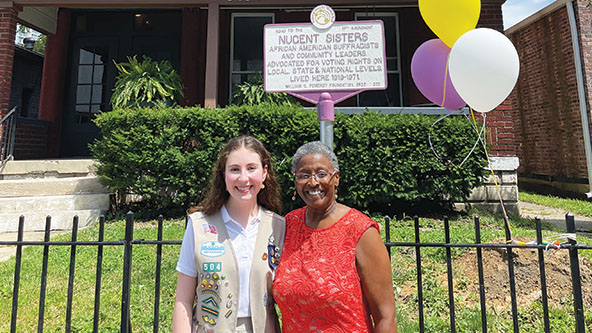
 Laura Bache (left) poses in front of the Nugent House NVWT marker with Jacqueline Glenn, whose family owns the home and cared for Alice Nugent in her old age. (Photo courtesy of Lisa Bache)
Dozens of people gathered for an afternoon tea in front of an unassuming two-and-a-half-story brick home in Old Louisville, Kentucky, last August. The occasion was the unveiling of a historical marker honoring sisters Georgia and Alice Nugent. Painted purple, white, and gold—colors of the National Woman’s Party—the sign informs passersby that the Nugent sisters resided at the home between 1919 and 1971 and were “African American suffragists and community leaders, [who] advocated for voting rights on local, state & national levels.”
The marker is the 202nd on the National Votes for Women Trail (NVWT), a project established by the National Collaborative for Women’s History Sites (NCWHS) and a legion of volunteers in 2016. NVWT memorializes landmarks of the US women’s suffrage movement and is part of the NCWHS’s mission to raise awareness about women’s history.
Across the United States, the number of national parks, historic sites, and public monuments honoring the Founding Fathers, former presidents, and military generals—all men—far surpass those honoring women. Monument Lab, a nonprofit public art and history organization, recorded fewer than 300 monuments of women among its dataset of nearly 5,000 entries.
“When I visit historical sites, the first thing I ask the tour guide is ‘Where’s the women’s history?’” says Marsha Weinstein, NCWHS president. “I want the rest of the story, and women are underrepresented.”
In response, the NCWHS set out to develop “a diverse trail for a diverse nation,” Weinstein says. Unfortunately, like the arduous journey for women’s suffrage, creating the NVWT was more challenging than the organizers had anticipated over 15 years ago.
The Search for Suffragists
The project that would become the NVWT began in 2007 when then-US Senator Hillary Clinton proposed funding for a similar project that would have created a trail of women’s-suffrage-related sites in New York state administered by the National Park Service. Clinton had been in talks about preserving women’s history with NCWHS members and Coline Jenkins, a descendant of Elizabeth Cady Stanton, a foremother of the women’s suffrage movement. The legislation was included in the Public Land Management Act of 2009 and signed by President Barack Obama on March 30, 2009, but funding was never appropriated by a Republican-led Congress, and the project languished.
NCWHS volunteers refused to let the project die and, in 2016, launched a virtual database of women’s suffrage sites, including former headquarters of associations that lobbied for women’s suffrage, locations of significant marches or other demonstrations, and gravesites of prominent suffragists. To find stories of little-known suffragists, the organization invited local communities to contribute. “There are certain names we’ve never heard before that are missing from the national narrative, but people might know them culturally or locally,” explains Ida Jones, associate director of special collections and university archivist at Morgan State University in Baltimore, Maryland, and NVWT’s Washington, DC, coordinator.
Dozens of state coordinators, including Weinstein in Kentucky and Jones in DC, liaised with local organizations and individuals who nominated places in their communities to add to the database. The NCWHS set a goal of documenting 2,020 sites by the end of 2020. The collaborative also created an interactive map to display their findings to the public.
The map quickly caught the attention of Paula Miller, then-executive director of the William G. Pomeroy Foundation, while she was searching for ways the organization could commemorate the centennial anniversary of the 19th Amendment in 2020.
The Pomeroy Foundation endeavors to support the celebration and preservation of community histories by funding historical roadside markers.
Deryn Pomeroy, trustee and director of strategic initiatives at the foundation, says that roadside markers have always been a part of her family’s culture. “Growing up, whenever we drove past a historical marker, we would stop and read it together,” she says. The Pomeroys’ love of historical roadside markers and the NVWT made for a perfect partnership. The foundation agreed to fund the transformation of more than 200 digital sites into physical markers and created a unique application process for NVWT coordinators to submit the sites in their state for the Pomeroy Foundation’s review and approval.
“This is why the trail is so important. We have to make sure people know their history so that we can turn things around.”
In 2016, NCWHS convened a 10-person advisory committee to vet nominated sites before they were added to the database or submitted to the Pomeroy Foundation. Funding from the National Trust for Historic Preservation and federal funds allocated by the Women’s Suffrage Centennial Commission covered the costs of the committee’s work and the creation of the digital map. The Pomeroy Foundation’s historians review submitted historical documents to ensure the accuracy of site histories and the roadside markers.
Paula Casey, the Tennessee state coordinator and now NVWT chair, says she used census records, old telephone books, newspaper clippings, and other historical sources held at the Tennessee State Library and Archives and local libraries to find and verify sites in her state. Killian O’Donnell, Florida’s state coordinator, says she amassed more than 11,000 files related to the NVWT locations in her state.
The search for suffragists of racially and ethnically diverse backgrounds from every corner of the nation was successful. Pomeroy-sponsored markers commemorate an Ojibwa suffragist in North Dakota, Mexican American women voters in Arizona, and dozens of Black suffragists, civil rights activists, and other organizers. Jones secured four historical markers in Washington, DC, each honoring Black women. She says the nation’s capital “was the nexus of the Black intellectual class” in the 19th and early 20th centuries, and the markers celebrate generations of Black women who fought for gender equality.
The Nugent House is another example of a site honoring Black women on the NVWT. Its path to recognition is a memorable one for Laura Bache, the high school student whose 100-page report on the Nugent sisters and their former home led to the site being added to the National Register of Historic Places and the NVWT.
She chose to commemorate a local women’s suffrage site because it combined her passions for storytelling, historical research, and women’s empowerment. Bache, now a freshman at the University of North Carolina, was on a mission to earn her Girl Scout Gold Award, the highest achievement within the Girl Scouts, granted to scouts who implement projects that provide lasting benefit to their communities.
“Coming out of slavery, Black women had to fight so much harder for their right to vote, and I wanted to tell that story,” Bache says.
Education as Inspiration
Today, the trail boasts more than 2,400 sites. And coordinators across the country succeeded in having 210 roadside markers funded through the Pomeroy Foundation.
In addition, the NCWHS is producing lesson plans and YouTube content for K-12 audiences, knowing there are many more students like Bache who would find inspiration in the stories behind the trail markers. In March 2023, to coincide with Women’s History Month, the collaborative also released its first series of lesson plans.
The team plans to produce more digital content, including a podcast. After hearing the popular “She Votes!” podcast in 2020, they contacted cohosts Lynn Sherr and Ellen Goodman at Wonder Media Network (WMN) about collaborating on a new series featuring sites along the NVWT, where each episode uses a spot on the trail to illustrate the diversity of the suffrage movement. They are now seeking funding to bring the show to life.
Funding is always a challenge, and the work behind the NVWT remains volunteer-driven. Many of those who give their time say they are motivated by the suffragist spirit and a desire to empower the next generation of voters, politicians, and activists. “I want them to know the history as a motivator to exercise their right to vote and be civically engaged,” Weinstein says.
For Tennessee-based Casey, recent attacks on democracy in her state and others make the work of the NVWT feel even more urgent. She believes the stories told on the NVWT offer an engaging form of civic education that could help disrupt alarming antidemocratic trends. “This is why the trail and the collaborative are so important,” Casey adds. “We have to make sure people know their history so that we can turn things around.”
The trail’s expansion will continue to foster a more nuanced understanding of American democracy. “That’s the intention of these markers,” Jones says, “to have them be viable, living spaces to engage the consciousness of Americans, future Americans, and people visiting the country to understand how this democracy was conceived and how it was actually lived out.”
Read more stories by Marianne Dhenin.